
Why a Few Pests Are Required for Biological Control to Work
A garden with zero pests can also have zero pest predators. Here is why tolerating a small number of insects in fall helps predators, parasitoids, and pathogens stay in your garden long enough to protect it.
September 28, 2026
By Diego Navarro
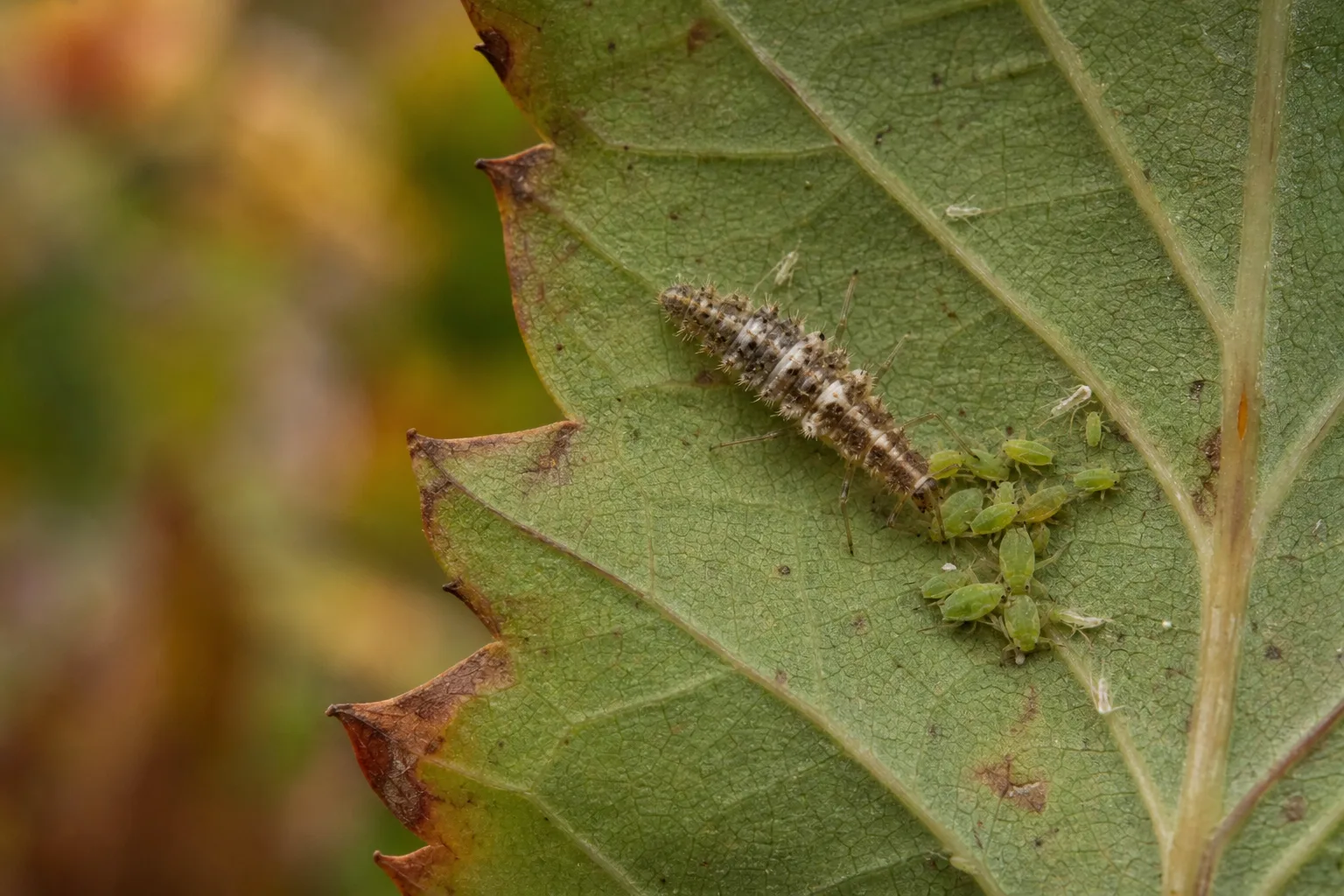
A garden with a few harmless pests can support the predators, parasitoids, and pathogens that keep larger outbreaks from taking over. A garden scrubbed to zero often starves those natural enemies, so the better fall strategy is to monitor early, tolerate low numbers, and protect the helpers already working. That is the position I build around.
Why does a zero-pest garden starve its own predators?
A zero-pest garden starves its own predators because beneficial insects and other natural enemies need prey, hosts, or disease-susceptible pests to remain in the garden and reproduce. Biological control is not extermination. It is the steady reduction or delay of pest populations through predation, parasitism, and disease, as Oklahoma State University Extension explains.
A lacewing cannot live on your good intentions. It needs prey. A parasitoid wasp needs a suitable host. A pathogen needs a susceptible pest population. Remove every aphid, caterpillar, or other target the moment you see one, and the natural enemy may leave, fail to reproduce, or never establish in the first place.
That does not mean you should celebrate a chewed plant. The useful target is a low, tolerable pest population that stays below the level where the plant loses vigor, looks unacceptable, or produces a poor harvest.
Up in New Jersey, I learned to judge a garden by whether it survived the first hard frost and returned in April. In Austin, I have stood over a bed in September and counted what was still alive after weeks of heat. The lesson is the same: do not confuse a quiet system with a dead one.
How many pests should you tolerate in fall?
There is no universal pest-per-leaf number for every garden, but in fall you should tolerate a small, scattered population that is not spreading rapidly, distorting new growth, killing stems, or damaging the part of the plant you value. Inspect twice a week and intervene when damage is accelerating, not merely because one insect appeared.
Start with a ten-minute inspection every three or four days. Check the newest leaves, leaf undersides, stems, and the soil line. Record the pest, the number of affected leaves, and whether damage increased since the last visit.
As a practical threshold, I would watch closely if pests appear on 1 in 10 leaves, act more deliberately around 2 in 10 leaves with fresh damage, and stop tolerating the situation if damage is climbing across several inspections. Those are working thresholds, not laws of nature. A young transplant, prized crop, or plant already under drought stress gets less room.
Everyone says to remove every bug immediately. In practice, identification matters more than speed, because some insects that look suspicious are predators or immature beneficials. UC IPM recommends careful observation and identification, including using a hand lens to distinguish helpful mites and larvae from plant-feeding pests in its natural-enemies guidance.
What should you do in the garden this fall?
This fall, inspect before you spray, identify the insect, remove only badly damaged leaves, and leave a low pest population in place if the plant is still growing well. Reduce disturbance around the bed, keep flowering resources available, and check again in three or four days so a small problem does not become a large one.
Look at five plants in each bed rather than glancing across the whole garden. Turn over three leaves on each plant. Use your phone camera or a hand lens, because tiny insects and eggs are not reliable identification by eyesight alone.
If you find a few aphids with active predators nearby, leave that colony alone for several days. If one branch is heavily infested, prune that branch, seal it in a bag, and place it in the trash rather than shaking it across the bed. Pruning removes food, so do it selectively.
Avoid broad-spectrum pesticide sprays as your first response. They can kill natural enemies along with pests, and many predators are especially vulnerable to pesticides, according to North Carolina State Extension. A clean-looking bed can be biologically empty. That is not a victory.
Which natural enemies need a steady supply of pests?
Predators, parasitoids, and pathogens all need access to suitable pests, but they use that food supply differently. Predators consume pests directly, parasitoids develop in or on a host, and pathogens infect susceptible pests; each group can disappear if the garden offers no usable prey or host for long enough.
Predators include lacewings and lady beetles, but a purchased release is not a magic reset button. Lacewings can help with suitable soft-bodied pests, yet released adults may leave if the garden lacks food or shelter. Lady beetles can also disperse quickly, so buying a container and scattering it over a bare bed often disappoints.
Trichogramma wasps are parasitoids used against particular pest eggs. Their strength is specificity, which is also the trade-off: they cannot control every insect chewing your plants, and success depends on the right host being present at the right time.
Entomopathogenic nematodes are microscopic pathogens used against certain insect stages in soil. They can supplement biological control, but they require a suitable target and careful application conditions, and they are not a general treatment for every garden pest. The Michigan State University guide separates conservation, augmentation, and other biological-control approaches for this reason.
Should you release lady beetles, lacewings, or nematodes?
Release natural enemies only when you have identified the pest, confirmed that the released enemy can use it, and provided the habitat and conditions it needs. I would favor conserving resident enemies first, then use a carefully matched release as a supplement, because purchased organisms are costly, may disperse, and rarely fix an unidentified problem.
| Option | Best use | Honest downside |
|---|---|---|
| Conserve resident predators and parasitoids | Low pest numbers already present | Results are slower and less dramatic |
| Release lacewings or lady beetles | A confirmed soft-bodied pest with suitable habitat | Adults may leave, and releases cost money |
| Release Trichogramma wasps | A confirmed pest with accessible eggs | They work only on compatible host eggs |
| Apply entomopathogenic nematodes | Certain soil-dwelling or lawn-feeding insect stages | They do not control pests outside their target range |
The resident population gets my first vote because it has already passed the hardest test: it found your garden and stayed. Keep leaf litter in a limited refuge, reduce unnecessary digging, and provide a mix of plant structure rather than one exposed row.
If you buy lacewings or lady beetles, release them near the target plants in the evening and follow the supplier's instructions. Do not release them into a dry, bare bed and expect them to sign a lease. The RHS notes that many biological controls are living organisms supplied by mail order, with handling and timing affecting success in its garden guidance.
Nematodes are a different tool because they are applied to soil rather than released as flying adults. Their trade-off is narrow targeting. You are paying for a biological tool, not a universal cure.
How do you protect beneficial insects without letting pests take over?
Protect beneficial insects by reducing broad disturbance, keeping diverse plant structure, identifying insects before removal, and reserving pesticides for a clearly defined problem. Habitat helps natural enemies live longer and reproduce, but habitat is not permission to ignore damage; monitoring still decides whether a low pest population has crossed your tolerance line.
Keep some undisturbed stems and ground cover through fall instead of cutting every plant to the soil. The trade-off is appearance. A perfectly clipped bed offers fewer refuges, while a slightly untidy bed can give beneficials places to shelter.
Use a shallow water source only if you can keep it clean and prevent standing water from becoming a nuisance. Keep flowering plants in the garden where possible, but choose plants suited to your site. Every added plant takes water, space, and maintenance, so diversity is useful only if you can sustain it.
Do not assume every wasp is a problem. Some wasps are parasitoids, while social wasps have different behavior and management concerns. Identify first. If you cannot identify the insect, photograph it and compare it with a trusted extension guide before reaching for a spray.
The same applies to leaf damage. One ragged leaf is information. A whole flush of distorted growth is a decision point.
Is biological control worth using in a home garden?
Biological control is worth using in a home garden when you can accept slower results, inspect regularly, and tolerate a small amount of cosmetic damage. It is a poor fit for a crop that must look perfect immediately, a plant facing rapid destruction, or a gardener unwilling to identify the pest before choosing a treatment.
This approach suits a mixed fall garden, established beds, homeowners who can inspect twice a week, and anyone trying to reduce unnecessary pesticide use. It also suits a garden with enough plant diversity and shelter that natural enemies can remain after one pest colony declines.
Ignore this approach, or use it only as part of a larger plan, if a single outbreak threatens a young plant within days. Extension guidance notes that biological control can be more costly and less immediate than pesticide treatment, and many natural enemies attack only specific insects according to NC State Extension.
You should also reconsider a purchased release if you have not identified the pest. Buying a beneficial insect for the wrong target is like buying a key for a different house. The package may be impressive. The lock will not care.
What is the biggest mistake people make with beneficial insects?
The biggest mistake is treating biological control as a one-time purchase instead of a living system that needs a target, shelter, and time. Gardeners often release a large number of beneficials, spray soon afterward, remove every pest, and then conclude that biological control failed when the habitat was never suitable.
A second mistake is confusing presence with control. Seeing one lady beetle does not prove that the population is large enough to suppress pests. Look for a trend across several inspections: fewer live pests, less fresh damage, and more evidence of natural-enemy activity.
A third mistake is expecting dramatic results overnight. Biological control often reduces or delays pest populations instead of making every insect vanish, which is the stated goal of many home-landscape programs in the Oklahoma State Extension fact sheet.
The fix is plain. Identify, count, wait three or four days, and count again. If the numbers rise quickly or damage spreads, choose a targeted response that does not destroy the whole community.
What should you check before you leave the garden today?
Before you leave the garden today, inspect ten leaves, identify anything you find, mark one active pest area, and return in three days to compare damage. Leave low pest numbers alone if the plant is growing and natural enemies are present, but remove a rapidly expanding infestation before it reaches the plant's valuable new growth.
Write down four things: the plant, the pest, the number of affected leaves, and whether you saw predators, parasitoids, eggs, or suspicious larvae. That small record keeps one alarming insect from becoming a full garden policy.
If you are unsure what belongs in your bed, the plant database can help you choose plants suited to your site and plan a more diverse planting. Diversity supports habitat, but each plant still has a water and maintenance cost, so do not build a jungle you cannot inspect.
If the bed needs a larger reset, use the get a concept for your yard tool to think through plant layers, refuge areas, and access before you start moving soil. Valeria draws the pretty version. I still have to get a shovel into it.
A few pests are not proof that the garden is failing. They may be the small food supply that keeps the real defense on the property.
How many pests should you tolerate in fall?
You should tolerate a small, scattered pest population in fall when the plant is still growing, damage is not spreading quickly, and natural enemies are present. Inspect every three or four days, and act when fresh damage accelerates across several inspections, reaches valuable new growth, or begins weakening the plant. One insect is information, not an emergency.
Should you release lady beetles, lacewings, or nematodes?
Release lady beetles, lacewings, or nematodes only after identifying the pest and confirming that the chosen natural enemy can use it. Resident beneficials are usually my first choice because they already fit the site. Purchased releases may leave, cost money, or fail if food, shelter, moisture, or the correct pest stage is missing.
How do you protect beneficial insects without letting pests take over?
Protect beneficial insects by avoiding broad-spectrum sprays, reducing unnecessary disturbance, retaining limited refuge areas, and checking plants twice a week. Keep low pest numbers if damage remains tolerable, but remove or treat a fast-growing infestation with a targeted method. Habitat supports natural enemies, but monitoring keeps habitat from becoming an excuse to ignore real damage.
Is biological control worth using in a home garden?
Biological control is worth using in a home garden if you can inspect regularly, accept some cosmetic damage, and wait for slower results. It is less suitable when a valuable crop is being damaged rapidly or must look perfect immediately. The method works best as prevention, reduction, or delay, not as instant extermination.
What is the biggest mistake people make with beneficial insects?
The biggest mistake is releasing beneficial insects without identifying the pest or preparing the garden to support them. A release can fail if the target pest is absent, the wrong life stage is present, the insects disperse, or a pesticide kills them afterward. Biological control is a continuing system, not a one-day delivery.
What should you check before you leave the garden today?
Before leaving the garden today, inspect ten leaves, identify the insects, mark one active pest area, and schedule another check in three days. Record the plant, pest, fresh damage, and natural enemies you see. Leave a low population alone if the plant is growing well, but act before rapidly increasing damage reaches new growth.
Want a plan for your own yard?
Tell us the space and we will put a planting plan together for it. Start at get my concept, or browse what actually grows where you are over on plants.
Frequently asked questions
How many pests should you tolerate in fall?
You should tolerate a small, scattered pest population in fall when the plant is still growing, damage is not spreading quickly, and natural enemies are present. Inspect every three or four days, and act when fresh damage accelerates across several inspections, reaches valuable new growth, or begins weakening the plant. One insect is information, not an emergency.
Should you release lady beetles, lacewings, or nematodes?
Release lady beetles, lacewings, or nematodes only after identifying the pest and confirming that the chosen natural enemy can use it. Resident beneficials are usually my first choice because they already fit the site. Purchased releases may leave, cost money, or fail if food, shelter, moisture, or the correct pest stage is missing.
How do you protect beneficial insects without letting pests take over?
Protect beneficial insects by avoiding broad-spectrum sprays, reducing unnecessary disturbance, retaining limited refuge areas, and checking plants twice a week. Keep low pest numbers if damage remains tolerable, but remove or treat a fast-growing infestation with a targeted method. Habitat supports natural enemies, but monitoring keeps habitat from becoming an excuse to ignore real damage.
Is biological control worth using in a home garden?
Biological control is worth using in a home garden if you can inspect regularly, accept some cosmetic damage, and wait for slower results. It is less suitable when a valuable crop is being damaged rapidly or must look perfect immediately. The method works best as prevention, reduction, or delay, not as instant extermination.
What is the biggest mistake people make with beneficial insects?
The biggest mistake is releasing beneficial insects without identifying the pest or preparing the garden to support them. A release can fail if the target pest is absent, the wrong life stage is present, the insects disperse, or a pesticide kills them afterward. Biological control is a continuing system, not a one-day delivery.
What should you check before you leave the garden today?
Before leaving the garden today, inspect ten leaves, identify the insects, mark one active pest area, and schedule another check in three days. Record the plant, pest, fresh damage, and natural enemies you see. Leave a low population alone if the plant is growing well, but act before rapidly increasing damage reaches new growth.
Free, no obligation
Ready to design your dream landscape? Start here.
Tell us where you are and we will start a free profile for you, with plants that actually survive your climate and a real sense of what the build would cost.