
When to Prune a Mango Tree in a Frost-Free Climate Versus a Marginal One
Mango pruning is a timing tradeoff: prune while the tree can regrow quickly, but not so late that tender new growth meets cold. If you are standing beside your mango tree in fall, the safest move is usually to remove only dead or dangerous wood now and save structural pruning for late spring or early summer.
October 1, 2026
By Diego Navarro
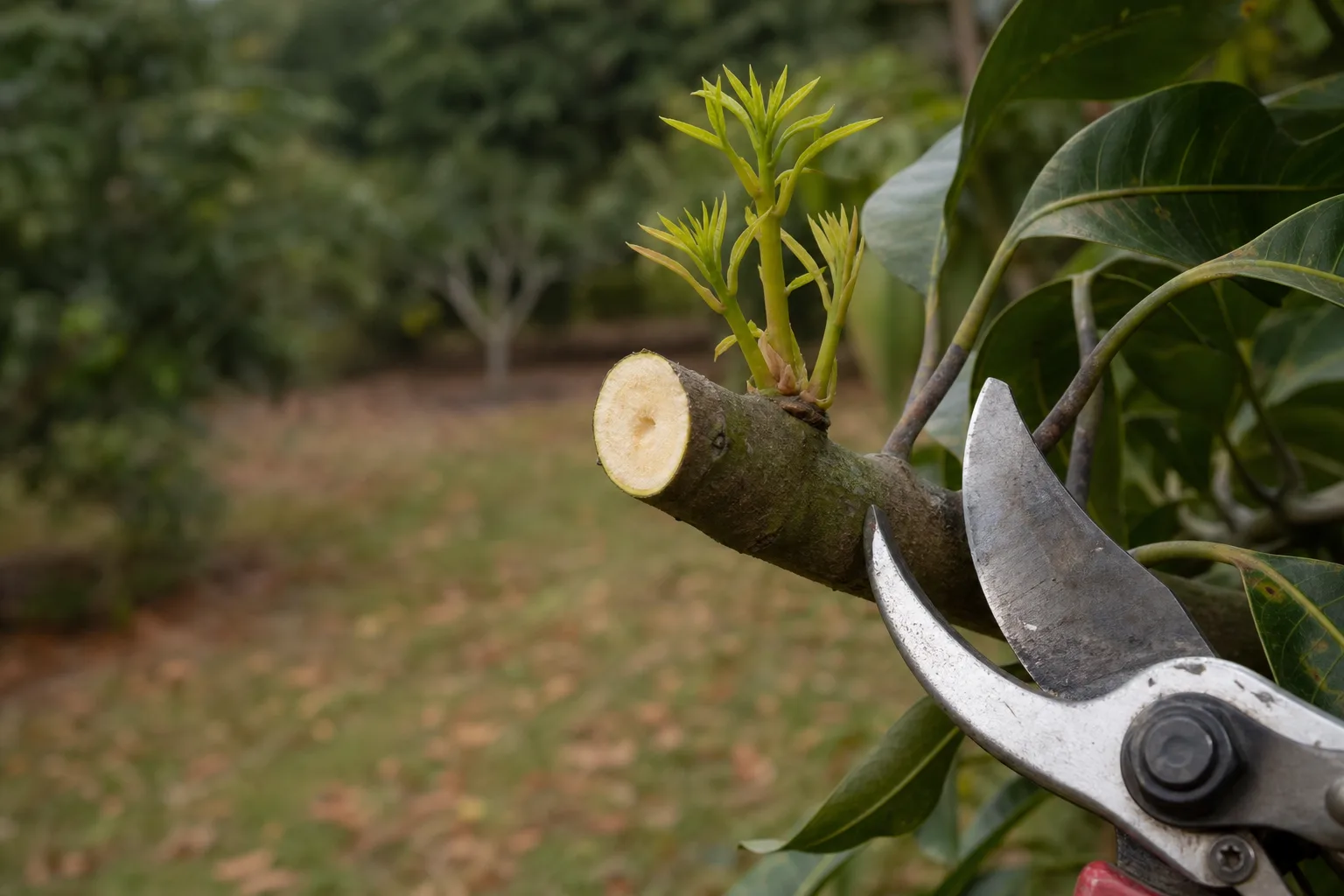
If you are standing beside your mango tree in fall with loppers in your hand, my answer is simple: do not give it a major haircut today unless a branch is dead, broken, or dangerous. The best general window is late spring or early summer, when the tree is actively growing and has time to replace what you remove, but a marginal climate gives you less room because late-season regrowth may meet cold.
Should you prune your mango tree in fall?
You should usually postpone major mango pruning in fall, especially in a marginal climate, because the tree may produce new growth too close to the cold season. Remove dead, broken, or hazardous branches now if needed, then wait for late spring or early summer for shaping, height reduction, or heavy thinning.
The research provided for this question gives one broad timing rule: late spring or early summer, while plants are actively growing, is the preferred pruning period. That recommendation appears in this pruning guidance from Justdial, which also advises using sharp, clean tools for a clean cut.
Fall feels like a natural cleanup season because the garden is less frantic. Mango trees do not care about our sense of order. A large cut now can push soft regrowth at the exact point in the year when you need the tree to be quiet and ready for cold.
If a limb is rubbing against a roof, hanging over a walkway, or already broken, deal with that hazard. Keep the cut limited to the immediate problem. Save the rest for a warmer growing window.
What is the difference between pruning in a frost-free climate and a marginal climate?
The difference is the amount of cold risk after pruning: a frost-free climate gives new mango growth a better chance to keep developing, while a marginal climate can expose fresh regrowth to damaging cold. The pruning window remains late spring or early summer in both places, but marginal growers should wait for a dependable warm stretch.
A frost-free site is not automatically safe for every pruning date. If you cut in October and the tree responds with tender shoots, those shoots still have to grow under the conditions your garden provides. The advantage is that the tree is less likely to face a hard freeze, not that timing stops mattering.
In a marginal site, I would treat any forecast near 32 degrees Fahrenheit as a reason to avoid major pruning, and I would prefer at least four to six weeks of reliably warm weather after the work. That four to six week buffer is my practical rule for reducing exposure, not a separate source-backed climate standard.
The tradeoff is clear. Prune early enough in the warm season and regrowth has time to mature. Prune late and you may get a smaller, cleaner tree today but more vulnerable shoots tomorrow.
| Climate situation | Pruning window I would use | Honest downside |
|---|---|---|
| Frost-free climate | Late spring or early summer, during active growth | Warm weather does not prevent weak regrowth or excessive shoots after a heavy cut |
| Marginal climate | Late spring or early summer, after the cold pattern has passed, with four to six warm weeks ahead | Waiting reduces the available growing season and may delay the shape you want |
| Fall emergency work in either climate | Dead, broken, or hazardous wood only | You solve the immediate problem but cannot complete the full structural prune |
When is the best time to prune a mango tree?
The best time to prune a mango tree is late spring or early summer, when the tree is actively growing and can begin replacing removed tissue. That timing applies to both frost-free and marginal climates in the available guidance, but growers in marginal areas should confirm that no late-season cold is likely after the cut.
In Austin, I would think in terms of the growing season rather than a ceremonial date on the calendar. Late May through June is often a more useful target than a vague instruction to prune after winter, because the question is whether the tree is actively moving and whether warmth is likely to continue.
Everyone says, “Prune in spring.” In practice, the better rule is “prune when active growth has started and cold is no longer waiting around the corner.” A warm calendar date followed by a cold snap is still a bad appointment.
The source guidance does not provide separate month-by-month calendars for frost-free and marginal locations, so I would not pretend that January is safe in one place and March is safe in another. Use the same seasonal principle, then adjust for your local cold risk.
Who is this mango pruning plan for, and who should ignore it?
This plan suits homeowners deciding what to do with a mango tree in fall, especially those in marginal climates who need to balance regrowth time against cold exposure. Ignore the major-pruning portion if a branch is an immediate safety hazard, because hazardous wood should be addressed rather than left in place while you wait for the ideal season.
It is for the person with a young tree that has become crowded, a mature tree that is too tall, or a canopy with crossing branches that need a deliberate correction. It is also for the gardener who wants one clear decision today instead of standing under the tree with a saw and negotiating with every branch.
It is not a plan for removing a dangerous limb over a driveway. It is not a substitute for professional help when a heavy branch is near electrical lines, a roof, or a place where a falling limb can hurt someone.
If your mango is in a frost-free climate and only needs a small cleanup, you have more flexibility, but I would still favor the active-growth window. If it is in a marginal climate, this plan is stricter because the cost of late regrowth is higher.
How much should you prune from a mango tree?
Prune only as much mango wood as you can justify for a specific purpose, such as removing dead material, correcting a crossing branch, reducing height, or opening an overcrowded section. A light correction is easier to recover from than a broad fall reduction, and heavy cuts create more regrowth that may face cold.
Start by walking around the tree before you cut anything. Pick the one or two branches that cause the real problem. If you cannot explain why a branch must come off, leave it for now. Trees are not obligated to become more attractive because you brought tools outside.
For fall work, I would remove dead, broken, or hazardous wood and stop there. For the late spring or early summer session, make the structural corrections one at a time, stepping back after each cut so you do not turn a modest repair into a bare framework.
Every pruning method has a tradeoff. Thinning out selected branches preserves more of the canopy but may not lower the tree enough, while heading back a branch gives faster size control but can produce a burst of shoots around the cut. I favor selective thinning first because it is harder to regret.
What should you do if a cold snap is forecast after pruning?
If a cold snap is forecast after mango pruning, stop making nonessential cuts and allow the tree to keep its existing canopy. In a marginal climate, postpone major pruning until the cold pattern has passed and you can expect roughly four to six weeks of continued warmth for regrowth.
A forecast near 32 degrees Fahrenheit is the line where I would become conservative. The research summary specifically warns marginal growers to watch for late-season cold after pruning, so the sensible response is not to gamble on a perfect recovery.
If you already made a cut, do not keep cutting to make the tree look finished. Do not add another round of shaping because the first branch now looks lonely. Let the tree sit, then inspect the new growth after the cold period has passed.
The same rule applies in a frost-free climate if an unusual cold event is coming. Frost-free does not mean every night is warm. It means your site usually avoids the kind of cold that makes the risk unacceptable.
Which tools and cuts are worth using for mango pruning?
Use sharp, clean pruning tools that make a clean cut, because the available pruning guidance specifically connects tool cleanliness and sharpness with cleaner pruning. Hand pruners suit small branches, loppers suit medium branches, and a pruning saw suits larger wood, but each tool has a tradeoff in reach, force, and the temptation to remove too much.
Clean the cutting surface before you begin and again if it becomes dirty. A dull tool crushes rather than cuts, while an oversized tool can make you confident enough to take off a branch you meant only to shorten. The tool should match the branch, not your mood.
Make one deliberate cut rather than sawing halfway through and leaving a torn stub. I would rather see a small, clean correction in late spring than a dramatic fall cut made with a tired saw and a deadline.
The source material identifies many mango trees as grafted varieties, including named grafted mango selections in this nursery listing. That matters as a reminder to identify the tree before pruning, because a grafted tree is not the same thing as an unknown seedling, and aggressive cutting can undo the shape you paid to establish.
How can you make a pruning plan before you cut?
Make a pruning plan by marking dead or hazardous wood, choosing one structural problem, and checking the expected warm period after the work. For a fall decision, circle only the urgent cuts; for late spring or early summer, list the branches that improve height, spacing, or balance and remove them in stages.
Take a photograph from each side of the tree before pruning. I do this because the branch that looks unnecessary from the patio may be the one carrying the shape from the street. A picture slows your hands down, which is useful around a tree.
If you are deciding among mango varieties or want to compare mature forms before planting another tree, use the plant database to research the plant first. The honest tradeoff is time: research will not make the cut for you, but it can prevent you from pruning a tree according to the wrong expectation.
You can also use get a concept for your yard if the mango is part of a larger layout and you need to understand how its eventual size fits the garden. A concept will not replace a pruning calendar, but it may keep you from solving a design problem with a saw.
I learned that kind of patience from my father's twelve foot strip of clay along our New Jersey driveway. The tomatoes were always too close together, and every year we cut something back because we had planted for hope instead of space. Trees make the lesson more expensive.
What are the most common questions about mango pruning in fall?
The short answers below follow one position: protect the tree from poorly timed regrowth, use fall for necessary safety work, and reserve major mango pruning for late spring or early summer. Each answer addresses a decision you can make while standing beside the tree today.
Should I prune my mango tree in fall?
You should usually postpone major mango pruning in fall and remove only dead, broken, or hazardous wood. Late spring or early summer is the better general window because the tree is actively growing then, while fall cuts can encourage regrowth that has less time to develop before cold.
Is pruning safer in a frost-free climate?
Pruning is generally more forgiving in a frost-free climate because fresh regrowth faces less risk from a hard freeze, but the preferred timing remains late spring or early summer. Frost-free does not mean every fall cut is wise, because the tree still needs active growth to recover from substantial pruning.
When should I prune a mango tree in a marginal climate?
You should prune a mango tree in a marginal climate in late spring or early summer, after the main cold period has passed and with roughly four to six warm weeks ahead. That timing gives new growth more opportunity to develop before the next cold event, which is the central risk in a marginal site.
What can I remove from a mango tree right now?
Right now, in fall, you can remove dead, broken, or hazardous branches if leaving them creates a clear problem. Keep the work limited to those immediate needs and postpone shaping, height reduction, and heavy thinning until late spring or early summer when active growth can support recovery.
What if my mango tree was pruned before a cold snap?
If your mango tree was pruned before a cold snap, stop making additional cuts and wait until the cold period passes before judging the result. Do not keep reshaping the canopy to compensate for one questionable cut, because more removed wood means more recovery work during the same weather risk.
Should I use sharp, clean tools on a mango tree?
You should use sharp, clean tools on a mango tree because the available pruning guidance says they help produce a clean cut and reduce the risk associated with rough cutting. Hand pruners, loppers, and a pruning saw each have different reach and force, so match the tool to the branch rather than forcing one tool to do everything.
Want a plan for your own yard?
Tell us the space and we will put a planting plan together for it. Start at get my concept, or browse what actually grows where you are over on plants.
Frequently asked questions
Should I prune my mango tree in fall?
You should usually postpone major mango pruning in fall and remove only dead, broken, or hazardous wood. Late spring or early summer is the better general window because the tree is actively growing then, while fall cuts can encourage regrowth that has less time to develop before cold.
Is pruning safer in a frost-free climate?
Pruning is generally more forgiving in a frost-free climate because fresh regrowth faces less risk from a hard freeze, but the preferred timing remains late spring or early summer. Frost-free does not mean every fall cut is wise, because the tree still needs active growth to recover from substantial pruning.
When should I prune a mango tree in a marginal climate?
You should prune a mango tree in a marginal climate in late spring or early summer, after the main cold period has passed and with roughly four to six warm weeks ahead. That timing gives new growth more opportunity to develop before the next cold event, which is the central risk in a marginal site.
What can I remove from a mango tree right now?
Right now, in fall, you can remove dead, broken, or hazardous branches if leaving them creates a clear problem. Keep the work limited to those immediate needs and postpone shaping, height reduction, and heavy thinning until late spring or early summer when active growth can support recovery.
What if my mango tree was pruned before a cold snap?
If your mango tree was pruned before a cold snap, stop making additional cuts and wait until the cold period passes before judging the result. Do not keep reshaping the canopy to compensate for one questionable cut, because more removed wood means more recovery work during the same weather risk.
Should I use sharp, clean tools on a mango tree?
You should use sharp, clean tools on a mango tree because the available pruning guidance says they help produce a clean cut and reduce the risk associated with rough cutting. Hand pruners, loppers, and a pruning saw each have different reach and force, so match the tool to the branch rather than forcing one tool to do everything.
Free, no obligation
Ready to design your dream landscape? Start here.
Tell us where you are and we will start a free profile for you, with plants that actually survive your climate and a real sense of what the build would cost.