
When Should You Pick Pears, and Why Must They Ripen Off the Tree?
Pick European pears while they are still firm and yellow-green, then let them finish ripening indoors. Leaving them on the tree until they turn yellow can produce a brown core and gritty, mealy flesh.
September 22, 2026
By Valeria Navarro
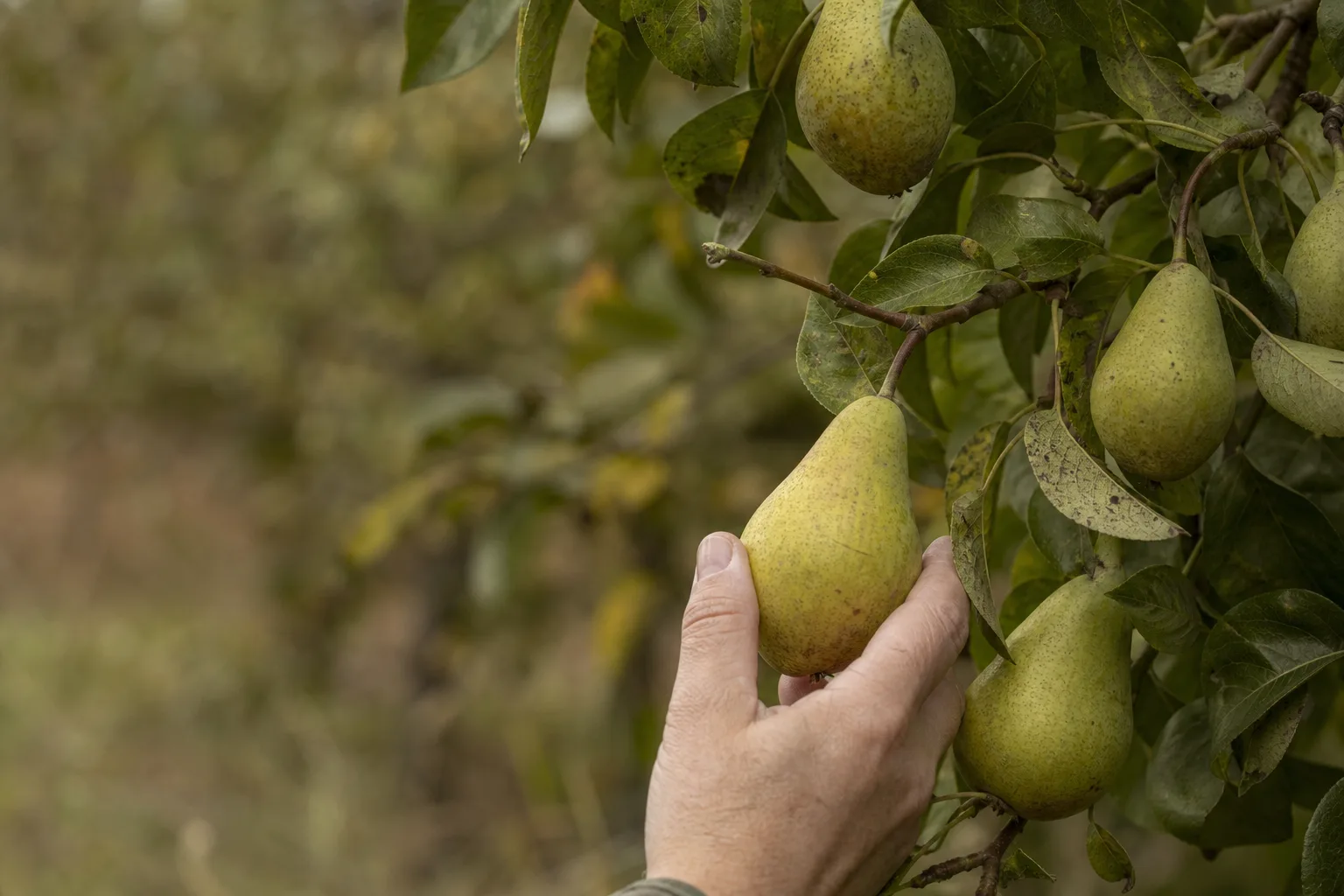
Pick European pears when they are firm, yellow-green rather than fully yellow, and release with a gentle lift. They must finish ripening indoors because pears left on the tree often develop gritty flesh and a brown, poorly flavored core. That is the harvest rule I would use in an Austin garden this fall, no drama and no sad pear confetti on the kitchen counter.
When should you pick pears from the tree?
Pick European pears at the mature-green stage, when the skin changes from deep green to yellow-green but the fruit is still firm. Lift each pear gently; if it detaches easily from the branch, harvest it. Do not wait for the skin to become fully yellow, because that usually means you waited too long.
The lift test is the useful part. Cup the pear in your hand and raise it slightly, then tilt it upward. If it comes away without tugging, it is ready. If the stem clings hard, leave it for a few more days and test again.
This is different from picking an apple. Everyone says to wait for a fruit to look ripe. In practice, European pears need to look almost, but not quite, ripe before you remove them from the tree. Purdue Extension explains that pears reach their best quality after harvest, not while hanging on the branch.
If you are standing beside the tree in October, check several fruits on different parts of the canopy. Harvest in two or three passes if they do not all release at once. The trade-off is a little more time with the basket, but fewer bruised fruits and fewer pears picked before they are mature enough to finish ripening.
Why do pears need to ripen off the tree?
European pears ripen from the inside outward, so the center can deteriorate before the outside gives you a useful warning. Left on the tree, they may develop stone cells, a gritty texture, a brown core, and off-flavors. Picking at mature green lets sweetness and flavor develop without sacrificing smooth flesh.
That is the argument. Pick early enough to protect texture, not so early that the fruit lacks the maturity to ripen. A tree-ripened pear can look beautiful in the hand and still eat like damp gravel near the center. I have killed basil with more dignity than some people eat a neglected pear, honestly.
The gritty texture is not a sign that you simply needed more patience indoors. It is a sign that the fruit stayed attached too long. Iowa State Extension specifically connects tree ripening in European pears with stone-cell development and poorly flavored, gritty fruit, which is why its harvest guidance says to pick at the yellow-green stage instead (Iowa State University).
The trade-off is that an off-tree pear asks you to manage a second stage in the kitchen. That is worth it. Four to ten days of checking a bowl is a much better bargain than an entire crop with a brown core.
How can you tell whether a pear is mature enough to pick?
A pear is mature enough to harvest when its deep green skin has shifted toward yellow-green, the fruit still feels firm, and it releases with a gentle lift. Color alone is not enough, and softness is not the goal at harvest. Those three signs together are more reliable than waiting for a fully yellow skin.
Use your eyes first. Compare the fruit with the greenest pears on the same tree. You are looking for a change, not a perfect color chart, because varieties differ in shape and skin color.
Then use your hand lightly. Do not squeeze the middle, especially if you plan to store the fruit. A firm pear may be mature; a soft pear may already be losing quality. The gentle lift matters more than a thumbprint.
Harvest a test pear if you are uncertain. Bring it inside and watch it over several days. If it softens evenly and develops a pleasant aroma, your timing is probably close. If it stays hard for a long time, the fruit may have been picked too early, and the trade-off is delayed eating rather than better flavor.
What should you do immediately after picking pears?
After picking, place European pears in a cool, humid area around 60 to 70°F and roughly 80 to 85 percent relative humidity. Keep them out of hot sun and handle them gently. The goal is to let the fruit finish ripening without drying out, bruising, or being pushed into softness too quickly.
Do not stack a deep mountain of pears in a bowl. One bruised fruit can spoil the useful information you are trying to get from the rest. A shallow tray or single layer gives you room to check the stem end and separate fruit that is ahead of the group.
A paper bag speeds the process by concentrating ethylene around the fruit. A ripe banana or apple in the bag speeds it further, but the trade-off is less control: check the pears daily because the enclosed air can move several fruits from firm to soft quickly. The bag is useful, not magic.
My old Miami patio taught me to expect water to disappear through sandy fill before I finished watering. Austin clay does the opposite, holding water and then setting hard, so I watch the indoor humidity and the fruit itself rather than trusting a calendar. Pears are fussy little clocks.
How long do pears take to ripen after harvest?
Most harvested European pears become ready to eat in about 4 to 10 days at 60 to 70°F, though the exact timing varies by variety and fruit maturity. Check them each day. A ripe pear gives slightly near the stem, while the body should not feel collapsed or mushy.
Press near the stem, not the broad belly. The stem end changes first and gives you a better eating test. If the pear is still rock hard after a week, give it more time. If the skin is wrinkled and the flesh yields deeply, you waited past the best window.
The banana or apple method can shorten the wait, but it does not repair an immature pear. A pear harvested before the mature-green stage may fail to develop good flavor, so rushing it with extra ethylene costs you a bag of fruit and several days of false hope.
Taste one when it gives slightly. If the flesh is smooth, juicy, and sweet, move the rest into a slower holding spot or the refrigerator. If the center is brown and grainy, the problem happened on the tree, not because you failed to leave it on the counter longer.
Should you refrigerate pears after they ripen?
Yes. Once European pears reach eating ripeness, move them to refrigeration at about 32 to 35°F as soon as possible. Cold storage slows further ripening and helps preserve quality. The downside is that refrigerator space becomes part of your harvest plan, especially if several pears soften during the same two-day stretch.
Do not refrigerate every hard pear immediately and expect it to improve there. Cold storage is for preserving a pear that is ready or nearly ready, not for replacing the indoor ripening stage. Bring a refrigerated pear back to room temperature before eating if you want its fullest flavor.
Use a simple rotation. Keep the firmest fruit in the cool room, the nearly ready fruit where you can see it, and the ripe fruit in the refrigerator. Labeling the harvest date helps if you have more than one batch. I use a pencil on a paper tag because pears do not need a spreadsheet to make themselves complicated.
| Option | Best use | Honest downside |
|---|---|---|
| Cool room at 60 to 70°F | Letting firm, mature-green European pears ripen over 4 to 10 days | Ripening can happen unevenly, so you must check daily |
| Sealed paper bag | Speeding ripening by concentrating ethylene | Fruit can move from firm to overripe quickly and needs frequent checking |
| Paper bag with ripe banana or apple | Speeding a small batch when you need pears soon | The extra ethylene gives you less control and does not fix immature fruit |
| Refrigerator at 32 to 35°F | Holding pears after they reach eating ripeness | It slows the process but cannot create good texture in a pear left too long on the tree |
Which pears should ripen on the tree instead?
Asian pears are the main exception: leave them on the tree until they become crisp and sweet, with the skin changing from green toward yellow. European pears such as Bartlett, Anjou, Bosc, Summercrisp, Moonglow, and Kieffer should ripen off the tree. The trade-off is identifying your variety before harvesting.
Asian pears are not a loophole for every pear that looks round. Check the tree label or your nursery record. If you treat an Asian pear like a European pear, you may pick it before its best flavor; if you treat a European pear like an Asian pear, you risk gritty flesh and a brown center.
Bartlett is a classic European pear, but its familiar yellow color is an eating-stage clue, not the harvest-stage clue. Bosc has firmer, russeted skin that can make color changes harder to judge. Kieffer can be productive, but a large crop still needs space for staged ripening. Every variety gives you a slightly different visual puzzle.
For variety-specific growing notes, use our plant database, then compare those notes with what your actual fruit is doing. Garden labels go missing. Trees keep the receipts.
Who should use off-tree pear ripening, and who should ignore it?
Off-tree ripening suits anyone growing European pears, harvesting a mixed crop, or trying to protect texture for fresh eating, preserving, or sharing. Ignore this method only if you have confirmed the tree produces Asian pears, which are meant to ripen on the tree until crisp, sweet, and yellowing.
It also suits a gardener who can check fruit once a day for a week. That is the real requirement. You need a cool place, a shallow tray, and enough attention to move ripe fruit into refrigeration.
This method is not a good fit if you plan to leave all pears on the branch until they feel soft. That shortcut costs you flavor and texture in European varieties. It is also a poor fit if you harvest while the fruit is still deep green and firmly attached, because off-tree ripening cannot turn immature fruit into excellent fruit.
You do not need a fancy fruit room. A stable, cool indoor spot works. If you are redesigning the garden around a pear tree and want the harvest area to be easy to use, you can get a concept for your yard before you plant, because a beautiful tree in the wrong walkway becomes a daily wrestling match with the harvest basket.
What are the most common pear harvest questions?
The short answers are simple: pick European pears firm and yellow-green, test them by lifting, ripen them indoors for several days, and refrigerate them once ready. Asian pears are different and should ripen on the tree. These answers solve most fall harvest mistakes before the first pear hits the counter.
When should you pick pears from the tree?
Pick European pears when they shift from deep green to yellow-green, remain firm, and detach easily when you lift them gently. Do not wait for fully yellow skin or softness on the tree, because the fruit may develop a brown core and gritty flesh before it looks ripe outside. Harvesting in two or three passes is fine.
Why do pears need to ripen off the tree?
European pears need to ripen off the tree because they mature from the inside outward. Leaving them attached can encourage stone cells, which create a gritty, mealy texture, a brownish core, and poor flavor. Indoor ripening allows sweetness and flavor to develop while the flesh stays smoother.
How long do pears take to ripen after harvest?
Most European pears take about 4 to 10 days to ripen after harvest when kept around 60 to 70°F. Check daily and test near the stem for slight give. A sealed paper bag, especially with a ripe banana or apple, can speed the process, but it also requires closer checking.
Should you refrigerate pears after they ripen?
Refrigerate pears at about 32 to 35°F once they reach eating ripeness or are nearly ready. Cold storage slows further ripening and preserves quality. Do not rely on the refrigerator to ripen very immature fruit, and do not leave ripe pears warm for days unless you plan to eat them immediately.
Which pears should ripen on the tree instead?
Asian pears should ripen on the tree until they are crisp and sweet and the skin changes from green toward yellow. European pears, including Bartlett, Anjou, Bosc, Summercrisp, Moonglow, and Kieffer, should be harvested mature-green and ripened indoors. Confirm the variety first, because the wrong harvest rule costs texture.
How can you tell whether a pear is mature enough to pick?
A pear is mature enough to pick when its deep green color has shifted to yellow-green, the fruit is still firm, and it releases from the branch with a gentle lift. If it resists, leave it for several more days. If it is already soft, you likely missed the best harvest window for a European variety.
Want a plan for your own yard?
Tell us the space and we will put a planting plan together for it. Start at get my concept, or browse what actually grows where you are over on plants.
Frequently asked questions
When should you pick pears from the tree?
Pick European pears when they shift from deep green to yellow-green, remain firm, and detach easily when you lift them gently. Do not wait for fully yellow skin or softness on the tree, because the fruit may develop a brown core and gritty flesh before it looks ripe outside. Harvesting in two or three passes is fine.
Why do pears need to ripen off the tree?
European pears need to ripen off the tree because they mature from the inside outward. Leaving them attached can encourage stone cells, which create a gritty, mealy texture, a brownish core, and poor flavor. Indoor ripening allows sweetness and flavor to develop while the flesh stays smoother.
How long do pears take to ripen after harvest?
Most European pears take about 4 to 10 days to ripen after harvest when kept around 60 to 70°F. Check daily and test near the stem for slight give. A sealed paper bag, especially with a ripe banana or apple, can speed the process, but it also requires closer checking.
Should you refrigerate pears after they ripen?
Refrigerate pears at about 32 to 35°F once they reach eating ripeness or are nearly ready. Cold storage slows further ripening and preserves quality. Do not rely on the refrigerator to ripen very immature fruit, and do not leave ripe pears warm for days unless you plan to eat them immediately.
Which pears should ripen on the tree instead?
Asian pears should ripen on the tree until they are crisp and sweet and the skin changes from green toward yellow. European pears, including Bartlett, Anjou, Bosc, Summercrisp, Moonglow, and Kieffer, should be harvested mature-green and ripened indoors. Confirm the variety first, because the wrong harvest rule costs texture.
How can you tell whether a pear is mature enough to pick?
A pear is mature enough to pick when its deep green color has shifted to yellow-green, the fruit is still firm, and it releases from the branch with a gentle lift. If it resists, leave it for several more days. If it is already soft, you likely missed the best harvest window for a European variety.
Free, no obligation
Ready to design your dream landscape? Start here.
Tell us where you are and we will start a free profile for you, with plants that actually survive your climate and a real sense of what the build would cost.