
Water Bath Versus Pressure Canning, Which Is Right for Each Food?
Acidity, not jar size or family tradition, decides whether a food belongs in a boiling-water bath or a pressure canner. Here is the safe fall harvest split for tomatoes, pickles, fruit, vegetables, beans, meat, soups, and sauces.
September 23, 2026
By Valeria Navarro
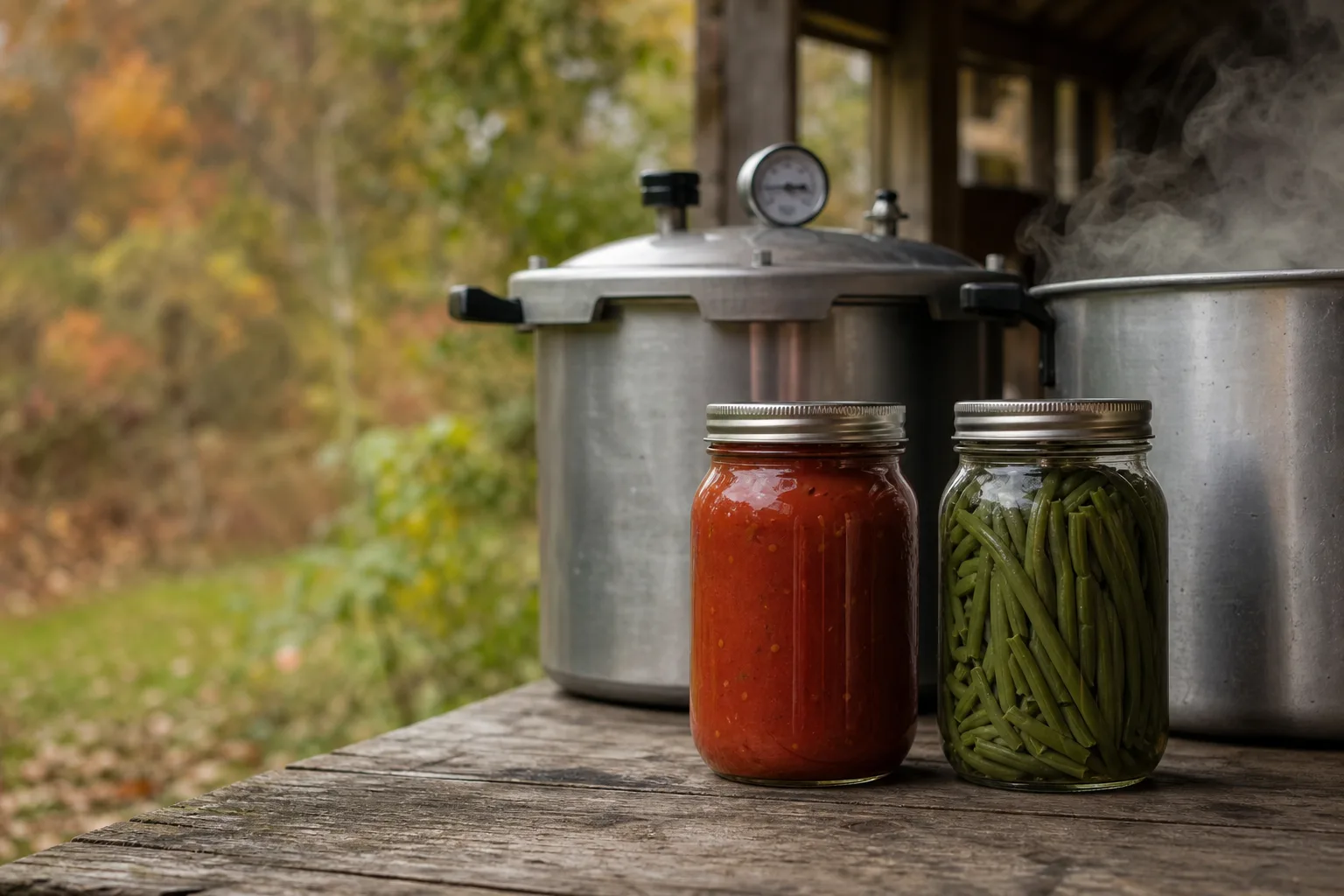
A boiling-water bath is for naturally acidic or properly acidified foods at pH 4.6 or lower. A pressure canner is for low-acid foods, including vegetables, beans, meat, poultry, fish, soups, stews, and most sauces, because 250°F is needed to destroy botulinum spores. That is the rule I use, every time. The pretty jars are not worth guessing.
Which foods belong in a boiling-water bath?
Naturally acidic foods and recipes acidified to pH 4.6 or lower belong in a boiling-water bath at 212°F. That includes most fruits, jams, jellies, marmalades, pickles, relishes, and tomato products made with the measured lemon juice or citric acid required by a tested recipe. The trade-off is simple: this method is easier, but it cannot make low-acid food safe.
Fruit is usually the friendly category. Peaches, berries, apples, pears, and fruit spreads are commonly processed this way, provided the recipe gives a tested time and jar size. Jam is convenient, but it costs you texture if you overcook it, and a pretty seal does not prove the recipe was safe.
Pickles and relishes qualify only when the recipe contains the right amount and strength of vinegar or another approved acid. A splash from the bottle is not a measurement. Quick refrigerator pickles are a different method, useful for a fast batch but dependent on refrigeration rather than shelf-stable canning, as this late-season preservation discussion explains here.
Which foods require a pressure canner?
Low-acid foods require a pressure canner at 10 psi and the processing time specified in a tested recipe. Vegetables, beans, meat, poultry, fish, soups, stews, and most prepared sauces fit this category because their acidity does not reliably stop Clostridium botulinum spores. The trade-off is time, heat, and equipment, but skipping it creates a serious safety risk.
Green beans, corn, carrots, potatoes, plain pumpkin, dried beans, and mixed vegetables are not boiling-water-bath foods. Neither are chicken, beef, fish, chili, vegetable soup, or gravy. Pressure canning takes longer to learn, and the canner needs careful venting, pressure control, and altitude adjustments, but that is the cost of preserving low-acid food safely.
A pressure canner is not the same thing as a pressure cooker used casually for dinner. Use a tested canning recipe, the specified pressure, and the full time. I would rather freeze a basket of beans than improvise a jar that sits in the pantry waiting to make somebody sick.
Why does acidity decide the canning method?
Acidity decides the method because foods at pH 4.6 or lower prevent growth of Clostridium botulinum, while low-acid foods can allow dangerous spores to survive ordinary boiling-water temperatures. A water bath reaches 212°F, but pressure canning reaches about 250°F at 10 psi, the higher heat needed for low-acid foods.
This is the part people try to negotiate with. They ask whether boiling the jars longer will compensate, whether a smaller jar will help, or whether their grandmother always did it that way. It will not turn a low-acid recipe into a tested pressure-canning process.
The 4.6 number is a boundary, not a suggestion. If a recipe says to add lemon juice, citric acid, or vinegar, measure it exactly. If you want to create your own formula, have the food reliably tested instead of trusting taste, because a sweet or tangy flavor does not tell you the pH.
Can you water-bath tomatoes and tomato sauce?
You can water-bath tomatoes and tomato sauce only when a tested recipe includes the required amount of lemon juice or citric acid. Tomatoes vary in acidity, so a sauce that looks and tastes tart enough may still need measured acid. The trade-off is a slightly sharper flavor, but that is easier to correct at serving time than unsafe canning is.
Do not reduce the acid because your tomatoes taste bright. Do not add extra onions, peppers, garlic, meat, or vegetables to a tested tomato recipe and assume the same processing time still works. Those additions change the food, and they can change its acidity and density.
For fall tomatoes, I would sort the plan before the pot heats. Acidified tomato products can go into a boiling-water bath according to the recipe. Tomato sauce with untested additions should not be treated as automatically safe, and a low-acid sauce belongs in a pressure canner only if a tested recipe supports that exact style.
Can vinegar or lemon juice make any recipe safe for a water bath?
No, adding a casual amount of vinegar or lemon juice does not make any recipe safe for a water bath. Acidification works only when a tested, approved recipe specifies the correct acid, strength, quantity, preparation, jar size, and processing time, or when the finished food’s pH is reliably verified at 4.6 or lower.
This is where the rule of thumb fails. Everyone says, “Just add vinegar.” In practice, a spoonful added to a dense bean, meat, or vegetable mixture does not prove that the whole jar reached a safe pH, and it may not distribute evenly.
Use bottled lemon juice when a tested recipe calls for it, because its acidity is consistent. Use vinegar at the strength named by the recipe. A refrigerator pickle can be a smart fall choice for peppers or cucumbers, but it is not a shelf-stable canned product, and its trade-off is that it occupies refrigerator space and needs refrigeration.
Which method should you choose for this fall harvest?
Choose a boiling-water bath for fruit, jams, jellies, marmalades, pickles, relishes, and properly acidified tomato products. Choose a pressure canner for plain vegetables, beans, meat, poultry, fish, soups, stews, and most sauces. If you cannot identify the food’s acidity and find a tested recipe, do not can it for pantry storage.
| Food or preparation | Method I would use | Honest downside |
|---|---|---|
| Most fruits, jams, jellies, and marmalades | Boiling-water bath at 212°F | Overprocessing can soften fruit or dull texture |
| Pickles and relishes with measured vinegar | Boiling-water bath | Weak or improvised brine is unsafe for shelf storage |
| Acidified tomato products | Boiling-water bath with prescribed lemon juice or citric acid | Added acid can make the finished flavor sharper |
| Plain vegetables and dried beans | Pressure canner at 10 psi | Requires equipment, monitoring, and altitude adjustment |
| Meat, poultry, fish, soups, stews, and most sauces | Pressure canner at 10 psi | Dense mixtures need exact tested times and cannot be improvised |
| Refrigerator pickles | Refrigeration, not pantry canning | They take refrigerator space and are not shelf-stable |
For a new canner, I would start with one clear, tested fruit or pickle recipe in October, then learn pressure canning before tackling beans or soup. A small batch teaches you how your stove behaves, how quickly the canner vents, and whether your jars seal without turning the whole kitchen into a stressful opera.
Who is water-bath canning for, and who should ignore it?
Water-bath canning suits a gardener preserving acidic fruit, measured pickles, relishes, jams, jellies, marmalades, or tested acidified tomatoes. Ignore it for plain vegetables, beans, meat, poultry, fish, soups, stews, and most sauces unless a reliable pH test or tested acidification method specifically supports it. The trade-off is giving up convenience for safety.
It also suits someone who can follow a recipe without “fixing” it halfway through. That means the named vinegar, the named lemon juice, the stated jar size, the stated headspace, and the full processing time. If your harvest is mixed, separate it rather than stuffing everything into one heroic sauce.
You should ignore water-bath canning if your plan begins with, “My neighbor does this,” or “I will just process it longer.” I have killed enough plants to respect instructions, and food preservation deserves the same humility. In Austin, the garden already gives us enough surprises with alkaline clay, August heat, and that February 2021 freeze everybody still remembers.
How should you decide what to do with vegetables today?
For vegetables standing in your garden now, first sort them into acidic foods and low-acid foods, then choose a tested recipe before washing jars. Water-bath canning is not the default for fall produce. Pressure can plain vegetables and beans, while quick refrigerator pickles or freezing may be better than inventing a shelf-stable recipe.
Harvest clean produce and remove damaged or spoiled pieces. Do not use a canning method to rescue food that was already questionable. The trade-off with freezing is freezer space and a softer texture after thawing, but it is safer than guessing at a pressure-canning time.
If you are unsure about a plant or ingredient, check our plant database while you sort the harvest. If the garden is larger than your preserving plan, you can also get a concept for your yard that gives you a more manageable mix of fruit, herbs, and vegetables instead of one giant October glut.
What should you do if a recipe and your instinct disagree?
Follow the tested recipe, not your instinct, when the recipe’s acidity or processing method conflicts with what you expected. A boiling-water bath is safe only for food at pH 4.6 or lower, and low-acid food needs pressure canning at 10 psi for the specified time, with altitude adjustments. If the method is unclear, refrigerate or freeze the food instead.
This is especially true for soups, stews, sauces, and mixed jars. Density matters. Ingredients matter. Jar size matters. A recipe that works for a thin, acidified tomato product does not automatically work for a thick sauce loaded with peppers, onions, beans, or meat.
One last practical rule: if you cannot explain why the food belongs in the bath or the pressure canner, stop before sealing the jars. Read the recipe again, check the acid measurement, and use a source with tested instructions. The OSU Extension Service is one place to look for extension-based preservation guidance, while a late garden harvest can also be divided between immediate refrigerator pickles and fermentation rather than forced into unsafe pantry storage.
Can I use a boiling-water bath for green beans?
No. Green beans are a low-acid vegetable and should be pressure-canned using a tested recipe, the specified processing time, and the correct pressure for your altitude. A boiling-water bath reaches 212°F, which is not enough to destroy the botulinum spores that may survive in low-acid foods. The safer alternative is pressure canning, freezing, or refrigeration.
Can I add lemon juice to make vegetables safe for a water bath?
Not by guessing. Lemon juice makes a low-acid vegetable safe for a water bath only when a tested, approved recipe specifies the exact amount, preparation, jar size, and processing time, or when reliable testing confirms a pH of 4.6 or lower. Otherwise, pressure-can the food with a tested recipe or freeze it instead.
Are tomatoes always safe for water-bath canning?
No. Tomatoes can vary in acidity, so use a tested tomato recipe that requires the specified amount of bottled lemon juice or citric acid. Water-bath process the recipe for its stated time and jar size. Do not add extra low-acid ingredients or reduce the acid and assume the original safety instructions still apply.
Is a pressure cooker the same as a pressure canner?
No. A pressure cooker used for dinner is not automatically a pressure canner for shelf-stable food. Low-acid foods need a pressure canner operated at the pressure and processing time specified by a tested recipe, with altitude adjustments. Using the wrong equipment costs you confidence at best and can leave dangerous spores alive at worst.
Can I water-bath can soup or chili if I boil it longer?
No. Soup and chili are usually low-acid, dense mixtures that require pressure canning with a tested recipe, not a longer boiling-water bath. Extra time at 212°F does not replace the higher temperature and controlled processing required for low-acid food. If you cannot find a tested recipe for the exact mixture, freeze it instead.
What should I do with extra fall vegetables if I cannot pressure-can them?
Freeze the vegetables, refrigerate them as a tested quick pickle, or use a tested fermentation recipe rather than improvising pantry canning. Freezing costs freezer space and may soften texture, while refrigerator pickles are not shelf-stable. Salt-brine fermentation can develop flavor over time, but it requires careful proportions, clean equipment, and refrigeration once the intended fermentation is complete.
Want a plan for your own yard?
Tell us the space and we will put a planting plan together for it. Start at get my concept, or browse what actually grows where you are over on plants.
Frequently asked questions
Can I use a boiling-water bath for green beans?
No. Green beans are a low-acid vegetable and should be pressure-canned using a tested recipe, the specified processing time, and the correct pressure for your altitude. A boiling-water bath reaches 212°F, which is not enough to destroy the botulinum spores that may survive in low-acid foods. The safer alternative is pressure canning, freezing, or refrigeration.
Can I add lemon juice to make vegetables safe for a water bath?
Not by guessing. Lemon juice makes a low-acid vegetable safe for a water bath only when a tested, approved recipe specifies the exact amount, preparation, jar size, and processing time, or when reliable testing confirms a pH of 4.6 or lower. Otherwise, pressure-can the food with a tested recipe or freeze it instead.
Are tomatoes always safe for water-bath canning?
No. Tomatoes can vary in acidity, so use a tested tomato recipe that requires the specified amount of bottled lemon juice or citric acid. Water-bath process the recipe for its stated time and jar size. Do not add extra low-acid ingredients or reduce the acid and assume the original safety instructions still apply.
Is a pressure cooker the same as a pressure canner?
No. A pressure cooker used for dinner is not automatically a pressure canner for shelf-stable food. Low-acid foods need a pressure canner operated at the pressure and processing time specified by a tested recipe, with altitude adjustments. Using the wrong equipment costs you confidence at best and can leave dangerous spores alive at worst.
Can I water-bath can soup or chili if I boil it longer?
No. Soup and chili are usually low-acid, dense mixtures that require pressure canning with a tested recipe, not a longer boiling-water bath. Extra time at 212°F does not replace the higher temperature and controlled processing required for low-acid food. If you cannot find a tested recipe for the exact mixture, freeze it instead.
What should I do with extra fall vegetables if I cannot pressure-can them?
Freeze the vegetables, refrigerate them as a tested quick pickle, or use a tested fermentation recipe rather than improvising pantry canning. Freezing costs freezer space and may soften texture, while refrigerator pickles are not shelf-stable. Salt-brine fermentation can develop flavor over time, but it requires careful proportions, clean equipment, and refrigeration once the intended fermentation is complete.
Free, no obligation
Ready to design your dream landscape? Start here.
Tell us where you are and we will start a free profile for you, with plants that actually survive your climate and a real sense of what the build would cost.