
Traditional uses of Purple Crownvetch (Coronilla varia)
Purple Crownvetch (Coronilla varia) has a history of traditional use among the Cherokee, mostly as a topical and emetic remedy. This article explores those recorded uses, the plant's moderate water needs, and its low toxicity status, so you can decide if it belongs in your garden.
August 30, 2026
By Valeria Navarro
TL;DR: Cherokee traditions recorded Purple Crownvetch (Coronilla varia) as a topical remedy for rheumatism and cramps, and as an emetic using a decoction of the bark. The plant is noted as having low toxicity and moderate water needs, but it is not considered palatable to humans. These uses are documented in twentieth-century ethnobotanical sources.
Last updated: August 30, 2026
What traditional uses of Purple Crownvetch were recorded among the Cherokee?
Cherokee sources from the twentieth century document Purple Crownvetch as a topical remedy for rheumatism and cramps, and as an emetic when a decoction of the bark was taken. These uses are attributed to the Cherokee and appear in both Hamel and Chiltoskey (1975) and Taylor (1940).
- The plant was crushed and rubbed on areas affected by rheumatism (Hamel & Chiltoskey, 1975).
- It was also used in the same way for cramps (Hamel & Chiltoskey, 1975).
- A decoction of the bark was taken as an emetic (Taylor, 1940; Hamel & Chiltoskey, 1975).
How does Purple Crownvetch compare to other plants with traditional uses?
Compared to other plants, the recorded uses of Purple Crownvetch are specific to external application for pain and internal use as an emetic, with all references coming from Cherokee tradition. The table below summarizes these uses based on the cited sources.
| Tradition | Part Used | What Was Recorded | Source |
|---|---|---|---|
| Cherokee | Unspecified | Plant crushed and rubbed on rheumatism | Hamel & Chiltoskey, 1975 |
| Cherokee | Unspecified | Plant crushed and rubbed on cramps | Hamel & Chiltoskey, 1975 |
| Cherokee | Unspecified | Used as an emetic | Hamel & Chiltoskey, 1975 |
| Cherokee | Bark | Decoction of bark taken as an emetic | Taylor, 1940; Hamel & Chiltoskey, 1975 |
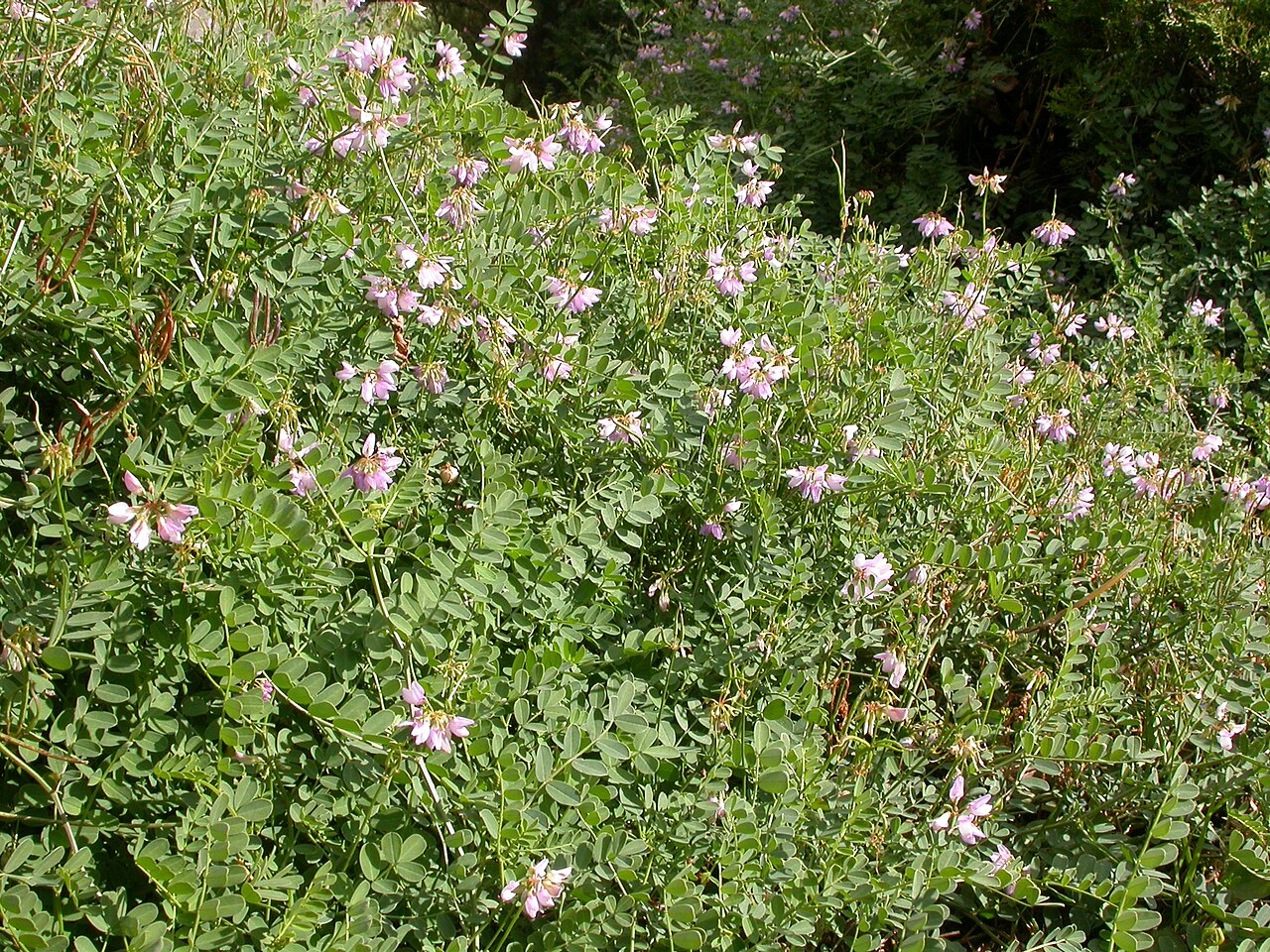
Photo by Matt Lavin from Bozeman, Montana, USA, licensed CC BY-SA 2.0, via Wikimedia Commons.
.jpg)
Who should grow Purple Crownvetch and who should skip it?
Gardeners with moderate water access and space for a spreading perennial might consider Purple Crownvetch, especially for erosion control. Skip it if you need something edible, have pets that chew plants, or want a plant that thrives in heavy clay that stays soggy after rain. Its low toxicity is still a caution for curious kids and animals.
What are the growing conditions and trade-offs for Purple Crownvetch?
Purple Crownvetch needs moderate water and is not palatable to humans. It can be aggressive, spreading quickly and sometimes crowding out other plants. In Central Texas, it may struggle in dense Blackland clay that stays wet after a storm, but does well where drainage is decent and summer heat is high.

Photo by Bjoertvedt, licensed CC BY-SA 3.0, via Wikimedia Commons.

Is Purple Crownvetch toxic or edible?
This plant is recorded as having low toxicity. It is not considered palatable to humans, so it’s not for your edible garden. While low toxicity means accidental contact is unlikely to be dangerous, it’s still smart to keep it out of reach of pets or kids who chew on leaves.
What is the evidence for these traditional uses?
All uses listed here come from documented twentieth-century ethnobotanical sources. The topical and emetic uses are well recorded among the Cherokee, but no other traditions or uses are cited in these references. The evidence is strong for the Cherokee context, but not widely reported elsewhere.
Frequently Asked Questions
What traditional uses of Purple Crownvetch were recorded among the Cherokee?
Cherokee sources from the twentieth century document Purple Crownvetch as a topical remedy for rheumatism and cramps, and as an emetic when a decoction of the bark was taken. These uses are cited in Hamel & Chiltoskey (1975) and Taylor (1940).
Is Purple Crownvetch toxic or edible?
Purple Crownvetch is recorded as having low toxicity and is not considered palatable to humans. While accidental contact is unlikely to be dangerous, it should not be eaten or included in edible gardens, especially where pets or children might chew on plants.
What are the growing conditions and trade-offs for Purple Crownvetch?
Purple Crownvetch requires moderate water and can spread aggressively, sometimes crowding out other plants. In Central Texas, it does best with decent drainage and summer heat, but may struggle in heavy, wet clay. Its low toxicity is still a caution for households with pets or small children.
Who should grow Purple Crownvetch and who should skip it?
Gardeners with moderate water access and space for a spreading perennial might consider Purple Crownvetch, especially for erosion control. It’s not suitable for edible gardens, households with pets that chew plants, or areas with persistently wet clay soil.
What is the evidence for these traditional uses?
All uses discussed are documented in twentieth-century ethnobotanical sources, specifically among the Cherokee. The evidence is strong for this context, but similar uses are not widely reported in other traditions or regions.
How does Purple Crownvetch compare to other plants with traditional uses?
The recorded uses of Purple Crownvetch are specific to external application for pain and internal use as an emetic, all from Cherokee tradition. No other traditions or uses are cited in the sources referenced, making its ethnobotanical profile quite focused.
Want this worked out for your own yard?
Dream Landscaper reads the conditions you actually have, then plans around them rather than around a generic zone chart. Start with the city plant guides to see what already thrives near you, and when you want a real layout instead of a list, get your concept and we will take it from there.
Sources
- Hamel, Paul B. and Mary U. Chiltoskey, 1975, Cherokee Plants and Their Uses -- A 400 Year History, Sylva, N.C. Herald Publishing Co., page 60
- Taylor, Linda Averill, 1940, Plants Used As Curatives by Certain Southeastern Tribes, Cambridge, MA. Botanical Museum of Harvard University, page 31
Valeria and Diego are not doctors, and nothing here is medical advice. This article shares traditional and ancestral plant wisdom that was passed down through generations. It may be beneficial when applied with your own discretion, and with medical supervision as needed.

Thanks for learning with me about the roots and risks of Purple Crownvetch, may your garden choices always be wise and well-informed.
Frequently asked questions
What traditional uses of Purple Crownvetch were recorded among the Cherokee?
Cherokee sources from the twentieth century document Purple Crownvetch as a topical remedy for rheumatism and cramps, and as an emetic when a decoction of the bark was taken. These uses are cited in Hamel & Chiltoskey (1975) and Taylor (1940).
Is Purple Crownvetch toxic or edible?
Purple Crownvetch is recorded as having low toxicity and is not considered palatable to humans. While accidental contact is unlikely to be dangerous, it should not be eaten or included in edible gardens, especially where pets or children might chew on plants.
What are the growing conditions and trade-offs for Purple Crownvetch?
Purple Crownvetch requires moderate water and can spread aggressively, sometimes crowding out other plants. In Central Texas, it does best with decent drainage and summer heat, but may struggle in heavy, wet clay. Its low toxicity is still a caution for households with pets or small children.
Who should grow Purple Crownvetch and who should skip it?
Gardeners with moderate water access and space for a spreading perennial might consider Purple Crownvetch, especially for erosion control. It’s not suitable for edible gardens, households with pets that chew plants, or areas with persistently wet clay soil.
What is the evidence for these traditional uses?
All uses discussed are documented in twentieth-century ethnobotanical sources, specifically among the Cherokee. The evidence is strong for this context, but similar uses are not widely reported in other traditions or regions.
How does Purple Crownvetch compare to other plants with traditional uses?
The recorded uses of Purple Crownvetch are specific to external application for pain and internal use as an emetic, all from Cherokee tradition. No other traditions or uses are cited in the sources referenced, making its ethnobotanical profile quite focused.
Free, no obligation
Ready to design your dream landscape? Start here.
Tell us where you are and we will start a free profile for you, with plants that actually survive your climate and a real sense of what the build would cost.