
Traditional uses of Rattlesnake Fern (Botrychium virginianum)
Rattlesnake Fern (Botrychium virginianum) was recorded in several Native American traditions for various medicinal purposes, including as a decoction for children’s illnesses and as a topical application for snake bites. This article reports the specific traditions, regions, and sources that documented these uses.
August 21, 2026
By Diego Navarro
TL;DR: Rattlesnake Fern (Botrychium virginianum) was documented in Native American traditions as a remedy for children’s illnesses, a topical application for snake bites, and for inducing sweating or soothing mucous membranes. These uses were recorded among the Abnaki, Cherokee, and Chickasaw peoples, with sources dating from the early to mid-20th century.
Last updated: August 21, 2026
What traditional medicinal uses were recorded for Rattlesnake Fern?
Rattlesnake Fern was documented in Native American traditions for a variety of medicinal purposes. Among the Abnaki, a decoction of the plant was given to children with illness and used as a demulcent (Rousseau, 1947, pages 155, 162). The Cherokee recorded using the root to induce vomiting and as a syrup for snake bites (Taylor, 1940, page 4; Hamel & Chiltoskey, 1975, page 34). The Chickasaw used it as a diaphoretic to promote sweating (Campbell, 1951, page 288289).
Which Native American groups used Rattlesnake Fern and for what purposes?
The Abnaki, Cherokee, and Chickasaw all recorded uses for Rattlesnake Fern. The Abnaki gave a decoction to children with illness and used it as a demulcent (Rousseau, 1947, pages 155, 162). Cherokee traditions included using the root to cause vomiting and applying a syrup to snake bites (Taylor, 1940, page 4; Hamel & Chiltoskey, 1975, page 34). The Chickasaw used the plant as a diaphoretic (Campbell, 1951, page 288289).

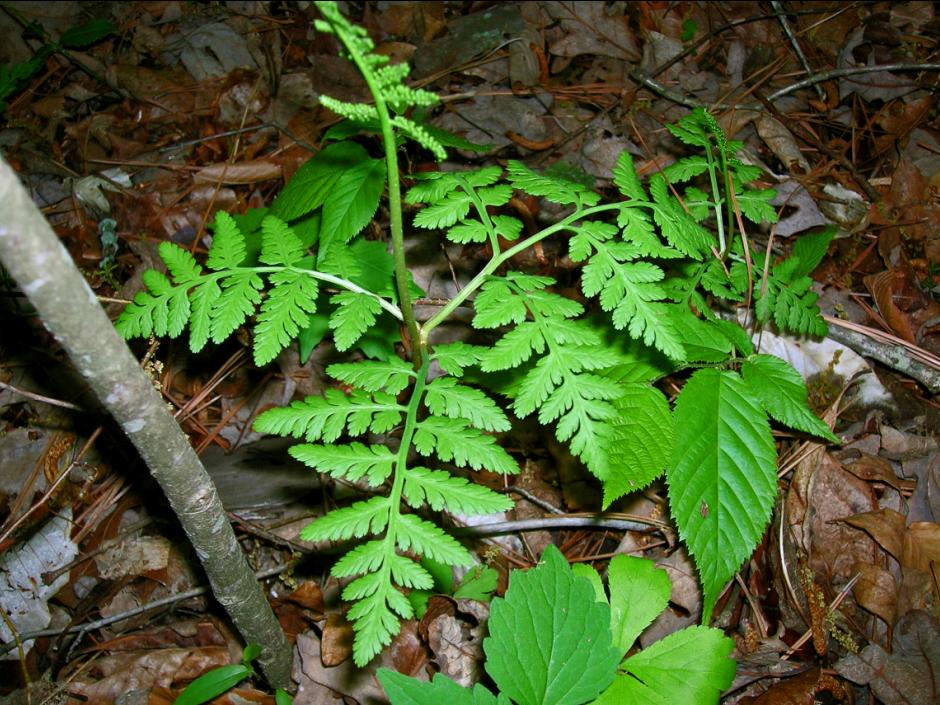
Photo by Photo by David J. Stang, licensed CC BY-SA 4.0, via Wikimedia Commons.

What parts of Rattlesnake Fern were used in these traditions?
Most sources did not specify which part of Rattlesnake Fern was used, except for Cherokee records that mentioned the root. Decoctions were the most common preparation, sometimes boiled down to a syrup for topical use (Taylor, 1940, page 4; Hamel & Chiltoskey, 1975, page 34). Other records simply refer to the whole plant or do not specify the part used.
How do the recorded uses of Rattlesnake Fern compare across traditions?
| Tradition | Part Used | What Was Recorded | Source |
|---|---|---|---|
| Abnaki | Unspecified | Decoction of plant given to children with illness | Rousseau, 1947, page 162 |
| Abnaki | Unspecified | Used as a demulcent | Rousseau, 1947, page 155 |
| Cherokee | Root | Decoction of roots taken to cause vomiting | Taylor, 1940, page 4 |
| Cherokee | Root | Decoction of root 'boiled down to syrup' rubbed on snake bite | Hamel & Chiltoskey, 1975, page 34 |
| Chickasaw | Unspecified | Plant used as a diaphoretic | Campbell, 1951, page 288289 |

Photo by Keisotyo, licensed CC BY-SA 4.0, via Wikimedia Commons.

Who should consider growing Rattlesnake Fern, and who should skip it?
Gardeners with moderate water availability and some shade can try Rattlesnake Fern, especially in woodland or shaded border settings. It is not recorded as edible, so skip it if you want a fern for salads or teas. Households with curious pets or children have no toxicity warning to worry about, but it is not palatable. In Central Texas, it may struggle in full sun or heavy clay that stays wet after rain.
What are the trade-offs or caveats of growing Rattlesnake Fern?
Rattlesnake Fern needs moderate water and does not tolerate long droughts or soggy, compacted clay. It is not a showy fern and won’t fill a space fast. There is no record of it being toxic or edible, so it’s mostly for gardeners interested in native shade plants or ethnobotanical gardens.
Where can I learn more about traditional uses of plants like Rattlesnake Fern?
For more on traditional plant uses, check the sources below or browse the plants page. If you’re planning a garden with native or traditional species, our get my concept tool can help you match plants to your site and goals.
Frequently Asked Questions
What medicinal uses of Rattlesnake Fern were recorded among Native American groups?
Rattlesnake Fern was recorded as a decoction for children’s illnesses among the Abnaki, as a diaphoretic by the Chickasaw, and for inducing vomiting or treating snake bites among the Cherokee. These uses are documented in sources from the early to mid-20th century.
Is Rattlesnake Fern edible or toxic?
There is no record of Rattlesnake Fern being palatable to humans, and no toxicity has been recorded in the sources cited. It is not used as a food plant in the documented traditions.
What growing conditions does Rattlesnake Fern require?
Rattlesnake Fern needs moderate water and some shade. It is not well-suited to full sun or soils that stay soggy after rain, especially in regions with heavy clay like Central Texas.
Who should consider planting Rattlesnake Fern?
Gardeners interested in native woodland plants or ethnobotanical gardens should consider Rattlesnake Fern. It is not a good choice for those wanting edible ferns or for filling large sunny spaces quickly.
What are the main trade-offs of growing Rattlesnake Fern?
The main trade-offs are its slow growth and limited ornamental value compared to some other ferns. It also requires consistent moisture and shade, so it may not thrive in drought-prone or exposed sites.
How was Rattlesnake Fern used for snake bites?
Among the Cherokee, a decoction of the root was boiled down to a syrup and rubbed on snake bites, as recorded by Hamel and Chiltoskey in 1975. This use was topical and is not a modern medical recommendation.
Want this worked out for your own yard?
Dream Landscaper reads the conditions you actually have, then plans around them rather than around a generic zone chart. Start with the city plant guides to see what already thrives near you, and when you want a real layout instead of a list, get your concept and we will take it from there.
Sources
- Rousseau, Jacques, 1947, Ethnobotanique Abenakise, Archives de Folklore 11:145-182, page 162
- Taylor, Linda Averill, 1940, Plants Used As Curatives by Certain Southeastern Tribes, Cambridge, MA. Botanical Museum of Harvard University, page 4
- Hamel, Paul B. and Mary U. Chiltoskey, 1975, Cherokee Plants and Their Uses -- A 400 Year History, Sylva, N.C. Herald Publishing Co., page 34
- Campbell, T.N., 1951, Medicinal Plants Used by Choctaw, Chickasaw, and Creek Indians in the Early Nineteenth Century, Journal of the Washington Academy of Sciences 41(9):285-290, page 288289
- Rousseau, Jacques, 1947, Ethnobotanique Abenakise, Archives de Folklore 11:145-182, page 155
Valeria and Diego are not doctors, and nothing here is medical advice. This article shares traditional and ancestral plant wisdom that was passed down through generations. It may be beneficial when applied with your own discretion, and with medical supervision as needed.
Photo of Rattlesnake Fern (Botrychium virginianum) by TheAlphaWolf, licensed CC BY-SA 3.0, via Wikimedia Commons.


Thanks for reading, and I hope this helps you understand both the history and the reality of growing Rattlesnake Fern in your own space.
Frequently asked questions
What medicinal uses of Rattlesnake Fern were recorded among Native American groups?
Rattlesnake Fern was recorded as a decoction for children’s illnesses among the Abnaki, as a diaphoretic by the Chickasaw, and for inducing vomiting or treating snake bites among the Cherokee. These uses are documented in sources from the early to mid-20th century.
Is Rattlesnake Fern edible or toxic?
There is no record of Rattlesnake Fern being palatable to humans, and no toxicity has been recorded in the sources cited. It is not used as a food plant in the documented traditions.
What growing conditions does Rattlesnake Fern require?
Rattlesnake Fern needs moderate water and some shade. It is not well-suited to full sun or soils that stay soggy after rain, especially in regions with heavy clay like Central Texas.
Who should consider planting Rattlesnake Fern?
Gardeners interested in native woodland plants or ethnobotanical gardens should consider Rattlesnake Fern. It is not a good choice for those wanting edible ferns or for filling large sunny spaces quickly.
What are the main trade-offs of growing Rattlesnake Fern?
The main trade-offs are its slow growth and limited ornamental value compared to some other ferns. It also requires consistent moisture and shade, so it may not thrive in drought-prone or exposed sites.
How was Rattlesnake Fern used for snake bites?
Among the Cherokee, a decoction of the root was boiled down to a syrup and rubbed on snake bites, as recorded by Hamel and Chiltoskey in 1975. This use was topical and is not a modern medical recommendation.
Free, no obligation
Ready to design your dream landscape? Start here.
Tell us where you are and we will start a free profile for you, with plants that actually survive your climate and a real sense of what the build would cost.