
Thornless Blackberry Trellising You Can Actually Harvest From
Separate fruiting canes from next year’s growth on a simple vertical wire trellis, and blackberry picking stops being an armful of tangled stems. Here is the fall setup that keeps floricanes open for harvest and primocanes ready for next season.
September 23, 2026
By Diego Navarro
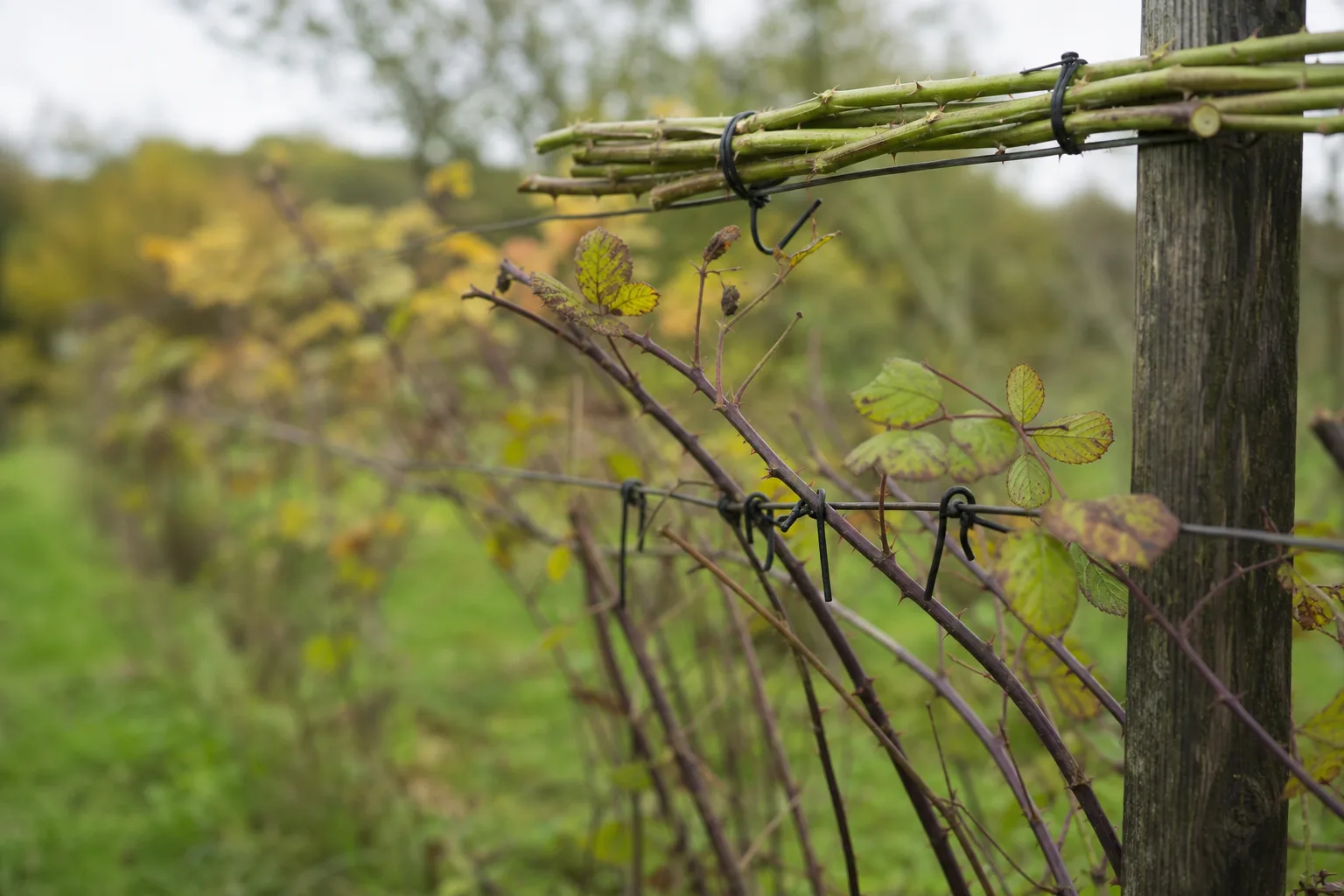
The best thornless blackberry trellis is a vertical wire system that keeps fruiting canes on the outside and next year’s canes bundled separately. In fall, cut spent floricanes at the base, move the bundled primocanes down to the lower wires, and leave the center open for new growth. Your arms will notice.
Why should I separate blackberry canes on the trellis?
Separating blackberry canes lets you pick fruit from open, reachable stems while keeping next year’s growth out of your hands and out of the way. Floricanes are second-year canes that carry the crop, while primocanes are first-year canes that will fruit next season. That division turns pruning from guesswork into a short fall job.
A tangled blackberry plant makes you pull one cane to reach another, which shakes ripe berries loose and puts your forearm into every loop of stem. Thornless does not mean harmless. The canes still catch sleeves, and the blackberry still believes your elbow is a trellis post.
Research from the RHS recommends keeping the current fruiting canes separate from young new canes as the season progresses. That is the rule I use because it solves two jobs at once: harvest stays accessible, and the old canes are easy to identify after fruiting.
The trade-off is that you must tie the plant more than once each year. That takes perhaps 20 minutes per plant in fall and another 15 minutes in spring. Leaving everything in one bundle saves those minutes and charges interest at harvest.
What should a vertical blackberry trellis look like?
Build a narrow vertical trellis with sturdy end posts and several horizontal wires, keeping the blackberry row about 12 to 18 inches wide. Put the lower wires roughly 24, 36, and 48 inches above the soil, with an upper wire near 60 inches. This arrangement gives fruiting canes room below and a clear lane for new growth above.
For one plant, use two end posts or a post at each end of the row, set firmly enough to resist the weight of wet canes and fruit. A wood, wire, and eyelet-screw trellis is inexpensive and workable, but the honest downside is that light hardware loosens as the canes pull against it. Use strong posts and tighten the wire before the season starts.
The vertical trellis is especially useful for trailing and semi-erect thornless blackberries, according to Illinois Extension. Its narrow row improves access for harvest and makes weed, insect, and disease control easier. The downside is that a fixed row gives you less flexibility than a free-standing plant, so place it where you can live with the footprint.
In Central Texas, I would not set a post without checking what is under the soil. Caliche or limestone may stop a shovel eight inches down, and a post hole can become a two-hour appointment with a rock bar. If the soil is black clay, brace the structure well because one wet winter can move a light trellis as the clay swells and shrinks.
What should I do with thornless blackberries this fall?
After the crop is finished, identify and remove the floricanes that fruited this year, cutting them at ground level. Then take the current primocanes, which are next year’s fruiting wood, out of their upper bundle and tie them along the lower wires. Leave the center or upper wire available for new primocanes.
Do this after harvest, once you are certain which canes carried berries. Floricanes are the second-year canes, so they have done their work. Cut them cleanly at the base rather than leaving short stubs that clutter the row and make next year’s selection harder.
Your remaining primocanes may be long, flexible, and inconvenient. Bundle them together on the upper wire until fall, as recommended by Oregon State University Extension, then spread or tie them along the lower wires after the old canes are gone. The bundle is useful temporarily, not as a permanent filing system.
Use soft twine for tying because it is easy to cut and does not bite into growing stems. Twine is cheap and forgiving, but it can loosen or rot after repeated wet seasons. Check every tie in spring and replace anything tight enough to mark the cane.
How can I tell floricanes from primocanes?
Floricanes are the older, second-year blackberry canes that produced flowers and fruit this season; primocanes are newer first-year canes that grew without carrying the main crop. In fall, the fruited floricanes look tired and carry old berry clusters, while healthy primocanes are usually smoother, more flexible, and free of spent fruit stems.
Do not rely on color alone. Sun, variety, drought, and age can change the cane’s appearance. Look for the evidence of fruiting: old flower or berry stems, side branches that held clusters, and a generally finished appearance. If a cane carried your summer crop, it is the one you remove after harvest.
If you are unsure, leave a questionable cane tied separately for one week and mark it with a small piece of twine. Then compare it with a cane you know fruited. The extra week costs less than cutting next year’s crop by mistake.
New canes often emerge from the crown or base and make a fresh, upright bundle. They are useful, but not every cane deserves a place. Remove broken, diseased, or very weak growth, because a crowded trellis gives you more stems and less fruit access.
Where should I tie the fruiting canes for easy picking?
Tie the floricanes along the lower three wires, spreading them enough that berries hang on the outside of the row. Keep the fruiting canes separate from the central bundle of primocanes, and avoid crossing several canes over the same wire. Open lower wires put the crop near your hands instead of behind a wall of leaves.
The lower wires should carry the fruiting wood because that is where you will reach repeatedly during harvest. Tie canes in a loose fan or gentle arc rather than wrapping them tightly around the wire. A tight wrap makes later removal slower and can press the cane against the wire as it thickens.
If a cane is long enough to cover more than one wire, guide it across two or three levels instead of forcing every stem onto one line. The RHS guidance specifically recommends training fruiting canes along the lower wires and tying them with twine. The downside is more tying now, but the payoff arrives every time you pick.
Keep the fruiting side exposed to the path. That matters more than making the trellis look symmetrical. Valeria can draw a beautiful clean elevation, but the plant does not care about the drawing if your harvesting side is blocked by a bundle of next year’s canes.
How should I train new primocanes in spring?
In spring, gather new primocanes into a vertical bundle along the top wire or through the center of the trellis, keeping them separate from the floricanes below. As they lengthen, tie them loosely in small groups rather than twisting them together. This keeps new growth tidy while preserving open lower wires for fruiting wood.
Start checking in March in Central Texas, or when new growth is clearly moving after winter. Tie the bundle before it sprawls across the path. Once a primocane has rooted itself into a neighboring cane, the repair takes longer and your language gets less suitable for church.
If the primocanes grow above the trellis, tip them back according to the training system you are using. Oklahoma State Extension describes leaving free-standing canes about 42 inches tall, or trimming them to about 10 inches above the top trellis wire. Tipping controls the shape, but the trade-off is that cutting too early or too hard removes growth you may want for the following crop.
Select the strongest canes that survived winter and remove damaged or diseased ones. Illinois Extension recommends selecting six to eight good canes for spring training in relevant blackberry systems. A smaller, orderly group is easier to tie and pick than every cane the plant offers you.
Who is this trellis system for, and who should skip it?
This system suits a homeowner with trailing or semi-erect thornless blackberries, a narrow planting strip, and enough access to tie canes twice a year. Skip it if you cannot reach the row from at least one side, if you need a completely maintenance-free shrub, or if your site cannot support a strong post-and-wire structure.
It is a good fit beside a vegetable garden path, along a fence line, or in a dedicated berry row where you can stand close to the lower wires. It is also useful for anyone harvesting with children or older family members because open fruiting canes are easier to see and reach.
The system loses its advantage if a fence, wall, or thick groundcover blocks the harvest side. It also fails on a weak trellis. Thornless blackberry canes still carry leaves, fruit, and winter wind, so a decorative wire stretched between two loose stakes will eventually lean into the walkway.
You should also think about water before planting or rebuilding. In an Austin August, I use drip irrigation on a timer because five weeks over 100 degrees can punish a plant faster than a missed hand-watering reminds you. Drip saves attention, but it adds tubing, emitters, and a timer that need checking.
If you are still deciding on varieties or companion plants, use the plant database to check mature size and site needs before placing the trellis. A beautiful plan that ignores mature cane length is still just a future obstruction.
Which trellis approach is best for harvest access?
For thornless blackberries, I would use the vertical multi-wire trellis with floricanes on the lower wires and primocanes bundled above until fall. It beats a single-wire line because it separates jobs by height, while a free-standing mound loses because the fruiting wood and new growth fold into the same picking space.
| Trellis approach | Best use | Honest downside |
|---|---|---|
| Vertical multi-wire trellis | Thornless trailing or semi-erect plants in a narrow row | Requires post construction and seasonal tying |
| Single wire or simple fence line | A small planting with very few canes | Canes pile into one level and become harder to separate |
| Free-standing mound | Erect types that need less wire support | Fruit and new growth are harder to keep apart and reach |
The vertical system also gives you a clear fall sequence: cut the fruited canes, move the primocanes down, then let next year’s new canes occupy the upper space. That sequence is why I choose it, not because it is the prettiest option in a catalog photograph.
A single wire can work for a young plant, but it loses control as cane numbers increase. The trade-off is cheap installation now and more tangling later. You are not saving maintenance, only postponing it until the berries are ripe.
For help laying out post locations, wire heights, and the walking side, you can get a concept for your yard before you buy lumber. Measure the row first. Blackberry planning gets expensive when the trellis is built one foot too close to the path.
What mistakes make blackberry trellises painful to harvest?
The most common mistakes are mixing old and new canes, tying every cane tightly to one wire, leaving spent floricanes in place, and building a weak structure. Each mistake hides the fruit or makes fall pruning harder. The fix is simple: separate by age, spread by level, remove finished canes, and brace the trellis.
Everyone says thornless blackberries are easy because they lack thorns. In practice, tangled thornless canes still grab fabric, bend into the harvest path, and make you reach through leaves. Thornless removes one problem. It does not remove the need for training.
Do not wait until spring to remove last year’s fruited canes if you can safely work in fall. They become a gray mass around the productive wood, and you lose the clean view that makes cane selection easy. If your plant is still fruiting, finish harvest first, then prune.
Do not bury the crown under thick, wet mulch or let the row stay weedy. The Illinois guidance notes that a trellis supports weed, disease, and insect control by keeping the planting narrow and secured. Mulch can help soil moisture, but the trade-off is that piled, wet material around the crown can hide problems.
In my father’s twelve-foot strip of New Jersey clay, we learned to think about the first hard frost and whether a plant would return in April. Central Texas asks a different question: whether the trellis and irrigation still make sense in September. Build for the hard season you actually have.
What questions do gardeners ask about thornless blackberry trellising?
The short answers are straightforward: train fruiting canes low, keep new canes separate, prune spent canes after harvest, and use a strong vertical trellis. The details matter because timing, wire height, and cane age determine whether your fall work creates an open harvest row or another blackberry knot.
How far apart should blackberry trellis wires be?
How far apart should blackberry trellis wires be? Place the lower wires about 24, 36, and 48 inches above the soil, with an upper wire near 60 inches. Exact spacing can vary with the post height and variety, but those four levels give fruiting canes room below and a place to bundle new primocanes above. The downside is a taller structure that needs firm posts.
When should I move blackberry primocanes to the lower wires?
When should I move blackberry primocanes to the lower wires? Move them in late autumn, after the spent floricanes are removed and the current season’s growth is clearly identified. Tie the primocanes along the lower wires so the center or top wire stays available for new growth next spring. Waiting until spring is possible, but the canes are usually more tangled by then.
How many blackberry canes should I keep on a trellis?
How many blackberry canes should I keep on a trellis? Keep the strongest six to eight canes where that recommendation fits your blackberry type and training system, removing damaged, diseased, or weak growth. Fewer orderly canes are easier to spread and harvest than every cane from the crown. The trade-off is that aggressive thinning may reduce the number of fruiting sites.
Can thornless blackberries grow on one wire?
Can thornless blackberries grow on one wire? Yes, a young or lightly loaded plant can use one wire, but a vertical multi-wire trellis is easier to harvest because it separates fruiting canes from new growth. One wire costs less and installs faster, but canes pile together as the plant matures. That is where the bargain ends.
Should I prune blackberry floricanes in fall?
Should I prune blackberry floricanes in fall? Yes, remove floricanes at the base after they finish fruiting, because those second-year canes have completed their crop. Cutting them out opens the lower wires for next year’s primocanes and makes new growth easier to manage. If fruit is still ripening, wait until harvest is finished rather than cutting productive wood early.
Do thornless blackberries still need tying?
Do thornless blackberries still need tying? Yes, thornless blackberries still need tying because their canes spread, cross, and fall into the harvest path without support. Tie fruiting canes along the lower wires and bundle new primocanes along the upper wire until fall. Soft twine is easy to handle, but it can loosen or decay and should be checked each season.
More questions people ask about this
How far apart should blackberry trellis wires be?
Place the lower wires about 24, 36, and 48 inches above the soil, with an upper wire near 60 inches. Exact spacing can vary with the post height and variety, but those four levels give fruiting canes room below and a place to bundle new primocanes above next spring. The downside is a taller structure that needs firm posts.
Want a plan for your own yard?
Tell us the space and we will put a planting plan together for it. Start at get my concept, or browse what actually grows where you are over on plants.
Frequently asked questions
How far apart should blackberry trellis wires be?
Place the lower wires about 24, 36, and 48 inches above the soil, with an upper wire near 60 inches. Exact spacing can vary with the post height and variety, but those four levels give fruiting canes room below and a place to bundle new primocanes above next spring. The downside is a taller structure that needs firm posts.
When should I move blackberry primocanes to the lower wires?
Move them in late autumn, after the spent floricanes are removed and the current season’s growth is clearly identified. Tie the primocanes along the lower wires so the center or top wire stays available for new growth next spring. Waiting until spring is possible, but the canes are usually more tangled by then.
How many blackberry canes should I keep on a trellis?
Keep the strongest six to eight canes where that recommendation fits your blackberry type and training system, removing damaged, diseased, or weak growth. Fewer orderly canes are easier to spread and harvest than every cane from the crown. The trade-off is that aggressive thinning may reduce the number of fruiting sites.
Can thornless blackberries grow on one wire?
Yes, a young or lightly loaded plant can use one wire, but a vertical multi-wire trellis is easier to harvest because it separates fruiting canes from new growth. One wire costs less and installs faster, but canes pile together as the plant matures. That is where the bargain ends.
Should I prune blackberry floricanes in fall?
Yes, remove floricanes at the base after they finish fruiting, because those second-year canes have completed their crop. Cutting them out opens the lower wires for next year’s primocanes and makes new growth easier to manage. If fruit is still ripening, wait until harvest is finished rather than cutting productive wood early.
Do thornless blackberries still need tying?
Yes, thornless blackberries still need tying because their canes spread, cross, and fall into the harvest path without support. Tie fruiting canes along the lower wires and bundle new primocanes along the upper wire until fall. Soft twine is easy to handle, but it can loosen or decay and should be checked each season.
Free, no obligation
Ready to design your dream landscape? Start here.
Tell us where you are and we will start a free profile for you, with plants that actually survive your climate and a real sense of what the build would cost.