
When Do Swales on Contour Help, and When Can They Cause Landslides?
Swales can slow runoff and protect a garden, but a swale cut into the wrong slope can load wet soil, redirect water, and help trigger a slide. Here is how to assess the grade, soil, shape, overflow, and warning signs before you dig this fall.
September 25, 2026
By Diego Navarro
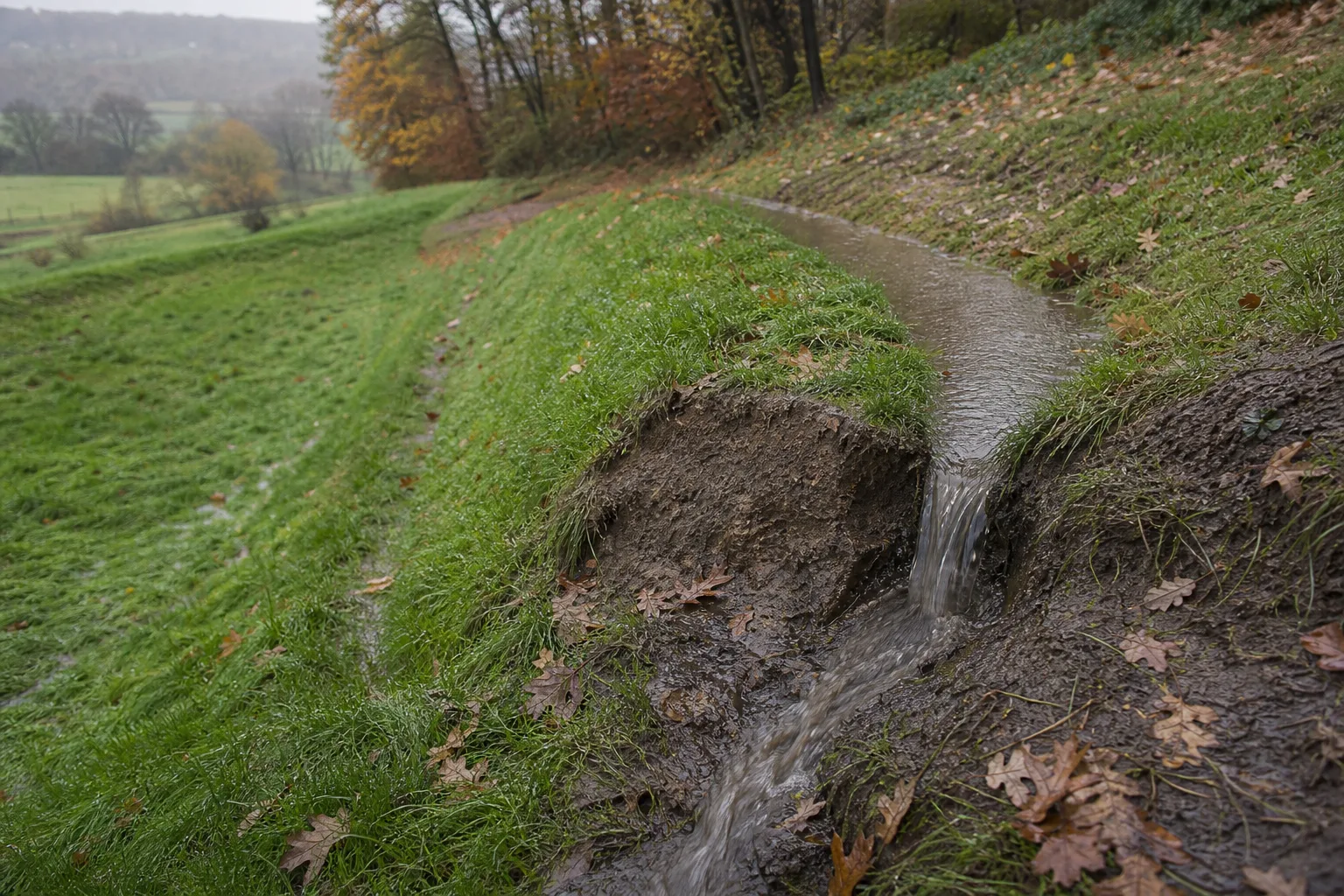
Are swales on contour safe for a sloped garden?
Swales on contour are safe only when the slope, soil, shape, and overflow all suit the site. I would use a shallow swale on a gentle to moderate slope below 15% to 20% grade, but I would not cut one into a slope above 30%, loose gravel, or visibly moving ground. That is the line.
A swale is a shallow channel laid across the slope, following the land's natural contour rather than pointing downhill. It slows runoff, spreads it across the upper side of the garden, and lets some water infiltrate instead of arriving at the bottom as one fast sheet.
The risk starts when the swale holds more water than the soil and slope can carry. Saturated soil weighs more, loses strength, and can begin sliding along a weak layer. A downslope berm can also fail if it is tall, steep, or compacted like a little earthen wall.
Contour banking has been used as an erosion-control practice on cultivated steep ground, and historical accounts describe the banks acting as both erosion control and working terraces. That does not make every backyard cut safe. A garden is not automatically a hillside farm just because the internet used the word permaculture. (Expedition Magazine)
What slope is too steep for a swale?
A slope above about 30% grade is too steep for a typical homeowner swale unless a qualified slope professional has designed the drainage and stabilisation. Between 15% and 20%, proceed carefully with a shallow, wide profile; below 15%, a swale is usually easier to shape and less likely to turn stored water into a slope problem.
Grade is rise divided by horizontal run. A 10-foot horizontal stretch that rises 2 feet is a 20% slope. A phone level or laser level can help, but measure several points because one flat-looking section can hide a steeper section above it.
Do not confuse a 30% grade with a 30-degree angle. Thirty degrees is much steeper. If your foot slips on the bare slope, your wheelbarrow rolls downhill by itself, or the soil has exposed roots and little flat ground, stop treating this as a casual weekend trench.
The practical test is what the water already does. Stand outside during a fall rain, watch where the first sheet forms, and mark any rills, gullies, or places where water seeps from the hill. A new swale should spread that flow, not make a fresh wet line across the slope.
Which soils make contour swales dangerous?
Cohesive loam and clay-loam are the most workable soils for a shallow contour swale, while loose sand, gravel, highly weathered soil, and already saturated ground raise the failure risk. Soil that crumbles immediately or drains through your hand will not reliably hold a berm, and soil that stays wet can lose strength after heavy rain.
Dig a test hole 12 inches deep in at least three places along the proposed line. If you hit limestone or caliche at 8 inches, as often happens around Austin, do not keep digging a deep trench and call the rock a design detail. The soil may be shallow, and the water may travel along the rock surface instead.
Squeeze a handful of moist soil. Loam or clay-loam holds together in a rough ball without becoming shiny mud. Sand falls apart, gravel leaves large gaps, and wet clay smears into a dense lump that may shed water rather than absorb it.
Black clay deserves special suspicion. It swells when wet, shrinks as it dries, and moves anything built on it, including a berm that looked perfect in October. Give it a broad, shallow shape, protect the surface, and provide a safe overflow before winter storms find the weak spot.
How deep and wide should a garden swale be?
A garden swale should usually be shallow, about 10 to 30 centimeters deep, with a width at least three times its depth and side slopes around 1:3 to 1:5. That means a 20-centimeter-deep swale should be at least 60 centimeters wide, with broad sides rather than a ditch cut like a V.
A shallow bowl gives water room to spread without creating a tall wall of stored water. The bottom should slope gently across its width, not form a narrow groove that concentrates flow at one point. Broad is boring. Boring is good here.
Keep the excavated soil on the downslope side only if it can form a low, stable berm. Do not stack all the spoil into a high, steep mound. A high berm adds weight where the slope is already trying to move and creates a larger failure when saturated.
The bottom needs living cover or mulch as soon as you finish shaping it. Grass protects the soil but competes with nearby beds for water. Wood mulch is quick and inexpensive but can wash away in a hard storm and needs replacing. Flat stones resist erosion but can make a slick channel and cost more to place.
Should a swale sit above or below the garden?
Put a swale upslope of the garden when the goal is to slow runoff before it reaches planting beds, patios, or paths. Do not place it directly above a house, retaining wall, septic area, or unstable bank without a designed overflow route, because failure or overtopping can send water and soil toward the thing you meant to protect.
The swale should intercept water before it gains speed, then spread it sideways along the contour. It should not collect every roof downspout, driveway discharge, and neighboring drainage path into one earthen bowl. That is a drainage project, not a small garden feature.
Every swale needs a gentle overflow notch set lower than the main berm. The notch should send excess water toward a stable, vegetated area, not over a bare side slope or toward a foundation. A swale without an overflow is a bathtub with dirt for a rim.
If you are standing in the garden this fall, mark the proposed line with flags and wait for rain before digging. Watch the water for one storm. Then adjust the line to spread it across stable ground rather than forcing it into the neatest drawing on paper.
What are the warning signs that a swale is failing?
A failing swale shows water that stays ponded too long, erosion in the bottom, cracks in the berm, fresh soil bulges below the swale, leaning plants or posts, and seepage appearing lower on the slope. Stop adding water immediately, keep people away from the area, and get local slope or drainage help if cracks widen or soil starts moving.
A brief pond after rain is expected. Water that remains for more than 24 to 48 hours in a soil that previously drained, or that resurfaces downslope in a new wet line, deserves attention. The exact timing depends on soil, rain, and season, so compare it with the rest of the yard.
Look at the berm after every major storm during the first winter. A narrow cut, muddy fan, or exposed root means the flow is concentrating. Patch the surface only after you understand why the water chose that route. Filling the hole without fixing the route is decorative denial.
Cracks across the berm are more serious than a little mulch moving. So are trees tilting downhill, doors or fences changing position, and a toe of soil bulging at the bottom. Those signs can mean the whole slope is shifting, not merely that your swale needs another wheelbarrow of dirt.
Local governments treat areas susceptible to landslip and debris flow as places needing special management to reduce risk to life and property. Your garden may be small, but gravity does not check the square footage before it starts working. (Yarra Ranges erosion management review)
Who should build a contour swale, and who should ignore it?
A contour swale suits a homeowner with a stable, gently sloping garden, moderate soil depth, a safe overflow area, and time to inspect the work through at least one wet season. Ignore the idea if the site is steep, actively eroding, beside a structure, underlain by loose fill, or showing cracks, seepage, leaning trees, or previous slides.
It can be useful above drought-prone beds where runoff currently races past the root zone. The trade-off is that the upper side may stay wetter while the lower side receives less water, and roots can suffer if the swale stays full in clay.
It can also suit a broad lawn or orchard row where mowing and access are simple. The trade-off is maintenance. Grass needs cutting, mulch moves, and an overflow notch can clog with leaves after the exact storm you hoped it would handle.
If you are building near a foundation, retaining wall, public sidewalk, or property line, choose a drainage professional rather than copying a contour line from a video. A professional costs money before the problem. Repair costs money after the hillside has made its decision.
Here is how I would compare the main choices for a sloped home garden:
| Option | Best use | Honest downside |
|---|---|---|
| Shallow swale on contour | Stable slopes below about 20% grade with loam or clay-loam | Needs overflow, inspection, and surface protection; poor placement can saturate the slope |
| Grass-covered diversion channel | Moving excess runoff safely toward a stable outlet | It concentrates water, so the outlet can erode if poorly protected |
| Terraced planting bed | Slopes where level growing space is needed and retaining details are designed properly | More excavation, cost, and structural responsibility |
| Leave the slope intact and plant deeply rooted cover | Unstable, steep, shallow, or rocky slopes | It may reduce erosion without creating useful flat growing space |
What should you do before digging a swale this fall?
Before digging this fall, measure the grade, test soil depth and texture, inspect the slope during rain, locate utilities and structures, flag a safe overflow, and start with a shallow test section no longer than 6 feet. Do not excavate the full contour until the test section survives a rain event without erosion, seepage, or berm movement.
Use a shovel, level, stakes, string, and a tape measure. In Central Texas, add a rock bar and patience. I have spent two hours opening a hole that looked like it would take twenty minutes, because limestone has a sense of humor and no interest in your schedule.
Shape the swale between October and early December if the soil is workable, avoiding days when clay is sticky enough to form a ribbon or so dry that the surface shatters. Seed or plant the disturbed soil immediately. Bare earth is an invitation to runoff.
For plant selection, use the plant database to choose groundcovers and grasses suited to your soil and moisture rather than guessing from a nursery label. Every plant has a trade-off: deep-rooted cover stabilizes soil but takes establishment water, while shallow turf covers quickly but may not hold a deeper slip plane.
If the grade is unclear or the slope shows movement, use the get a concept for your yard tool for an initial layout, then have a qualified local professional review the drainage before excavation. A concept can show where a garden might go. It cannot certify a hillside.
What is the safest alternative if a swale is risky?
The safest alternative to a risky swale is usually to leave the slope mostly intact, protect it with suitable rooted vegetation, and move concentrated runoff through a designed, stable route rather than storing water behind a berm. On unstable ground, drainage and slope stability come before extra planting space, even if that means the garden plan gets smaller.
Rooted plants can protect the surface from raindrop impact and shallow erosion, but they are not a magic net for a deep slide. A grass cover may wash away at an outlet, and shrubs can add weight high on the slope. Choose plants for roots, moisture, and maintenance, not a romantic promise that nature will handle the engineering.
A grass-lined channel may be better than a swale when water must travel to a known outlet. Its trade-off is concentration, so the channel needs a gentle grade, protected edges, and an outlet that cannot scour. Rock, mulch, or a small check feature can help, but each needs inspection after storms.
Terracing can create usable beds, but retaining walls add structure, drainage, and cost. One wall can fail from water pressure behind it even when the blocks look handsome in November. I would rather keep a slope planted than build a pretty wall that has nowhere for water to go.
How long should you monitor a new contour swale?
Monitor a new contour swale after every heavy rain and through at least one full wet season, usually six to twelve months. Walk the berm, overflow, bottom, and downslope area within 24 hours of a strong storm, then check again after the soil dries enough to reveal cracks, rills, or settlement.
Fall is a good time to begin because winter rain exposes poor shaping before summer drought hides it. Do not wait until August to discover that the overflow points at your vegetable bed. August does not negotiate in Texas.
Record the date, rainfall if you know it, ponding duration, and any soil movement. Photos from the same two locations make small changes easier to see. Repair minor surface erosion with soil and cover only after the cause is clear.
If the berm settles evenly, the water spreads briefly, and the overflow stays stable, the swale is doing its job. If the ground cracks, seeps, bulges, or moves, stop treating it as a garden maintenance issue. Get an assessment before the next storm.
Are swales on contour safe for a sloped garden?
Swales on contour are safe only on stable, gentle to moderate slopes with suitable soil, a broad shallow profile, and a safe overflow. They are poor choices above roughly 30% grade, in loose sand or gravel, or on ground already showing cracks, seepage, erosion, leaning trees, or movement. A swale can reduce runoff or worsen saturation, depending on the site.
What slope is too steep for a swale?
A slope above about 30% grade is too steep for a typical homeowner swale without professional design. Slopes between 15% and 20% need careful shaping and inspection, while slopes below 15% are generally easier to manage. Grade means rise divided by horizontal run, so a 2-foot rise over 10 feet is a 20% slope.
How deep and wide should a garden swale be?
A garden swale should usually be 10 to 30 centimeters deep and at least three times as wide as it is deep, with side slopes around 1:3 to 1:5. A 20-centimeter-deep swale therefore needs at least 60 centimeters of width. The broad profile slows water without creating a narrow, erosive ditch.
What are the warning signs that a swale is failing?
Warning signs include ponding that lasts more than 24 to 48 hours, erosion in the swale bottom, berm cracks, fresh soil bulges below the channel, new seepage, leaning plants or posts, and downslope movement. Stop adding water, keep people away from the area, and seek local slope or drainage help if cracks widen or soil shifts.
Should a swale sit above or below the garden?
A swale usually belongs upslope of the garden when its purpose is to slow runoff before water reaches planting beds, paths, or patios. It still needs a gentle overflow directed toward stable, vegetated ground. Do not put one directly above a house, retaining wall, septic area, or unstable bank without a designed drainage route.
What is the safest alternative if a swale is risky?
The safest alternative is usually to leave the slope intact, establish suitable rooted vegetation, and route concentrated runoff through a stable, designed channel. On unstable ground, drainage and slope stability matter more than creating another planting bed. A smaller garden that stays put is a better garden. Flatly.
Want a plan for your own yard?
Tell us the space and we will put a planting plan together for it. Start at get my concept, or browse what actually grows where you are over on plants.
Frequently asked questions
Are swales on contour safe for a sloped garden?
Swales on contour are safe only on stable, gentle to moderate slopes with suitable soil, a broad shallow profile, and a safe overflow. They are poor choices above roughly 30% grade, in loose sand or gravel, or on ground already showing cracks, seepage, erosion, leaning trees, or movement. A swale can reduce runoff or worsen saturation, depending on the site.
What slope is too steep for a swale?
A slope above about 30% grade is too steep for a typical homeowner swale without professional design. Slopes between 15% and 20% need careful shaping and inspection, while slopes below 15% are generally easier to manage. Grade means rise divided by horizontal run, so a 2-foot rise over 10 feet is a 20% slope.
How deep and wide should a garden swale be?
A garden swale should usually be 10 to 30 centimeters deep and at least three times as wide as it is deep, with side slopes around 1:3 to 1:5. A 20-centimeter-deep swale therefore needs at least 60 centimeters of width. The broad profile slows water without creating a narrow, erosive ditch.
What are the warning signs that a swale is failing?
Warning signs include ponding that lasts more than 24 to 48 hours, erosion in the swale bottom, berm cracks, fresh soil bulges below the channel, new seepage, leaning plants or posts, and downslope movement. Stop adding water, keep people away from the area, and seek local slope or drainage help if cracks widen or soil shifts.
Should a swale sit above or below the garden?
A swale usually belongs upslope of the garden when its purpose is to slow runoff before water reaches planting beds, paths, or patios. It still needs a gentle overflow directed toward stable, vegetated ground. Do not put one directly above a house, retaining wall, septic area, or unstable bank without a designed drainage route.
What is the safest alternative if a swale is risky?
The safest alternative is usually to leave the slope intact, establish suitable rooted vegetation, and route concentrated runoff through a stable, designed channel. On unstable ground, drainage and slope stability matter more than creating another planting bed. A smaller garden that stays put is a better garden. Flatly.
Free, no obligation
Ready to design your dream landscape? Start here.
Tell us where you are and we will start a free profile for you, with plants that actually survive your climate and a real sense of what the build would cost.