
Should You Top a Mango Tree That Has Outgrown Its Space?
A mango tree that has outgrown its space needs a phased height reduction, not a one-day haircut. Here is what topping costs you, how crown reduction works, what fall changes, and what a two to three year pruning plan may cost.
September 24, 2026
By Diego Navarro
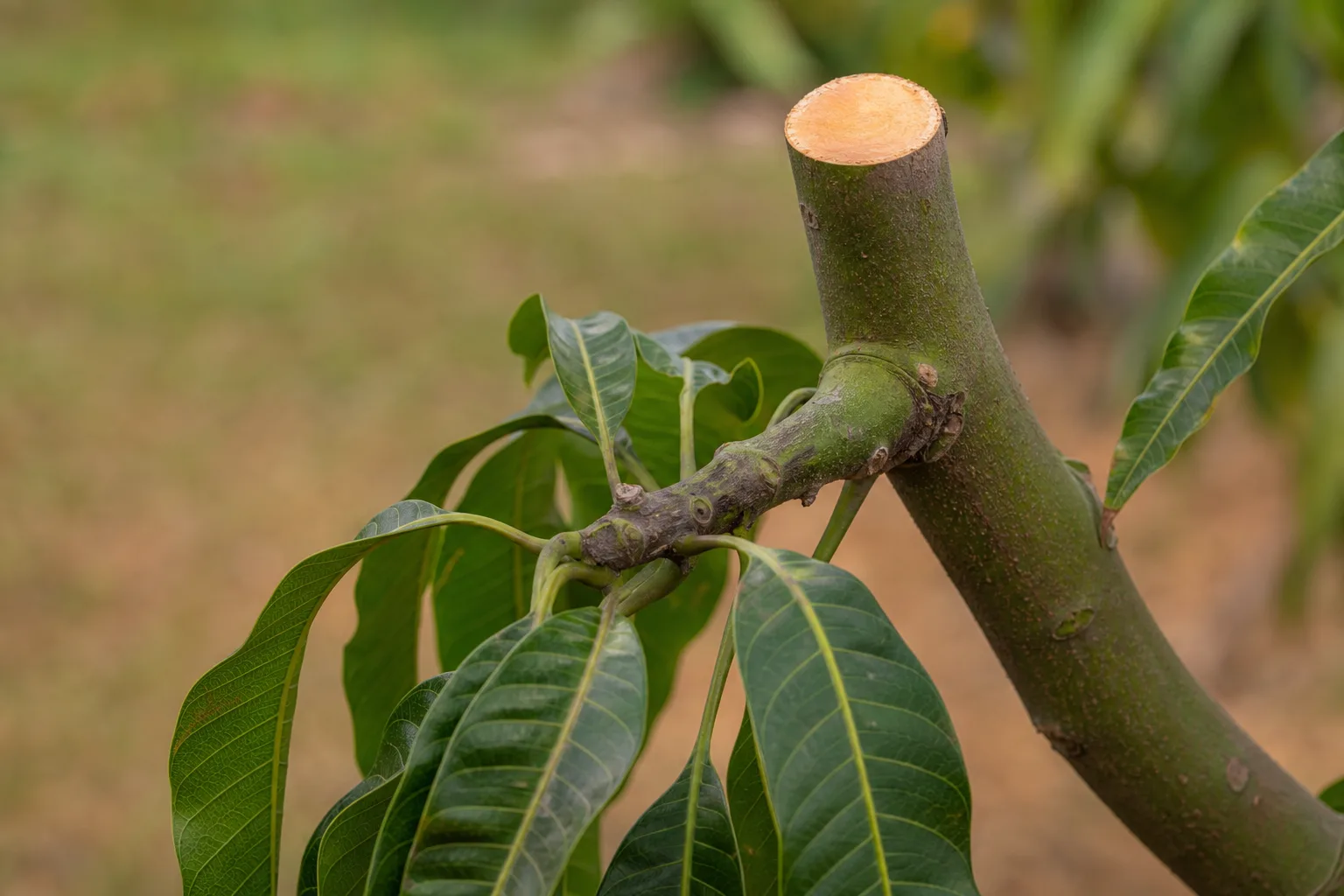
Should you top a mango tree that has outgrown its space?
You should not top a mango tree by cutting its upper branches back to stubs, even if the tree is crowding your roof or power lines. Use a phased crown reduction instead, removing no more than 20 to 30 percent of the live canopy per season and repeating the work over two to three years. Topping is fast. It is also a bad bargain.
Topping, sometimes called heading or rounding over, removes the uppermost branches to force a tree shorter. The cut ends leave stubs, and the tree answers with a flush of shoots that can look busy while creating weak attachment points. Coleman Tree Service describes topping as the removal of upper branches to reduce height and spread, but that definition does not make it the right answer for your mango.
A proper crown reduction cuts back to healthy lateral branches, preserving the tree's basic form. That distinction matters during a storm, when heavy fruit and wind put force on every new branch.
I learned the emotional part of this job from my father's tomatoes in a twelve foot strip of New Jersey clay. You cut something back because it is too big, then spend the next season asking whether you helped it or simply made a mess. A mango gives you more wood and a much larger bill.
How much of a mango tree can you remove in fall?
Remove no more than 20 to 30 percent of the mango tree's live canopy in one season, and treat fall as the planning point rather than an excuse for a drastic cut. The exact timing depends on the tree's condition, access, local weather, and the hazard it creates, so a certified arborist should set the first reduction and the return date.
If the tree is touching a roof, blocking a driveway, or growing toward utility lines, document the problem now with photographs and measurements. Mark the height you actually need, not the height you wish the tree had been planted at. A mature mango will not become a small patio tree because you had a productive Saturday.
The 20 to 30 percent limit applies to live canopy, not just the branches you can reach from the ground. Removing a few giant limbs can exceed that limit even when the pile looks modest. The downside of a conservative first cut is that the tree may still look too large next spring, but that is cheaper than rebuilding a stressed crown.
For a tree near power lines, do not make your own clearance cuts. The downside of professional utility clearance is the cost of a site visit, but a ladder, saw, and live wire are a poor combination.
What is the difference between topping and crown reduction?
Topping cuts upper branches back to stubs, while crown reduction shortens selected limbs back to healthy lateral branches that can carry the remaining growth. Crown reduction keeps more of the mango's natural structure and makes the canopy easier to manage over time. Its downside is that it takes several visits instead of one dramatic cut.
A reduction cut should leave a lateral branch large enough to take over the direction of growth. Cutting every limb at the same height creates the familiar hat rack form, which looks tidy from the street and performs badly under wind or heavy fruit. TreeWise describes crown reduction as the proper alternative to topping when a tree has outgrown its space.
The arborist should identify the final height, then work backward through the upper crown. That means preserving useful branch unions and removing selected limbs rather than flattening the canopy like a hedge. The tradeoff is visual patience: the tree may look uneven after the first visit because a living canopy cannot be reduced like a boxwood.
Ask where every major cut will land before work begins. If the answer is simply “at the height you requested,” get a second opinion.
Who is a phased mango tree reduction for, and who should ignore it?
A phased reduction suits a mature mango that still has good structure but is too close to a building, power line, walkway, or neighboring tree. It is not the right shortcut for a tree with severe decay, dangerous major limbs, or a location where even a reduced crown cannot be safe. In those cases, removal may be the more honest option.
This plan also suits homeowners who can budget for two or three visits and tolerate a tree that changes gradually. The downside is that you pay for a relationship with the tree, not a single cleanup. That is frustrating if you need instant clearance, but the tree's biology does not accept rush service.
You should ignore phased reduction as a do-it-yourself weekend project if the tree requires climbing, rigging, work near wires, or cutting limbs larger than you can safely control. You should also ignore it if the tree is already failing and the real question is whether it should remain.
Do you need the tree shorter, or do you need one branch moved away from the roof? Those are different jobs. A single properly chosen reduction cut may solve the second problem without starting a whole-canopy project.
What does a two to three year mango reduction plan look like?
A two to three year plan starts with one controlled reduction, followed by a monitoring visit after 12 to 18 months and another round of selective pruning if needed. Each season should remove only the agreed share of live canopy, then shape new shoots rather than repeatedly cutting the same ends. The goal is a stable, useful crown, not permanent punishment.
In the first visit, the arborist assesses height, branch unions, access, nearby structures, and disposal needs. The first cut should establish the direction of future growth and reduce the most urgent clearance problem. Its downside is that new shoots may appear before the final shape is settled.
At the follow-up, the arborist thins or reduces those shoots while they are still manageable. Waiting three years between visits can allow vigorous regrowth to become another expensive climb. The research recommendation for a 12 to 18 month follow-up is practical because it catches the tree before the new growth becomes the next structural problem.
If you are standing outside in fall, take measurements now, request an estimate, and schedule the assessment. Do not confuse scheduling the work with removing half the tree today.
What does it cost to reduce a mango tree's height?
Professional height reduction typically costs about $250 for a small, accessible mango tree and $1,200 or more for a large, high-risk tree requiring rigging, multiple climbs, or a crane. Because the work is phased, a mature mango commonly totals $500 to $2,500 over two to three years, plus monitoring and maintenance.
| Option | What it does | Honest downside |
|---|---|---|
| Topping | Cuts upper branches back to stubs for immediate height reduction | Stresses the tree, encourages weak shoots, and can leave a hat rack crown |
| Phased crown reduction | Removes selected limbs back to healthy laterals over two to three years | Costs more than one cut and requires follow-up visits |
| Removal and replacement | Eliminates the clearance problem entirely | Loses the established tree and adds removal, disposal, and replacement work |
The estimate should account for height, access, branch disposal, after-care, and permits where required. A tree over open lawn may be straightforward; the same tree over a roof with limited drop space is a rigging job. The downside of choosing the cheapest quote is that it may price the saw work while ignoring the return visit that keeps the new growth under control.
A low first-year quote does not necessarily mean low total cost. Ask for the price of the first reduction, the expected number of visits, the follow-up interval, and the total projected range. Put the plan in writing.
Can you reduce an overgrown mango tree yourself?
You can handle a few small, reachable cuts with the right knowledge, but you should not climb or dismantle a large mango tree yourself when it threatens a roof, power line, road, or occupied area. The work becomes professional arboriculture when limbs need rigging or the canopy must be reduced without destroying its structure. The tradeoff of hiring help is cost, not guesswork.
A pole saw does not turn you into a climber, and a ladder does not provide reliable control of a heavy branch. One dropped limb can damage roofing, fences, irrigation, or the tree's remaining scaffold. The branch disposal may also cost extra, so ask whether hauling is included.
Look for a certified arborist who can explain reduction cuts, the 20 to 30 percent limit, and the follow-up schedule. If someone promises to make a mature mango half its height in one visit, ask what happens to the stubs and the shoots next year. A confident answer is not the same thing as a sound plan.
For plant selection around the reduced canopy, use our plant database to check mature sizes and site needs before you add another problem under the branches. A new shrub that grows six feet wide is not a clearance solution just because it came in a small pot.
What happens if you top the mango tree anyway?
Topping can stress the mango, increase vulnerability to pests and disease, and produce weak new shoots with a hat rack appearance. Those shoots may fail under wind or heavy fruit because they grow from damaged ends rather than from a carefully preserved branch structure. The immediate height reduction is real, but so is the cost of correcting the next problem.
Everyone says the tree will “grow back fuller.” In practice, that fast regrowth is the reason topping often creates a repeat bill: many shoots arrive where you wanted a few strong branches. The tree may also become harder to inspect and manage because the new growth is dense and poorly organized.
Topping is sometimes used under utility or property restrictions, but that is a special case requiring a safety assessment, not a general recommendation. Even the sources that discuss topping frame it as a more drastic measure and emphasize controlled height reduction where possible. If the tree cannot be made safe by reduction, removal deserves a direct conversation.
You can get a visual starting point with our free design tool to get a concept for your yard, but a concept image cannot inspect a branch union or price a crane. Pretty is not structural analysis.
What should you ask before hiring someone to reduce your mango tree?
Ask how much live canopy will be removed, where the reduction cuts will land, how many visits are expected, and what follow-up costs. A useful estimate names access equipment, branch disposal, permits, and the 12 to 18 month monitoring visit. If the proposal only says “top tree to desired height,” it has not described a responsible plan.
The contractor should explain whether the tree needs crown reduction, selective thinning, or removal. Each method has a tradeoff, and the right choice depends on clearance, tree condition, and the space available after pruning. You do not need a lecture, but you do need more than a chainsaw price.
Ask what they will do if the first reduction reveals decay or a weak union. Ask whether the crew is insured and whether the person making the cuts is the same person who assessed the tree. On a large mango, the person who knows the plan should not disappear before the climbing starts.
Here are the questions I would put on the estimate before signing:
Should you top a mango tree that has outgrown its space?
You should not top a mango tree by cutting its upper branches back to stubs. Use a phased crown reduction that removes no more than 20 to 30 percent of the live canopy per season, then repeat the work over two to three years so new growth can be shaped and the tree can recover.
How much of a mango tree can you remove in fall?
Remove no more than 20 to 30 percent of the mango tree's live canopy in one season, and use fall to assess the problem and plan the work rather than rushing into a drastic cut. A certified arborist should account for tree condition, access, nearby hazards, and the clearance you actually need.
What does crown reduction cost for a mature mango tree?
A mature mango tree commonly costs about $500 to $2,500 to reduce over two to three years. Individual visits may range from about $250 for a small, accessible tree to $1,200 or more for a large, high-risk tree requiring rigging, a crane, or multiple climbs.
How often should a reduced mango tree be checked?
A reduced mango tree should receive a follow-up visit every 12 to 18 months so new shoots can be thinned or reduced before they become large structural problems. The exact schedule depends on regrowth, clearance, tree condition, and whether the first visit solved the original hazard.
Is crown reduction better than topping for a mango tree?
Crown reduction is better than topping for a mango tree because it shortens selected limbs back to healthy lateral branches while preserving more of the tree's natural form. Topping cuts back to stubs, which can stress the tree and encourage weak shoots that may fail under wind or heavy fruit.
Should you remove a mango tree instead of reducing it?
You should consider removing a mango tree when it has severe decay, dangerous major limbs, or cannot be made safe even after phased reduction. Removal loses an established fruit tree and adds disposal and replacement work, but it can be more responsible than repeatedly cutting a tree that has no safe place left to grow.
Want a plan for your own yard?
Tell us the space and we will put a planting plan together for it. Start at get my concept, or browse what actually grows where you are over on plants.
Frequently asked questions
Should you top a mango tree that has outgrown its space?
You should not top a mango tree by cutting its upper branches back to stubs. Use a phased crown reduction that removes no more than 20 to 30 percent of the live canopy per season, then repeat the work over two to three years so new growth can be shaped and the tree can recover.
How much of a mango tree can you remove in fall?
Remove no more than 20 to 30 percent of the mango tree's live canopy in one season, and use fall to assess the problem and plan the work rather than rushing into a drastic cut. A certified arborist should account for tree condition, access, nearby hazards, and the clearance you actually need.
What does crown reduction cost for a mature mango tree?
A mature mango tree commonly costs about $500 to $2,500 to reduce over two to three years. Individual visits may range from about $250 for a small, accessible tree to $1,200 or more for a large, high-risk tree requiring rigging, a crane, or multiple climbs.
How often should a reduced mango tree be checked?
A reduced mango tree should receive a follow-up visit every 12 to 18 months so new shoots can be thinned or reduced before they become large structural problems. The exact schedule depends on regrowth, clearance, tree condition, and whether the first visit solved the original hazard.
Is crown reduction better than topping for a mango tree?
Crown reduction is better than topping for a mango tree because it shortens selected limbs back to healthy lateral branches while preserving more of the tree's natural form. Topping cuts back to stubs, which can stress the tree and encourage weak shoots that may fail under wind or heavy fruit.
Should you remove a mango tree instead of reducing it?
You should consider removing a mango tree when it has severe decay, dangerous major limbs, or cannot be made safe even after phased reduction. Removal loses an established fruit tree and adds disposal and replacement work, but it can be more responsible than repeatedly cutting a tree that has no safe place left to grow.
Free, no obligation
Ready to design your dream landscape? Start here.
Tell us where you are and we will start a free profile for you, with plants that actually survive your climate and a real sense of what the build would cost.