
How Do You Raise or Lower Soil pH, and How Long Does It Take?
Lime raises soil pH and elemental sulfur lowers it, but neither works overnight. Test first, apply a modest amount in fall, mix it into the top 6 inches, water it in, and retest after six months before adding more.
September 20, 2026
By Diego Navarro
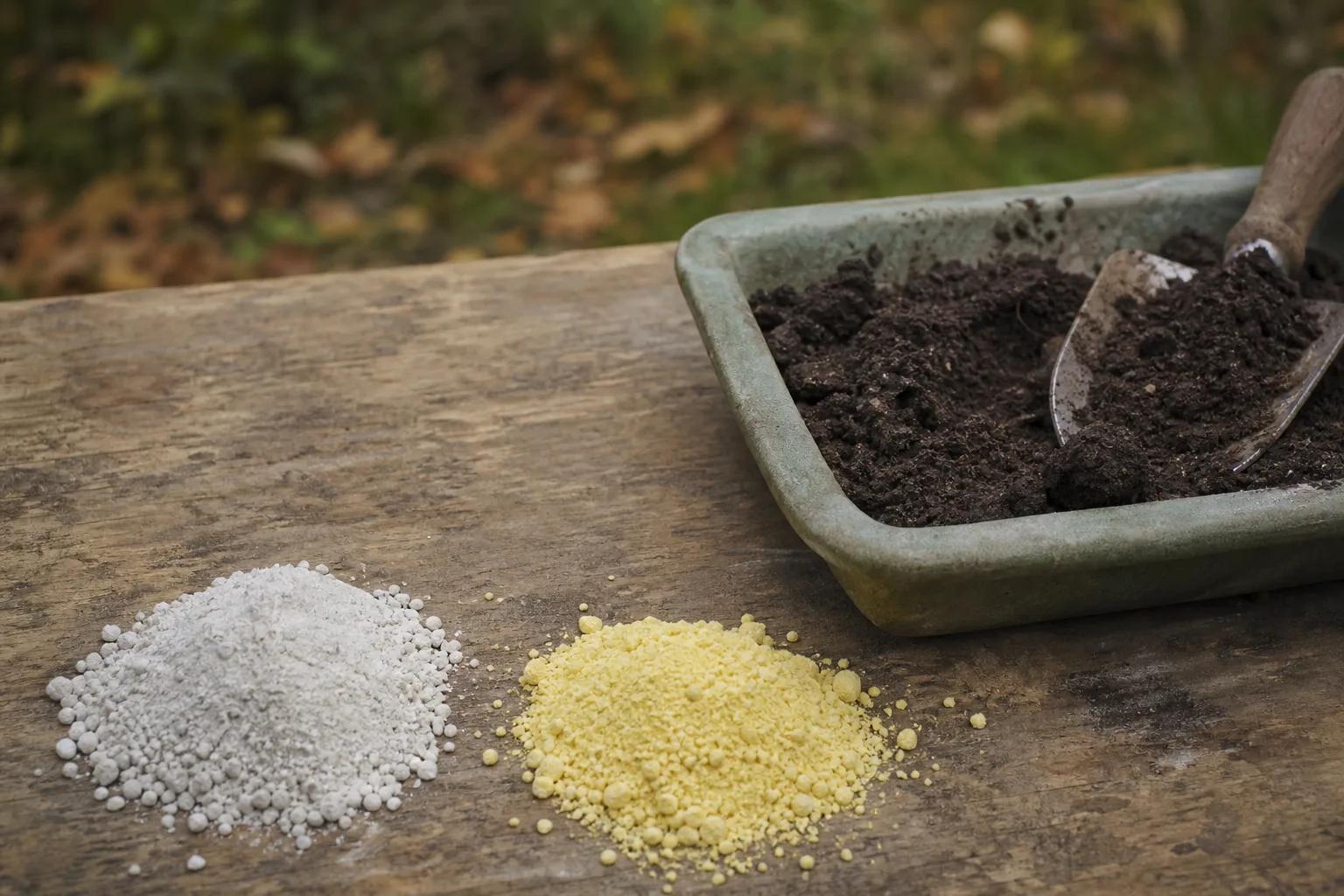
Use calcitic or dolomitic lime to raise soil pH, and elemental sulfur to lower it. Both amendments need a season or more, so test first, apply a modest amount in fall, mix it into the top 6 inches, water thoroughly, and retest after six months before making another adjustment.
Should you change your soil pH this fall?
Yes, fall is the right time to test and begin a measured pH adjustment because lime can take three to four months to affect soil pH before spring planting. Elemental sulfur also needs several months, especially in heavy or strongly buffered soil, so neither amendment is a rescue treatment for next weekend's planting. Clemson Extension identifies fall as the ideal season for incorporating lime.
Start with a soil test from the bed you actually plan to amend. A quick home kit can show a rough number, but a laboratory test may also report buffer pH or lime requirement, which tells you how stubborn the soil will be.
The practical fall sequence is simple: test, calculate a small application, spread it evenly, mix it through the top 6 inches, and water the bed. Do not dump a bag beside one tomato hole and expect chemistry to organize itself.
At my father's house in New Jersey, we built around the first hard frost and waited for April to tell us what survived. In Austin, I build around the fifth week over 100 degrees and the fact that September can still punish a new bed. Timing is part of the amendment.
How do you raise soil pH safely?
Raise acidic soil pH with calcitic lime or dolomitic lime, applied in small amounts after a reliable test. For a loam soil, about 65 pounds of calcitic lime per 1,000 square feet may raise pH by roughly 1.3 units, but most home gardens should aim for a 0.5 point shift, incorporate it into the top 6 inches, water it, and retest after six months.
Calcitic lime is calcium carbonate. Dolomitic lime contains calcium carbonate plus magnesium carbonate, so it can add magnesium while raising pH, but adding magnesium you do not need can create a different soil imbalance. That is why I do not choose dolomitic lime by habit.
The research figure is a starting point, not a universal prescription. Soil texture, organic matter, moisture, temperature, and buffering capacity all change the result, and a clay soil may resist a correction that works quickly in loam.
If the test says pH 5.8 and your crop is comfortable near 6.0 to 7.0, do not chase a perfect 6.8. A small correction costs less, disturbs fewer nutrients, and gives you a clear reading at the next test.
How do you lower soil pH without wasting sulfur?
Lower alkaline soil pH with elemental sulfur, applied to moist soil during warm weather and mixed thoroughly into the top 6 inches before watering. Roughly 2.4 pounds per 100 square feet of loam may lower pH by one point, but a home garden usually needs a smaller shift and may require split applications across one season or several seasons.
Elemental sulfur works through soil activity, so it is not an instant acid wash. Warm, moist soil helps it react, while cold or dry soil slows the process. That makes a fall application useful only if the soil stays workable and receives enough moisture to support the reaction.
Do not make a large correction in one dramatic afternoon. Apply a portion, mix it evenly, water it in, and retest before adding more. The honest downside of sulfur is patience, plus the risk of overshooting if you keep applying it without measuring.
If your soil contains free lime, lowering pH can take multiple seasons because that alkaline material keeps resisting the change. You cannot out-muscle a calcareous soil with a single bag of sulfur. The soil has votes too.
How much lime or sulfur should you apply?
Use the test result and the product label first, then make a modest adjustment rather than treating the research rate as an automatic order. A useful starting comparison is 65 pounds of calcitic lime per 1,000 square feet of loam for about a 1.3 unit rise, or 2.4 pounds of elemental sulfur per 100 square feet of loam for about a one point drop.
Those figures do not transfer cleanly to every bed. The lime example is for loam, and the sulfur example is also for loam, while clay, sand, organic matter, and free lime change how much material the soil can absorb before the pH responds.
For most homeowners, I would divide a large requested change into two applications. Make the first adjustment this fall, retest in roughly six months, and decide whether the second portion belongs in spring or the following fall.
| Option | What it does | Timing | Honest downside |
|---|---|---|---|
| Calcitic lime | Raises acidic soil pH and adds calcium | Apply in fall or at least 3 to 4 months before planting | Slow, and the rate depends heavily on soil buffering |
| Dolomitic lime | Raises acidic soil pH and adds calcium and magnesium | Apply in fall and retest after six months | Can add unnecessary magnesium if the test does not call for it |
| Elemental sulfur | Lowers alkaline soil pH | Apply to warm, moist soil and allow several months | Slowest in cold, dry, clay-rich, or calcareous soil |
A spreader gives you a more even application over a lawn-sized area, but it does not fix a wrong rate. For a raised bed, weigh the amendment with a kitchen scale, mark the bed dimensions, and keep the material away from a concentrated pile.
Does soil type change how quickly pH moves?
Yes, soil type changes both the amount of amendment needed and the waiting time. Loam is the reference soil for common application estimates, while clay, organic-rich soil, and soil containing free lime can resist pH change more strongly, requiring smaller split applications, longer reaction periods, and annual retesting rather than one large treatment.
This is where Central Texas gives you a practical lesson before you even open the bag. Caliche and limestone can stop a shovel at 8 inches, while black clay swells, shrinks, and moves whatever you set on it, including a pH plan that was never mixed evenly.
A soil test matters more than a guess based on color. Two beds can both look dark and still react differently because their mineral content and buffering capacity are not the same.
Mixing depth matters too. The recommendation is the top 6 inches, not a dusting on the surface. If you amend only the first inch, roots encounter layers with different chemistry and the test may not represent the active root zone.
How long does lime take to raise pH?
Lime usually takes at least three to four months to begin producing the planned pH change, and you should retest after about six months before adding more. Moisture, temperature, particle size, soil mixing, and buffering capacity all affect the speed, so a fall application may help prepare a bed for spring without reaching its final reading by planting time.
Lime is not fertilizer in the ordinary sense, and more is not automatically better. Its job is to neutralize acidity, while the soil test tells you whether calcium or magnesium is already adequate.
The failure mode I see most often is impatience. Someone applies lime on Saturday, tests again on Monday, sees no change, and adds more. That is how a correction becomes a new problem.
If you need to plant within four weeks, do not promise yourself that lime will remake the bed in time. Choose plants suited to the current pH for this season, then let the amendment work on the longer schedule.
How long does elemental sulfur take to lower pH?
Elemental sulfur generally takes several months to lower soil pH, and larger changes may require split applications over a season or multiple seasons. Apply it to warm, moist soil, incorporate it through the top 6 inches, water it in, and retest annually when the soil has high buffering capacity or contains free lime.
Sulfur is the right tool for a real pH reduction, but it is the wrong tool for panic. If a test shows alkaline soil in October and you want to plant next week, sulfur will not give you a dependable answer by then.
Everyone says to add sulfur for acid-loving plants. In practice, the plant's tolerance and the soil's resistance matter more than the slogan, because free lime can keep the pH high even after several applications.
Split applications also reduce the cost of a bad guess. You pay for less material upfront, disturb the bed less, and keep the next test useful instead of burying the result under an oversized correction.
Who should adjust soil pH this fall, and who should wait?
Fall pH adjustment suits gardeners with a lab test, an empty or lightly planted bed, and at least three to six months before the next major planting. Wait if you have only a vague symptom, a quick unconfirmed test, no way to mix the amendment into 6 inches, or soil containing free lime where the desired change may take several seasons.
You should adjust now if the test gives you a clear pH number and identifies a correction worth making. A vegetable bed being rebuilt for spring is a good candidate, especially if you can spread the amendment evenly and water the soil afterward.
You should wait if you are reacting to yellow leaves alone. pH can affect nutrient availability, but a symptom is not a measurement, and adding lime or sulfur without testing can spend money while leaving the real problem untouched.
If you are planning a new bed, use our plant database to choose plants that tolerate your current soil while the amendment works. For a larger layout, you can also get a concept for your yard before deciding how much ground deserves correction.
How should you retest soil after applying an amendment?
Retest amended soil after about six months for lime, and at least annually for sulfur or any bed with high buffering capacity. Take samples from the same 6-inch depth and the same bed area, mix several small cores into one representative sample, and do not apply more amendment until the new result confirms that the first treatment was insufficient.
A fall application followed by a spring test gives you useful information before warm-season planting. If the pH has moved partway, that is not failure. It may be the correct reason to wait another season rather than double the rate.
Keep a simple record with the date, bed size, soil test number, amendment type, amount, and weather or irrigation conditions. A notebook beats memory, especially after August has turned every outdoor task into a negotiation.
The question is worth asking plainly: do you need to change the pH again? Only if the retest and the plant plan say yes. Soil pH naturally varies by up to about half a point over the year, so one decimal place should not make you reckless. Seasonal pH variation is documented in this soil pH guidance.
How long does lime take to raise soil pH?
How long does lime take to raise soil pH? Lime usually takes at least three to four months to produce a meaningful change, and you should retest after about six months before applying more. The response is slower in heavily buffered soil, so a fall application may prepare the bed for spring without reaching its final pH immediately.
How long does elemental sulfur take to lower soil pH?
How long does elemental sulfur take to lower soil pH? Elemental sulfur usually takes several months, and a large reduction may require split applications across one season or multiple seasons. Warm, moist soil helps it react, while cold, dry, clay-rich, or calcareous soil can slow the change substantially.
What raises soil pH in a garden?
What raises soil pH in a garden? Calcitic lime raises acidic soil pH, while dolomitic lime raises pH and also supplies magnesium. Apply either only after testing, mix it into the top 6 inches, water the bed, and retest after about six months because an oversized application can create a new nutrient problem.
What lowers soil pH in a garden?
What lowers soil pH in a garden? Elemental sulfur is the standard garden amendment for lowering alkaline soil pH. Apply it in a modest, measured amount to warm, moist soil, incorporate it through the top 6 inches, water it in, and wait several months before deciding whether another application is needed.
Can you change soil pH in one week?
Can you change soil pH in one week? No, not reliably with garden lime or elemental sulfur. Both amendments need months to react, and the soil must be mixed and moist for the change to develop. If planting is one week away, choose plants suited to the existing pH and begin a measured correction for the next season.
Should you use lime or sulfur without a soil test?
Should you use lime or sulfur without a soil test? No, because both amendments can overshoot the target when the starting pH and soil resistance are unknown. Test first, use a modest rate, mix the material into 6 inches, water it, and retest after six months before adding more.
Want a plan for your own yard?
Tell us the space and we will put a planting plan together for it. Start at get my concept, or browse what actually grows where you are over on plants.
Frequently asked questions
How long does lime take to raise soil pH?
How long does lime take to raise soil pH? Lime usually takes at least three to four months to produce a meaningful change, and you should retest after about six months before applying more. The response is slower in heavily buffered soil, so a fall application may prepare the bed for spring without reaching its final pH immediately.
How long does elemental sulfur take to lower soil pH?
How long does elemental sulfur take to lower soil pH? Elemental sulfur usually takes several months, and a large reduction may require split applications across one season or multiple seasons. Warm, moist soil helps it react, while cold, dry, clay-rich, or calcareous soil can slow the change substantially.
What raises soil pH in a garden?
What raises soil pH in a garden? Calcitic lime raises acidic soil pH, while dolomitic lime raises pH and also supplies magnesium. Apply either only after testing, mix it into the top 6 inches, water the bed, and retest after about six months because an oversized application can create a new nutrient problem.
What lowers soil pH in a garden?
What lowers soil pH in a garden? Elemental sulfur is the standard garden amendment for lowering alkaline soil pH. Apply it in a modest, measured amount to warm, moist soil, incorporate it through the top 6 inches, water it in, and wait several months before deciding whether another application is needed.
Can you change soil pH in one week?
Can you change soil pH in one week? No, not reliably with garden lime or elemental sulfur. Both amendments need months to react, and the soil must be mixed and moist for the change to develop. If planting is one week away, choose plants suited to the existing pH and begin a measured correction for the next season.
Should you use lime or sulfur without a soil test?
Should you use lime or sulfur without a soil test? No, because both amendments can overshoot the target when the starting pH and soil resistance are unknown. Test first, use a modest rate, mix the material into 6 inches, water it, and retest after six months before adding more.
Free, no obligation
Ready to design your dream landscape? Start here.
Tell us where you are and we will start a free profile for you, with plants that actually survive your climate and a real sense of what the build would cost.