
Should You Build a Rain Garden or Bioswale on a Small Lot?
A small-lot rain garden or bioswale can keep roof and driveway water out of the street by slowing it, spreading it, and letting it soak into the soil. Here is how to choose the right shape, calculate the size, prepare the basin, and plant for both storm saturation and dry Central Texas weeks.
September 18, 2026
By Diego Navarro
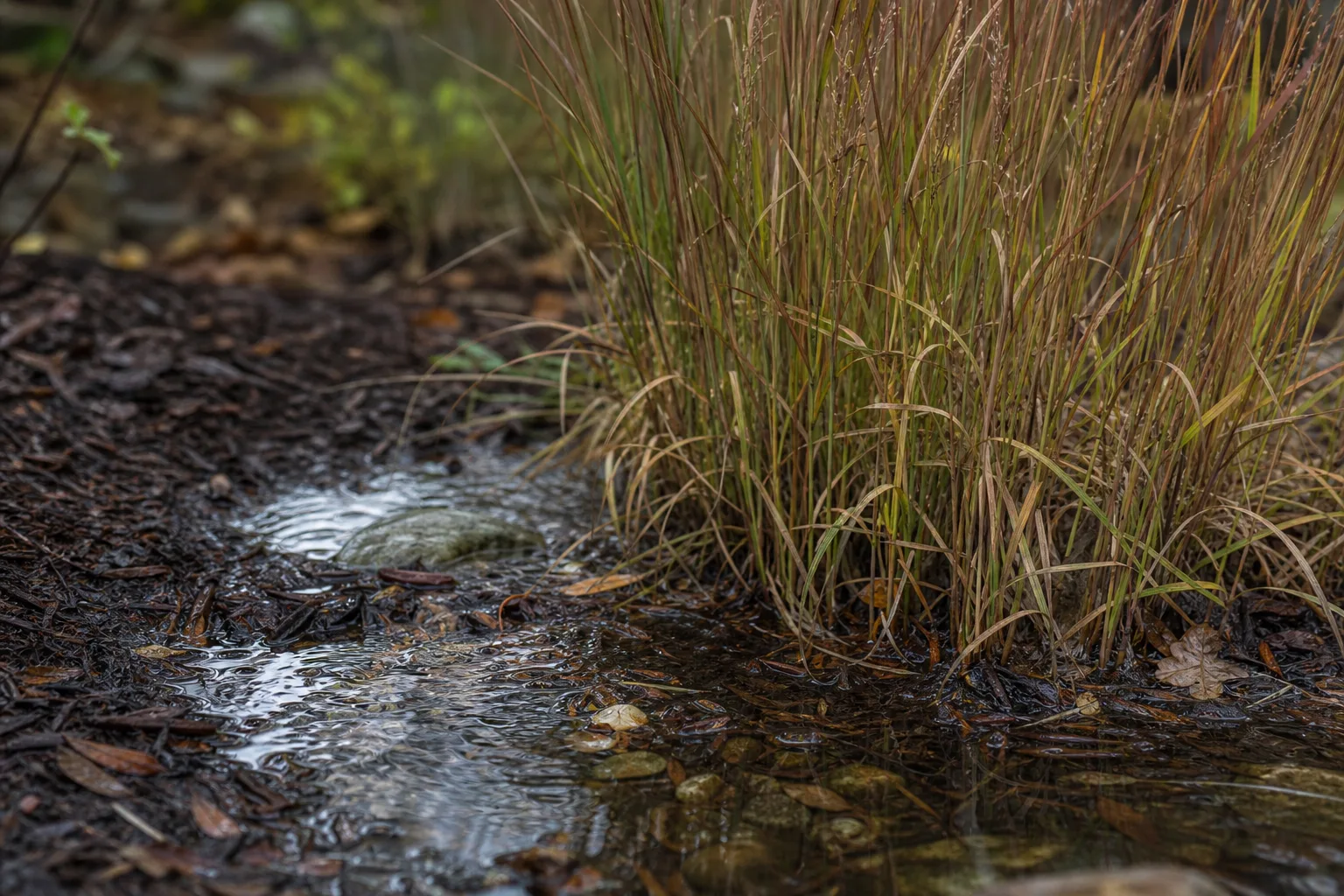
A rain garden or bioswale is worth building on a small lot if it catches water before that water reaches the street. My position is simple: infiltrate the runoff on your property instead of piping it away, but choose a shallow rain garden for most compact yards and reserve a bioswale for a long, narrow drainage path.
Is a rain garden or bioswale better for a small lot?
A rain garden is usually better for a small lot because it fits a shallow basin into the natural low point, while a bioswale needs a longer strip to move and spread water. Both features slow runoff, hold it briefly, and let it soak into the ground instead of sending it down the curb. The American Littoral Society describes bioswales as long, shallow planted dips.
Choose a rain garden if your downspout, patio, or driveway sends water toward one low corner. A typical residential basin is 4 to 8 feet wide and 6 to 12 feet long, which is a workable footprint beside a walk or lawn.
Choose a bioswale if runoff crosses a side yard in a line, especially where the available planting area is at least 4 feet wide and 12 feet long. Its long shape slows flow better than a round hole, but it takes more grading and gives you less room for a mistake.
A rain garden can look like a planted bed. Its trade-off is that the low spot may hold water for a short time after a storm. A bioswale can look more like a deliberate drainage channel, and its trade-off is more excavation, more edging, and more opportunities for water to find one fast-moving rut.
Where should you put a rain garden this fall?
Put the rain garden at the natural low point where roof or pavement runoff already wants to collect, on level or gently sloping ground, with the inlet arranged to spread water across the basin. Do not build it where water already stays ponded, because the feature needs soil that can receive and release stormwater rather than remain saturated.
Stand outside today and watch the ground after the next rain. Follow the dark line of wet soil, the place where mulch collects, and the edge where a downspout discharge has cut a small channel. That pattern is more honest than the property sketch.
In Central Texas, test the digging before you commit. Caliche or limestone may stop a shovel 8 inches down, and black clay can swell, shrink, and move whatever you set on it over one wet winter. If a rock bar spends two hours making a hole that is still too shallow, the site is telling you to move the garden or reduce its size.
Keep the inlet away from the foundation and make sure the overflow has a safe route toward lawn or an existing drainage path. The rain garden is not a foundation drain, and it is not permission to aim a downspout at the house. Gravity remains undefeated.
How much water should a small rain garden hold?
Calculate the design volume by multiplying the impervious contributing area by 0.62 gallons per square foot for a 1-inch storm, then size the basin to hold 75 to 100 percent of that amount. A 200-square-foot roof section therefore contributes about 124 gallons, so the basin must be sized to receive most of that water without overtopping.
Measure the roof, patio, or driveway area that drains toward the feature, not the entire lot. A 200-square-foot roof section may be only one face of the house, and counting the whole roof will make a small basin look falsely undersized.
For a typical small-lot installation, begin with the research range of 4 to 8 feet wide and 6 to 12 feet long. Then check the volume created by the depth and soil mix. A broad, shallow basin is safer to mow around and easier to plant than a narrow pit with steep sides.
The target is not permanent storage. Water should enter, spread, and infiltrate. If the basin still has standing water 48 hours after a normal storm, inspect compacted soil, sediment at the inlet, and the drainage rate before adding more plants.
What soil mix should you use in the basin?
Use a 6-to-12-inch-deep basin lined with native-soil-grade material that drains at 1 to 5 inches per hour, then fill it with 50 percent sand, 30 percent compost, and 20 percent topsoil. This mix provides pore space for infiltration and enough organic matter for roots, but it must be blended evenly instead of dumped in separate layers.
The sand fraction helps create room for water to move. Its trade-off is cost and labor, especially if the site is reached through a gate or across an existing lawn. Compost supports root growth and soil structure, but it settles as it breaks down, so the finished grade should sit slightly proud of the surrounding soil before mulch is added.
Topsoil supplies mineral soil for the planting mix, but a thick layer of poor topsoil can compact and slow infiltration. Do not create a buried bathtub with plastic, landscape fabric, or a solid liner. The research calls for native-soil-grade material that drains at the stated rate, not a sealed container.
Test the prepared basin with a hose before planting. Spread water from the inlet, watch where it moves, and repair any low groove that sends water straight across the basin. Everyone says a rain garden is just a hole with plants. In practice, the grade does the work.
How should you grade and build the inlet and outlet?
Grade the basin with a 2 to 3 percent slope toward the inlet and a gentle 1 to 2 percent outlet slope, so water spreads into the planting area without ponding in one corner. Use permeable stone, brick, or landscape timbers to retain soil and define the edges, while keeping a safe overflow route.
A 2 percent slope changes 2 inches over 8 feet. Mark that change with stakes and string before you excavate, because your eye will lie once the ground is disturbed. The inlet should release water across the basin, not dump it into a single point.
Stone edging holds its shape and lets some water pass, but it can shift on expansive black clay. Brick gives a clean edge, but joints can open when the soil moves. Landscape timbers are easy to install, but they eventually rot and can trap sediment along the low side.
Use the least structure that keeps soil in place. The San Antonio River Authority explains low-impact development as managing stormwater on site, and that principle matters here: the feature should slow and spread water, not turn a garden bed into a hard engineered chute.
Which plants tolerate both storm saturation and dry soil?
Plant a mixed community of native or well-adapted species that can handle wet soil during storms and periodic dry-down afterward. Swamp milkweed, blue flag iris, cardinal flower, black-eyed Susan, coneflower, little bluestem, and switchgrass fit that job, while Japanese painted fern and fountain grass add texture with more site-specific trade-offs.
Put the plants in zones rather than scattering them randomly. Swamp milkweed and blue flag iris belong in the wetter lower basin, but swamp milkweed can look bare after flowering and blue flag iris may struggle if the basin dries too hard. Cardinal flower adds strong color, yet it is less forgiving of extended dry conditions than the grasses.
Black-eyed Susan and coneflower handle the drier shoulder better than the basin floor. Black-eyed Susan can reseed more freely than you want, while coneflower may look tired after a hot, dry August without irrigation. Little bluestem stabilizes soil with a narrow form, but it does not provide the broad mass some homeowners expect from a shrub.
Switchgrass has deep fibrous roots and strong structure, but mature clumps can become large for a 4-foot bed. Japanese painted fern brings a softer leaf texture, but it needs more consistent moisture and shade than the open edge. Fountain grass supplies texture, but it is not my first choice for a native-focused basin because its ornamental appeal does not erase its trade-off in regional fit.
For more plant options, compare mature size and moisture tolerance in the plant database. Plant in fall while the soil is moist, then mulch 2 to 3 inches with shredded hardwood or pine bark. Hardwood mulch lasts longer but can mat at the inlet; pine bark is lighter and breaks down sooner.
Who is a rain garden or bioswale actually for?
A rain garden suits a homeowner with a low corner, a downspout or paved area that sheds water, and enough room for a 4-by-6-foot basin without blocking access. A bioswale suits a long side yard with a visible drainage line. Neither suits a foundation edge, a permanently wet hole, or a site where rock prevents the required depth.
This is a good fall project if you can observe the lot before winter and plant while the soil is workable. It is not a good project if you need the yard finished in one afternoon or if the only possible location is against the house.
You should also ignore the idea if every storm already floods the neighboring property. First solve the larger grading problem and confirm where overflow can go. A small planted basin can reduce runoff, but it cannot absorb an entire failed drainage system.
If you are unsure whether your shape is a basin or a swale, sketch the water path and mark the low point. You can also get a concept for your yard before bringing in soil, because a pretty drawing is cheaper than moving 2 cubic yards of wet clay twice.
| Option | Best small-lot use | Honest downside |
|---|---|---|
| Rain garden | One low corner receiving roof or pavement runoff | Takes up a concentrated area and may briefly hold visible water |
| Bioswale | Long, narrow side yard where water travels across the property | Needs more grading, length, and maintenance along the flow path |
How do you plant and maintain it after construction?
Plant the basin in fall when the soil is moist but not waterlogged, apply 2 to 3 inches of shredded hardwood or pine bark, and inspect the feature after every major storm for the first season. Remove sediment at the inlet, restore eroded soil, re-mulch annually, and replace dead plants before bare ground becomes a flow channel.
Space plants according to mature size rather than the size of the nursery pot. Crowding may look full on planting day, but it creates competition for water during dry weather and hides sediment buildup. Leave enough access to reach the inlet without stepping through the wettest planting zone.
The first storm is a test, not a final exam. Look for water bypassing the basin, mulch washing into the outlet, or a single channel forming through the plants. Stone check dams can slow runoff on a slope, while a level or gently sloped lot usually needs better spreading at the inlet instead.
In Austin, set drip irrigation on a timer during the first growing season because August can bring five weeks over 100 degrees. Drip is efficient, but it adds a line to inspect and does not excuse choosing plants that can handle dry-down. The garden should become less dependent on supplemental water as roots establish.
What are the most common small-lot mistakes?
The most common mistakes are putting the basin beside the foundation, making it too deep, ignoring the soil drainage rate, sending water through one narrow channel, and planting species that tolerate wet feet but fail during dry weeks. A successful feature is shallow, broad, planted, and connected to a safe overflow route.
A deep hole is not automatically a better rain garden. It can stay saturated, collapse at the edges, and become difficult to maintain. A shallow 6-to-12-inch depression gives water room to spread while keeping the planting accessible.
Another mistake is treating mulch as the drainage system. Mulch slows splash and suppresses weeds, but it can wash into the inlet and reduce capacity. Inspect it after storms and keep the inlet open enough for water to fan across the basin.
I learned the soil lesson from my father's tomatoes in a twelve-foot strip of clay along our New Jersey driveway, where every shovel hit a different argument with the ground. Central Texas is less sentimental about it. Here, I test the hole first, because caliche and limestone do not care about the planting plan.
What questions do homeowners ask before building one?
A small stormwater garden raises practical questions about size, plants, soil, standing water, and whether the project belongs on a particular lot. The direct answers are below, and each one starts with the condition that matters most: where the water comes from, where it can go, and how quickly the soil receives it.
Can a rain garden work on black clay?
Can a rain garden work on black clay? Yes, but only after you confirm the soil can drain at 1 to 5 inches per hour and build the specified 50 percent sand, 30 percent compost, and 20 percent topsoil mix. Black clay swells and shrinks, so keep the basin shallow, provide overflow, and expect edging to move over time.
How deep should a small rain garden be?
How deep should a small rain garden be? Make the basin 6 to 12 inches deep, with gentle grades that spread water instead of concentrating it. A deeper excavation is not automatically better because it can stay saturated and become hard to maintain. Size the footprint to hold 75 to 100 percent of the 1-inch design storm.
How long can water stay in a rain garden?
How long can water stay in a rain garden? Water should infiltrate rather than remain permanently ponded, so inspect the basin if standing water remains 48 hours after a normal storm. Check for compacted soil, sediment at the inlet, and a blocked outlet before changing the plants or adding more soil.
Can I plant ornamental grass in a bioswale?
Can I plant ornamental grass in a bioswale? Yes, fountain grass can provide texture, but I would favor little bluestem and switchgrass for a native-focused planting because they stabilize soil with deep fibrous roots. Fountain grass has a trade-off in regional fit, while switchgrass can become too large for a narrow 4-foot planting strip.
Should I build a bioswale beside my house?
Should I build a bioswale beside my house? No, not as the first choice for roof runoff beside a foundation. Put the feature at the natural low point with a safe overflow route, and use a rain garden for a compact receiving area. A bioswale needs a long, shallow path and careful grading to prevent water from moving toward the house.
What should I do to a rain garden in fall?
What should I do to a rain garden in fall? Plant while the soil is moist but not waterlogged, apply 2 to 3 inches of mulch, clear sediment from the inlet, and inspect the basin after the next storm. Fall is also the right time to mark the drainage pattern, because fresh runoff shows where the lot is actually sending water.
Want a plan for your own yard?
Tell us the space and we will put a planting plan together for it. Start at get my concept, or browse what actually grows where you are over on plants.
Frequently asked questions
Can a rain garden work on black clay?
Can a rain garden work on black clay? Yes, but only after you confirm the soil can drain at 1 to 5 inches per hour and build the specified 50 percent sand, 30 percent compost, and 20 percent topsoil mix. Black clay swells and shrinks, so keep the basin shallow, provide overflow, and expect edging to move over time.
How deep should a small rain garden be?
How deep should a small rain garden be? Make the basin 6 to 12 inches deep, with gentle grades that spread water instead of concentrating it. A deeper excavation is not automatically better because it can stay saturated and become hard to maintain. Size the footprint to hold 75 to 100 percent of the 1-inch design storm.
How long can water stay in a rain garden?
How long can water stay in a rain garden? Water should infiltrate rather than remain permanently ponded, so inspect the basin if standing water remains 48 hours after a normal storm. Check for compacted soil, sediment at the inlet, and a blocked outlet before changing the plants or adding more soil.
Can I plant ornamental grass in a bioswale?
Can I plant ornamental grass in a bioswale? Yes, fountain grass can provide texture, but I would favor little bluestem and switchgrass for a native-focused planting because they stabilize soil with deep fibrous roots. Fountain grass has a trade-off in regional fit, while switchgrass can become too large for a narrow 4-foot planting strip.
Should I build a bioswale beside my house?
Should I build a bioswale beside my house? No, not as the first choice for roof runoff beside a foundation. Put the feature at the natural low point with a safe overflow route, and use a rain garden for a compact receiving area. A bioswale needs a long, shallow path and careful grading to prevent water from moving toward the house.
What should I do to a rain garden in fall?
What should I do to a rain garden in fall? Plant while the soil is moist but not waterlogged, apply 2 to 3 inches of mulch, clear sediment from the inlet, and inspect the basin after the next storm. Fall is also the right time to mark the drainage pattern, because fresh runoff shows where the lot is actually sending water.
Free, no obligation
Ready to design your dream landscape? Start here.
Tell us where you are and we will start a free profile for you, with plants that actually survive your climate and a real sense of what the build would cost.