
How to Prune Kiwi and Hardy Kiwi Vines Before They Take Over
Kiwi vines need hard winter pruning and repeated summer cuts, or they become tangled, shaded, and impossible to harvest in two seasons. Here is what to cut this fall, what to leave for winter, and how to keep fuzzy kiwi and hardy kiwi trained on a manageable trellis.
September 20, 2026
By Diego Navarro
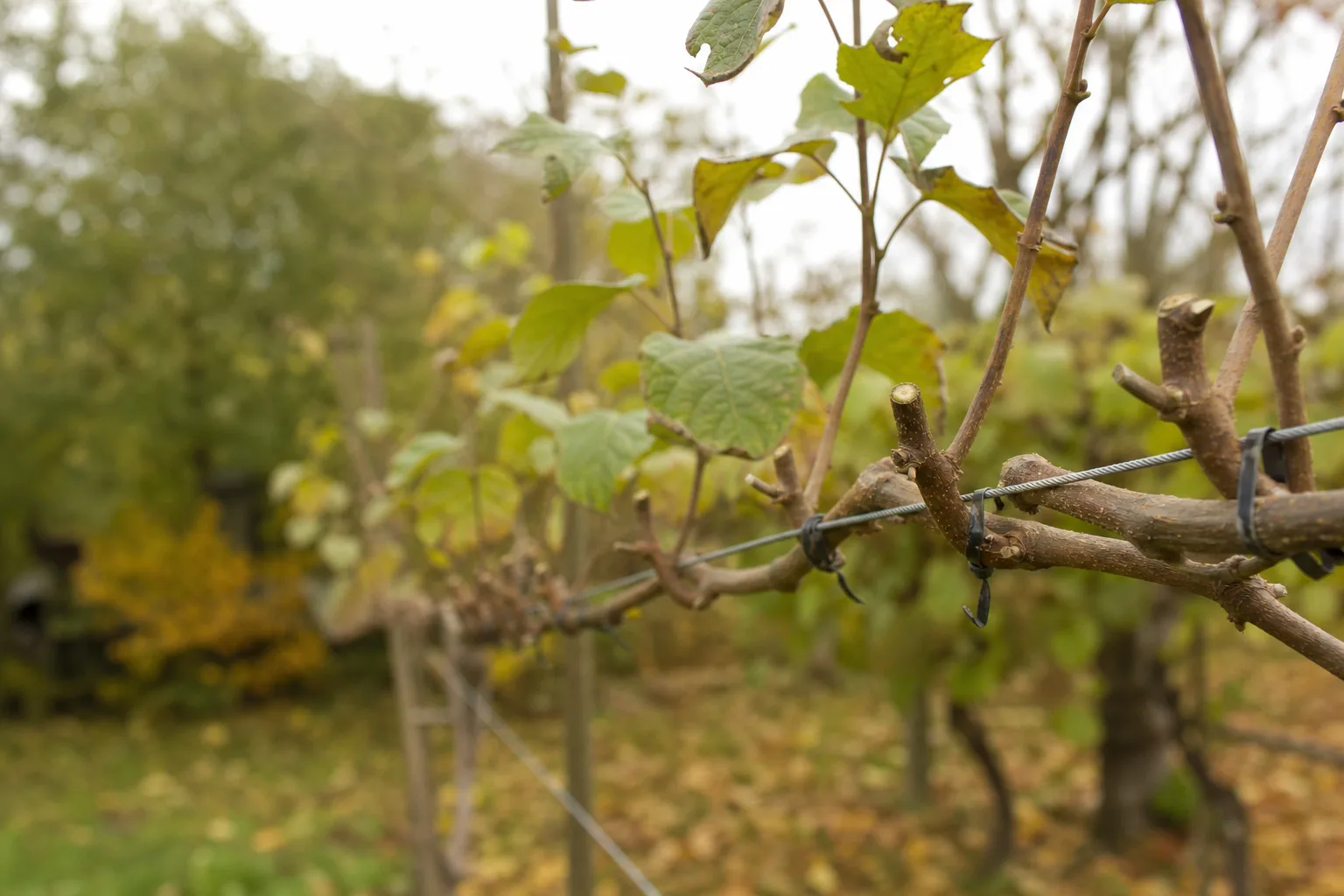
Kiwi vines are not polite plants. If you leave a fuzzy kiwi or hardy kiwi alone, it can become an unharvestable tangle in two growing seasons, so my position is simple: prune hard in winter, cut again through summer, and keep the framework tied to a sturdy trellis at about 10 to 12 feet. Fall is for cleanup and planning, not the main haircut.
Should I prune kiwi vines in fall?
You should clean up kiwi vines in fall, but save the heavy pruning for dormancy, roughly December through March in most U.S. gardens. Remove obvious tangles, dead-looking pieces, suckers, and vines hanging into walkways now, then wait for the leaves to fall before cutting the main framework so heavily that you may lose next season's fruiting wood.
The fall job is visibility. Once the leaves drop, you can see which canes actually belong to the cordon, which ones are wrapped around neighbors, and which shoots have crossed the trellis wire.
Do not turn a fall cleanup into a complete haircut just because the vine looks wild. Kiwi responds with more vigorous growth after hard cuts, and the plant already has plenty of enthusiasm. It does not need encouragement.
Tie useful canes loosely with soft garden ties, and remove only what is clearly dead, broken, entangled, or growing where people will walk. A short tie now can save an hour of sorting in January.
What should I do to a kiwi vine this fall?
This fall, remove fallen fruit and loose debris, cut out dead or broken wood, separate vines from one another, and mark the strongest one-year-old canes for winter selection. Keep the main cordons and trellis wires visible, but leave most living wood until dormancy, when the plant can be pruned with a clear view of its fruiting structure.
Start at the ground and work upward. Remove suckers from the base and water sprouts that shoot straight up from older wood, because both steal space without giving you a useful, orderly framework. Hardy kiwi is especially vigorous, so a few missed shoots become a problem quickly. Penn State Extension describes summer pruning and training as necessary because of that high vigor.
Then inspect the trellis. A kiwi vine is heavy, and a decorative fence or light arbor can bow under the load. If the wire is loose, fix the support before winter pruning, because tying a large cut vine to a failing structure is how gardeners get a second project for free.
You can use the plant database to check whether your vine is fuzzy kiwi, hardy kiwi, or another Actinidia before you choose a pruning pattern. The name matters less than the growth habit here, but the winter cold where you live still matters.
When is heavy kiwi pruning best?
Heavy kiwi pruning is best during winter dormancy, generally from December through March, after the leaves have fallen and before strong spring growth begins. Use that dormant window to cut back the old framework, retain the strongest one-year-old canes, and space the remaining fruiting spurs about 6 to 12 inches apart.
The exact date moves with your weather. In Central Texas, I would not blindly copy a December calendar date if the vine is still active or a sharp freeze is coming; I would wait until the leaves are down and choose a dry day when the cuts can dry cleanly.
Up north, winter pruning may happen later, especially where the vine stays dormant through February. The useful rule is not a magical date. The useful rule is dormant wood, a clear structure, and no rush before a hard weather swing.
Use clean, sharp bypass pruners for small canes and a lopper for older wood. Disinfecting tools between visibly diseased cuts is sensible, but the bigger mistake is making ragged cuts with a dull blade and leaving torn stubs that die back.
How much old kiwi growth should I remove?
Remove up to 70 percent of old kiwi growth during dormant pruning, keeping only the strongest one-year-old canes that are at least one-quarter inch thick and well placed on the trellis. Leave fruiting spurs 6 to 12 inches apart, because a crowded row produces shade and tangles instead of an easy harvest.
Do not count every inch of vine as equally valuable. A thick, healthy cane tied along the cordon is useful; three skinny shoots wrapped around it are not. Cut weak, damaged, badly placed, and crossing wood first.
Keep the strongest canes that can be tied horizontally or in a clean fan without crossing one another. Cut those selected canes back to the space your trellis gives you, then remove extra shoots until the fruiting points are visibly separated.
A quarter-inch minimum is a practical filter, not a trophy requirement. A slightly thinner cane in an excellent position may beat a thick cane that hangs six feet outside the trellis, but most pencil-thin, shaded growth is not worth preserving.
Everyone says to leave more branches for more fruit. In practice, kiwi gives you more fruiting wood than you can manage, and that excess blocks light, limits airflow, and makes picking miserable. Grow Organic makes the same case for regular pruning, linking dense unchecked growth with poor light, airflow, and fruit quality.
How do summer cuts keep kiwi harvestable?
Summer pruning keeps kiwi harvestable by shortening flowering shoots to four to six leaves beyond the last flower and removing water sprouts, suckers, and new vines that become entangled. Start after flowering, then repeat the inspection through summer, because one cut is not enough for a vine this vigorous.
Find the last flower on a fruiting shoot and count four to six leaves past it. Cut there. This keeps the fruiting section close to the framework instead of allowing a long whip to run across the trellis and into the nearest tree.
Remove water sprouts that rise aggressively from older wood, especially those shading the fruiting zone. Remove suckers at the base before they become thick enough to compete with the cordon. If a shoot has wrapped around another cane, separate it early or cut the offender rather than pulling until both vines tear.
Summer pruning feels wrong if you grew up protecting every green leaf. My father grew tomatoes in a twelve-foot strip of New Jersey clay, and I learned early that a plant can be alive and still be poorly managed. Kiwi is the same lesson with longer arms.
Who should grow and prune kiwi this way?
This pruning system suits homeowners who have a strong trellis, several short summer check-ins, and a dormant winter window for heavy cutting. It does not suit a vine planted beside a weak fence, a narrow path that must stay clear, or a gardener who cannot reach the upper framework, because kiwi will outgrow those situations before the second harvest.
A fuzzy kiwi has larger, familiar grocery-store fruit, but it needs a suitable climate and a structure strong enough for a vigorous perennial vine. Its trade-off is that the fruiting and pruning system demands room, support, and regular work.
Hardy kiwi produces smaller, smooth-skinned fruit and is valued for cold tolerance, but it is no low-maintenance groundcover. Its trade-off is exactly the vigor that helps it cover a trellis, because that same growth can bury the fruiting wood under a green knot.
If you are choosing between a small arbor and a dedicated fruit trellis, I would choose the dedicated trellis. An arbor invites you to let the vine run overhead, which sounds romantic until you are standing on a ladder with a basket and no idea which cane is holding the fruit.
You can get a concept for your yard before planting if you are unsure whether the trellis, access path, and pruning height will work together. Draw the harvest position first. Then buy the vine.
Should fuzzy kiwi and hardy kiwi be pruned differently?
Fuzzy kiwi and hardy kiwi should both receive heavy dormant pruning and repeated summer pruning, because both can become overly vigorous and tangled. The difference is not a softer pruning rule for hardy kiwi; its cold tolerance does not make it self-managing, and its smaller fruit does not excuse a weak trellis or neglected summer growth.
Hardy kiwi is often grown in colder regions and can reach roughly 10 feet at maturity, but mature height does not tell you how much lateral growth will cover the trellis. The reported growing range for hardy kiwi is broad, from zones 3 through 9, yet that tolerance still comes with a vigorous vine that needs training.
Fuzzy kiwi may be the choice if you want full-sized fruit, while hardy kiwi may fit better where winter cold is a serious constraint. Either way, select canes by strength and position, not by sentiment. A vine does not know that you liked last year's branch.
For either type, keep the framework around 10 to 12 feet tall so pruning and harvest stay practical. Taller is not automatically better. It is mostly farther away.
| Pruning approach | Best use | Honest downside |
|---|---|---|
| Heavy dormant pruning from December through March | Resetting an overgrown vine and selecting strong fruiting wood | Removes a large amount of living growth and takes time to sort correctly |
| Repeated summer pruning after flowering | Keeping shoots short, open, and harvestable | Requires several visits during the growing season |
| Minimal pruning and letting the vine run | Covering a large structure where fruit harvest is secondary | Becomes tangled, shaded, and difficult to harvest within about two seasons |
What does a simple kiwi pruning calendar look like?
A simple kiwi calendar starts with fall cleanup, moves to heavy dormant pruning from December through March, and returns to summer cuts after flowering. In fall, clear tangles and repair the trellis; in winter, remove up to 70 percent of old growth; in summer, shorten fruiting shoots and remove new problem growth before it hardens.
Fall, now: remove dead or broken pieces, base suckers, obvious water sprouts, and vines hanging into access areas. Tie useful canes loosely and photograph the trellis before the leaves disappear, because memory is a poor garden record.
December through March: choose the strongest one-year-old canes, favoring wood at least one-quarter inch thick. Cut out weak and crossing wood, remove up to 70 percent of old growth, and leave fruiting spurs 6 to 12 inches apart.
After flowering: cut each fruiting shoot back to four to six leaves beyond the last flower. Remove fresh water sprouts, suckers, and entangled shoots every few weeks rather than waiting for one heroic pruning day.
Late summer: check that the canopy remains tied, the fruiting wood is visible, and the vine has not escaped over the top of the trellis. Stop treating the vine like a hedge. It is a fruiting framework.
What are the most common kiwi pruning mistakes?
The most common kiwi pruning mistakes are waiting until spring growth is dense, leaving every thick cane, ignoring the trellis, and making only one summer cut. These errors let vigorous shoots shade fruiting wood and create a tangle that is technically alive but functionally unharvestable, often by the second season.
A late spring rescue cut can remove the very shoots you wanted for fruit, while a timid winter cut leaves too many canes competing for the same wire. The answer is not more fertilizer or a larger ladder. It is selection.
Another mistake is fertilizing heavily to force recovery. Penn State recommends cautious feeding because kiwi roots burn easily, with no fertilizer in the planting year and a measured increase beginning in the second spring. Read the extension guidance before feeding a young vine.
Finally, do not let the vine dictate the harvest height. Set the trellis and cordons where you can reach them, then prune every season to preserve that decision. A kiwi vine will gladly redesign the garden without asking.
What questions do gardeners ask about pruning kiwi vines?
Gardeners usually want to know whether fall is too early, how much wood to remove, and whether hardy kiwi gets a lighter treatment than fuzzy kiwi. The direct answers are below, and each one comes back to the same rule: kiwi stays productive when you replace tangled excess with a small, well-spaced framework.
Should I prune kiwi vines in fall?
You should do light cleanup in fall, but save heavy kiwi pruning for dormancy, usually December through March. Remove dead or broken wood, suckers, water sprouts, and dangerous tangles now, then select the strongest one-year-old canes after the leaves fall. A complete fall haircut can remove useful fruiting wood before you can see the framework clearly.
How much old growth should I remove from a kiwi vine?
Remove up to 70 percent of old growth during dormant pruning, while keeping strong one-year-old canes at least one-quarter inch thick and spacing fruiting spurs 6 to 12 inches apart. Remove weak, crossing, damaged, and badly positioned wood first. The goal is a clear fruiting framework, not the largest possible pile of prunings.
When should I prune hardy kiwi?
Prune hardy kiwi heavily during winter dormancy, roughly December through March, then prune it again several times during summer after flowering. Hardy kiwi is cold-tolerant, but that does not make it self-managing. Its vigorous growth still needs selected canes, a sturdy trellis, and shoots shortened to four to six leaves beyond the last flower.
How far back should I cut kiwi shoots after flowering?
Cut kiwi shoots back to four to six leaves beyond the last flower after flowering. This keeps fruiting growth near the trellis and reduces the long, loose shoots that cross wires or wrap around neighboring canes. Repeat the check through summer, because kiwi can produce new water sprouts and entangling vines after your first cut.
Can fuzzy kiwi and hardy kiwi use the same pruning method?
Fuzzy kiwi and hardy kiwi can use the same basic pruning method: heavy dormant pruning, selected one-year-old canes, 6 to 12 inches between fruiting spurs, and repeated summer cuts. Their fruit and cold tolerance differ, but neither vine benefits from being left alone. The trade-off for vigorous coverage is regular pruning work.
What height should a kiwi trellis be?
Keep a kiwi trellis and trained vine around 10 to 12 feet tall so the framework remains reachable for pruning and harvest. A taller structure may hold more vine, but it also moves fruit and pruning cuts beyond comfortable reach. Use a strong support system, because mature kiwi growth can overwhelm a light fence or decorative arbor.
Want a plan for your own yard?
Tell us the space and we will put a planting plan together for it. Start at get my concept, or browse what actually grows where you are over on plants.
Frequently asked questions
Should I prune kiwi vines in fall?
You should do light cleanup in fall, but save heavy kiwi pruning for dormancy, usually December through March. Remove dead or broken wood, suckers, water sprouts, and dangerous tangles now, then select the strongest one-year-old canes after the leaves fall. A complete fall haircut can remove useful fruiting wood before you can see the framework clearly.
How much old growth should I remove from a kiwi vine?
Remove up to 70 percent of old growth during dormant pruning, while keeping strong one-year-old canes at least one-quarter inch thick and spacing fruiting spurs 6 to 12 inches apart. Remove weak, crossing, damaged, and badly positioned wood first. The goal is a clear fruiting framework, not the largest possible pile of prunings.
When should I prune hardy kiwi?
Prune hardy kiwi heavily during winter dormancy, roughly December through March, then prune it again several times during summer after flowering. Hardy kiwi is cold-tolerant, but that does not make it self-managing. Its vigorous growth still needs selected canes, a sturdy trellis, and shoots shortened to four to six leaves beyond the last flower.
How far back should I cut kiwi shoots after flowering?
Cut kiwi shoots back to four to six leaves beyond the last flower after flowering. This keeps fruiting growth near the trellis and reduces the long, loose shoots that cross wires or wrap around neighboring canes. Repeat the check through summer, because kiwi can produce new water sprouts and entangling vines after your first cut.
Can fuzzy kiwi and hardy kiwi use the same pruning method?
Fuzzy kiwi and hardy kiwi can use the same basic pruning method: heavy dormant pruning, selected one-year-old canes, 6 to 12 inches between fruiting spurs, and repeated summer cuts. Their fruit and cold tolerance differ, but neither vine benefits from being left alone. The trade-off for vigorous coverage is regular pruning work.
What height should a kiwi trellis be?
Keep a kiwi trellis and trained vine around 10 to 12 feet tall so the framework remains reachable for pruning and harvest. A taller structure may hold more vine, but it also moves fruit and pruning cuts beyond comfortable reach. Use a strong support system, because mature kiwi growth can overwhelm a light fence or decorative arbor.
Free, no obligation
Ready to design your dream landscape? Start here.
Tell us where you are and we will start a free profile for you, with plants that actually survive your climate and a real sense of what the build would cost.