
Why You Should Observe Your Garden for a Full Year Before Major Earthworks
Before you move soil, watch water, shade, wind, wildlife, and wild plants through every season. A year of observation can prevent expensive paths, drains, swales, beds, and trees from being placed where the site will fight them.
September 28, 2026
By Valeria Navarro
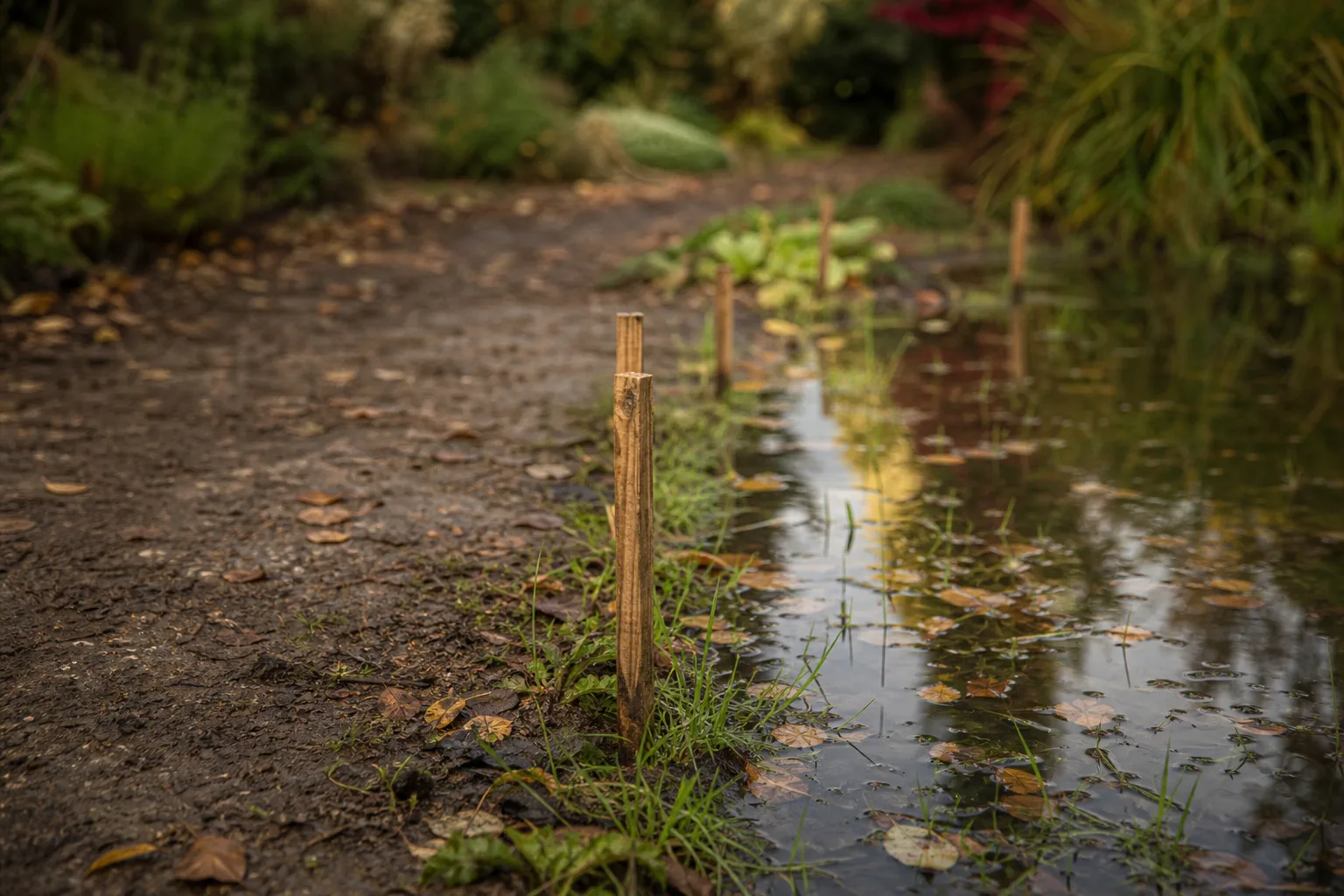
Start with observation, not a machine. If you are standing in the garden this fall, give yourself until next fall before you commit to major earthworks, permanent paths, big trees, or a water system. The cheapest permaculture tool is patience because one year of watching can keep you from paying twice for a bad decision.
Should I really wait a full year before changing my garden?
Yes, wait a full growing season before making permanent decisions about trees, paths, water, or buildings, especially if the project involves moving soil. A full year shows you wet and dry conditions, changing shade, seasonal wind, plant behavior, and the places where water repeatedly travels instead of merely showing you one pleasant afternoon in October. Observe and Interact makes the same recommendation.
That does not mean you must do nothing. Pull invasive weeds by hand if they threaten existing plants. Repair a dangerous step. Add a temporary chair, hose, or marked walking route so you can use the garden while you study it.
I have killed plants by designing from a single visit. In Miami, sandy fill drained before I finished watering. In Austin, clay can hold water, then set like a brick, and February 2021 taught every gardener here that a warm-looking site can still turn brutal.
The pause is not indecision. It is site work without the excavator bill.
What should I observe in the garden this fall?
This fall, observe where water sits, where it runs, where shade lands, how wind moves, what soil does underfoot, and which wild plants appear without your help. Record the same features after rain, during a dry spell, on a cold morning, and at midday, because one view cannot reveal a site’s full pattern.
Begin with a notebook and a simple sketch. Mark the house, fence, mature trees, utilities, existing beds, slopes, gates, and any place where people already walk.
After every meaningful rain, note puddle locations and how long they last. A puddle that disappears in two hours is different from one that remains for three days, especially if you are considering a tree or a buried drain nearby.
Watch the sun in November, January, April, and July. A patio that feels bright in fall may sit under afternoon shade once a nearby tree leafs out. If you plan to cook outside, place a temporary chair where the future kitchen garden might go and notice whether you actually want to stand there.
Photograph the same four corners each month. The pictures will show changes your memory smooths over.
How do I track water before building earthworks?
Track water by visiting the garden during and after rain, marking flow lines, puddles, erosion, and drying time before you shape the ground. Observing for an entire year while water is present is recommended for understanding diffused surface water, so do not place a swale, berm, drain, pond, or path from a single storm pattern. Choosing the Best Location for Your Garden explains why.
Use wooden stakes only as temporary markers. They are cheap and visible, but they rot, move, and can become a tripping hazard if you leave them scattered. A string line can help you trace a suspected flow path, but it shows your guess, not the final answer.
After a storm, walk from the highest part of the yard toward the lowest. Look for muddy fans, exposed roots, washed mulch, tiny channels, and sediment caught against grass. In Central Texas, caliche, limestone, and thin soil can make water behave very differently within a few feet.
Everyone says to design around the first obvious drainage line. In practice, several smaller paths may combine only during a hard storm, while ordinary rain follows a gentler route, because soil saturation and rainfall intensity change the site’s behavior.
Do not excavate a swale just because the word sounds regenerative. A swale is a level or nearly level ditch with a berm, and its downside is that poor placement can hold water against a foundation, stay wet in heavy clay, or send overflow somewhere you did not intend.
Which observations matter most before moving soil?
The most useful observations are repeated ones: water movement, soil moisture, sunlight, wind, access, existing vegetation, and human movement through the garden. Prioritize patterns that affect safety, drainage, tree survival, and daily use, because a beautiful plan still fails if the path floods, the bed bakes, or nobody wants to carry a basket across the yard.
Keep a weekly record from October through the following September. Use a simple scale for soil: dusty, workable, sticky, puddled, or frozen. You do not need laboratory precision to notice that one bed is workable two days after rain while another stays sticky for a week.
Notice where wild plants gather. Their presence does not give you a complete soil test, and the plants may be responding to mowing, irrigation, or disturbance, but repeated patterns deserve attention before you cover them with imported soil.
Observe the existing Ashe juniper before removing it. It can compete for water and cast dense shade, so it is not automatically the right tree for a food garden, but removing mature cover also changes wind, sun, temperature, and runoff.
Watch deer pressure before choosing new plants. Deer may browse young trees and many tender garden plants, so fencing costs space and money, while ignoring the pressure costs replacement plants and months of growth.
What can I do now without ruining next year’s information?
You can improve access and safety now while keeping the ground mostly unchanged. Mow a temporary route, clear fallen branches, repair hazards, label existing plants, and use removable markers, but postpone grading, deep trenching, large berms, and permanent paving until the site has shown you more than one season.
A temporary mulch layer can reduce mud on a walking route, but mulch needs replenishing and can hide small changes in soil or water movement. Use it on a path you need, not across every square foot of the garden.
A rain barrel can collect roof runoff for later use, but it needs an overflow plan, a stable base, and regular cleaning, and its storage does not replace understanding where water naturally leaves the property. If you install one now, treat it as a temporary experiment and record how quickly it fills.
Compost can improve organic matter over time, but it costs labor, space, and repeated turning or careful moisture management. Do not spread a thick layer everywhere just to make the yard look finished before you know which areas truly need it.
You can also plant short-lived annuals in containers. Containers let you test sunlight and daily access, but they dry faster than ground beds and require more frequent watering, especially during an Austin summer.
Should I wait on paths, trees, and garden beds too?
Yes, wait on permanent paths, large trees, and fixed garden beds when their placement depends on uncertain water, shade, access, or soil information. A temporary arrangement lets you test how you live in the yard before expensive construction locks you into a route or location that looks good on paper but performs badly in July or after a storm.
For paths, walk the route in rain boots after a storm. Mark where your feet naturally go, then check whether that route crosses a puddle, a root, or a place that dries slowly. Gravel is forgiving and relatively easy to move, but it migrates, needs edging, and can be unpleasant for bare feet or wheeled carts.
For trees, mark possible planting spots with pots rather than digging immediately. A potted tree is not a long-term solution because roots can become crowded and watering is constant, but the marker helps you study shade, views, roof clearance, and access for future maintenance.
For beds, use cardboard or temporary edging to outline shapes for several weeks. Cardboard breaks down and can blow away, so it is not a permanent border, but it shows whether the bed blocks a gate or makes you walk an awkward extra fifty feet to the kitchen.
I would rather lose one fall planting season than lose a mature tree after discovering that its roots sit in water through winter.
Who is a full year of observation for, and who should ignore it?
A full year of observation suits homeowners planning major grading, swales, ponds, retaining walls, orchards, food forests, permanent paths, or buildings, and anyone gardening on clay, shallow soil, or a sloped site. Ignore the full pause only for urgent safety repairs, accessibility needs, or small reversible experiments that do not redirect water.
If your yard floods toward the house, act sooner on professional drainage and structural safety rather than waiting for a perfect record. The observation period can continue around the repair, but danger deserves a direct response.
If you rent, observe anyway, but choose movable improvements such as containers, temporary seating, and removable trellises. A trellis gives vertical growing space, but it needs anchoring and can shade nearby plants, so it still deserves a small trial before you fill it with a vigorous vine.
If your project is only a six-foot herb bed in a known sunny patch, a full year may be excessive. Place it temporarily, watch it through one hot month and one wet period, and keep the investment modest.
For a new property with no clear pattern, wait. The larger the machine, the harder the mistake is to undo.
What should I record from fall through next fall?
Record date, rainfall, puddle location, drying time, sunlight, wind, soil condition, wild plants, wildlife pressure, and how people actually use the space. A weekly note plus photographs after major weather events will give you a practical site history by next fall, even if you never create a formal map.
Use this seasonal checklist:
| Season | Watch for | Honest limitation |
|---|---|---|
| Fall, October to November | First rain paths, leaf drop, prevailing wind, comfortable seating locations | Cool weather can make a site seem easier than it is during summer heat |
| Winter, December to February | Slow drainage, freeze exposure, bare-tree shade, saturated soil | A mild winter may not reveal damage from a severe freeze |
| Spring, March to May | Fast growth, April hail exposure, erosion, flowering shade patterns | Spring growth can hide soil surface and make access look better than it is |
| Summer, June to August | Water stress, afternoon heat, irrigation reach, cracking clay, deer browsing | Water restrictions may change what you can maintain, so summer performance costs more to test |
| Early fall, September to October | Which plants recover, where shade returns, final dry-season patterns | One year still cannot predict every extreme weather event |
Mark observations on one map instead of keeping scattered notes. Use separate symbols for water, shade, wind, access, and wildlife. The map will become more useful each month because repeated marks show patterns, while isolated marks stay in their proper place as exceptions.
If you want help matching observations to plants after the season, compare candidates in the plant database. Do not choose a plant only because it survives Austin on a label; every plant still has a cost in water, space, pruning, or protection.
How do I turn a year of watching into a design?
Turn observation into design by ranking repeated patterns, then placing the least flexible elements first. Keep buildings, access routes, drainage safety, and large trees at the top of the list, and fit smaller beds, seating, compost, and decorative planting around what the site consistently does rather than forcing the site to match a sketch.
At the end of each season, review your notes and circle facts repeated at least three times. For example, water crosses the same corner after three storms, the west wall becomes unbearable by June, or deer visit the same opening every evening.
Separate facts from preferences. “The north bed stays damp for four days” is an observation. “I want tomatoes there” is a preference. Tomatoes need warmth and regular care, but their placement also carries a water and disease-management cost, so the sunny location may be worth more than the convenient one.
Choose the design that solves several problems at once. A path can provide access and define a bed, but it costs material and maintenance. A tree can provide shade and habitat, but it also creates roots, leaf cleanup, irrigation needs, and a long-term commitment.
If you want a first layout while your notes are still growing, use the get a concept for your yard tool as a starting point, not a command. Your actual garden gets the final vote.
Is patience really the cheapest permaculture tool?
Yes, patience is usually the cheapest permaculture tool because observation costs little and can prevent expensive earthworks from being placed against the site’s real water, soil, shade, and access patterns. The sources recommend a full growing season or up to a year of watching before permanent decisions, while the cost-saving conclusion is my practical design judgment from that advice.
The sources support the waiting period. They do not literally state that patience is the cheapest tool, so I am making that argument plainly rather than pretending it is a quotation.
A rented excavator costs money by the hour. Imported soil costs money by the load. A relocated path costs labor twice, and a dead tree costs the years you cannot buy back.
This fall, take the notebook outside. Watch one storm. Notice one shadow. Mark one puddle. Do that again in January, April, July, and September, and your future design will be quieter, cheaper, and much harder for the garden to reject.
What are the most common questions about waiting before earthworks?
Waiting is not a rule that forbids all gardening for twelve months. It is a way to match the size of your intervention to the quality of your information, so reversible actions can continue while permanent earthworks wait for repeated evidence.
Should I really wait a full year before changing my garden?
Yes, wait a full growing season before making permanent decisions about trees, paths, water, or buildings, especially if the project involves moving soil. A full year shows wet and dry conditions, changing shade, seasonal wind, plant behavior, and the places where water repeatedly travels instead of merely showing you one pleasant afternoon in October.
How do I track water before building earthworks?
Track water by visiting the garden during and after rain, marking flow lines, puddles, erosion, and drying time before you shape the ground. Observing for an entire year while water is present helps you understand diffused surface water, so do not place a swale, berm, drain, pond, or path from a single storm pattern.
What can I do now without ruining next year’s information?
You can improve access and safety now while keeping the ground mostly unchanged. Mow a temporary route, clear fallen branches, repair hazards, label existing plants, and use removable markers, but postpone grading, deep trenching, large berms, and permanent paving until the site has shown you more than one season.
Should I wait on paths, trees, and garden beds too?
Yes, wait on permanent paths, large trees, and fixed garden beds when their placement depends on uncertain water, shade, access, or soil information. A temporary arrangement lets you test how you live in the yard before expensive construction locks you into a route or location that performs badly in July or after a storm.
Who is a full year of observation for, and who should ignore it?
A full year of observation suits homeowners planning major grading, swales, ponds, retaining walls, orchards, food forests, permanent paths, or buildings, and anyone gardening on clay, shallow soil, or a sloped site. Ignore the full pause only for urgent safety repairs, accessibility needs, or small reversible experiments that do not redirect water.
Is patience really the cheapest permaculture tool?
Yes, patience is usually the cheapest permaculture tool because observation costs little and can prevent expensive earthworks from being placed against the site’s real water, soil, shade, and access patterns. The sources recommend a full growing season or up to a year of watching before permanent decisions, while the cost-saving conclusion is my practical design judgment from that advice.
Want a plan for your own yard?
Tell us the space and we will put a planting plan together for it. Start at get my concept, or browse what actually grows where you are over on plants.
Frequently asked questions
Should I really wait a full year before changing my garden?
Yes, wait a full growing season before making permanent decisions about trees, paths, water, or buildings, especially if the project involves moving soil. A full year shows wet and dry conditions, changing shade, seasonal wind, plant behavior, and the places where water repeatedly travels instead of merely showing you one pleasant afternoon in October.
How do I track water before building earthworks?
Track water by visiting the garden during and after rain, marking flow lines, puddles, erosion, and drying time before you shape the ground. Observing for an entire year while water is present helps you understand diffused surface water, so do not place a swale, berm, drain, pond, or path from a single storm pattern.
What can I do now without ruining next year’s information?
You can improve access and safety now while keeping the ground mostly unchanged. Mow a temporary route, clear fallen branches, repair hazards, label existing plants, and use removable markers, but postpone grading, deep trenching, large berms, and permanent paving until the site has shown you more than one season.
Should I wait on paths, trees, and garden beds too?
Yes, wait on permanent paths, large trees, and fixed garden beds when their placement depends on uncertain water, shade, access, or soil information. A temporary arrangement lets you test how you live in the yard before expensive construction locks you into a route or location that performs badly in July or after a storm.
Who is a full year of observation for, and who should ignore it?
A full year of observation suits homeowners planning major grading, swales, ponds, retaining walls, orchards, food forests, permanent paths, or buildings, and anyone gardening on clay, shallow soil, or a sloped site. Ignore the full pause only for urgent safety repairs, accessibility needs, or small reversible experiments that do not redirect water.
Is patience really the cheapest permaculture tool?
Yes, patience is usually the cheapest permaculture tool because observation costs little and can prevent expensive earthworks from being placed against the site’s real water, soil, shade, and access patterns. The sources recommend a full growing season or up to a year of watching before permanent decisions, while the cost-saving conclusion is my practical design judgment from that advice.
Free, no obligation
Ready to design your dream landscape? Start here.
Tell us where you are and we will start a free profile for you, with plants that actually survive your climate and a real sense of what the build would cost.