
Do Mycorrhizal Fungi Help in a Fall Vegetable Garden?
Mycorrhizal inoculation can help tomatoes, corn, beans, carrots, and other crops that form fungal partnerships, especially in depleted soil. It is a waste of money for brassicas and beets, which do not form the association at all.
October 4, 2026
By Diego Navarro
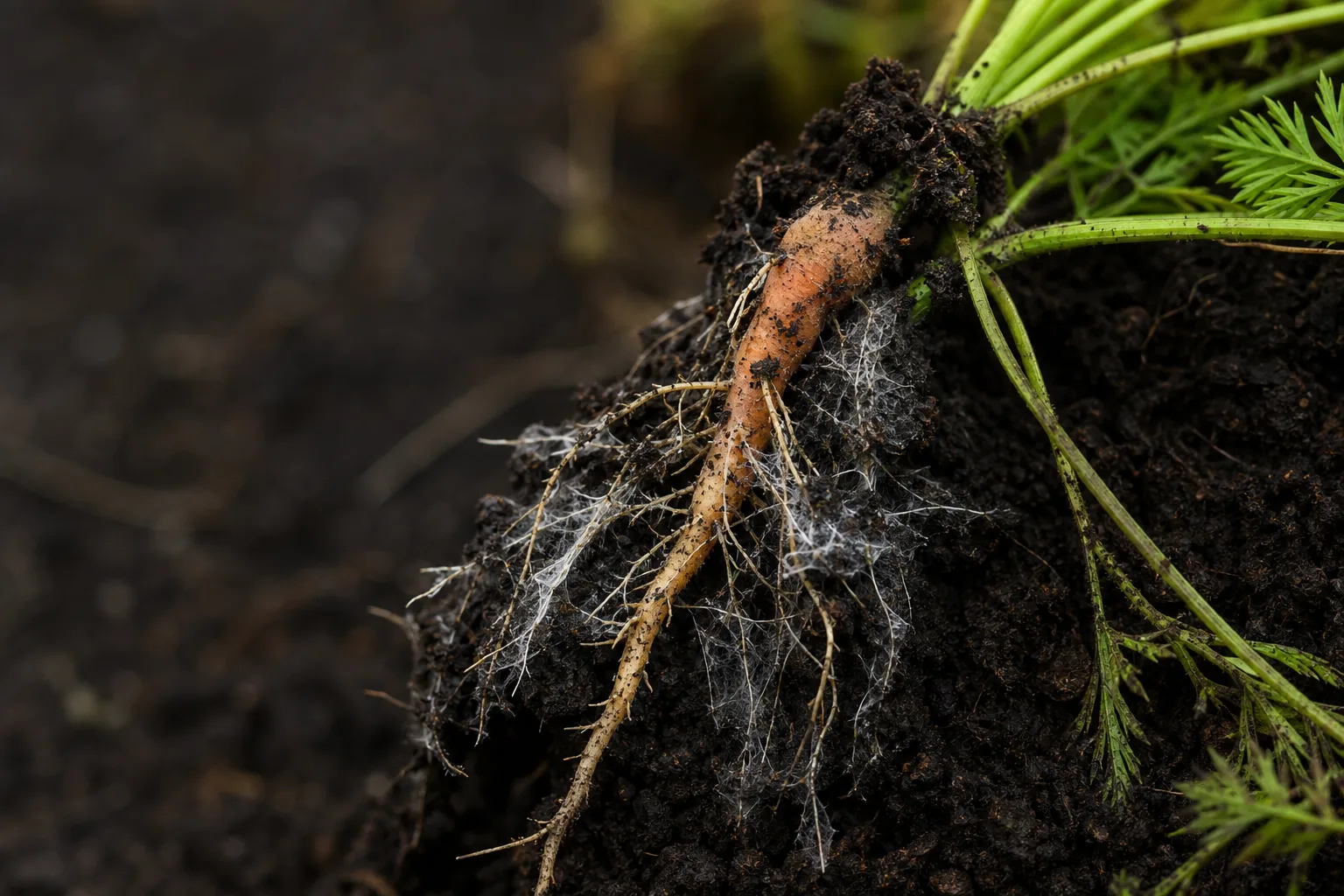
If you are standing in the garden this fall, my position is simple: use mycorrhizal inoculant only for crops that actually form the partnership, and skip it for brassicas and beets. Collards, turnips, radishes, mustard, and garden beets do not form mycorrhizal associations, so adding fungal spores around them buys you a little powder and no useful result. That is the whole argument. The label can be very confident. Soil biology is less impressed.
Do mycorrhizal fungi help fall vegetables?
Mycorrhizal fungi can help fall vegetables that form arbuscular mycorrhizal relationships by extending the effective reach of their roots, improving access to phosphorus and water, and helping seedlings establish. The best opportunity is at planting or transplanting, especially in degraded, heavily fertilized, or freshly disturbed soil. They cannot help a crop that does not host them. Research on mycorrhizal benefits describes fungal hyphae as fine threads that reach beyond ordinary roots while requiring less plant energy than building more root hairs.
In practical terms, I would consider inoculation for carrots or beans in a tired bed, but I would not use it as a general fall garden seasoning. A living fungal network can improve establishment, but only if a compatible root is present and the spores survive contact with the soil.
The biggest benefit is timing. Fungal hyphae can grow faster than young roots, which may help a new seedling reach water and fertility sooner. That matters in Central Texas, where a September bed can look friendly on top while the soil underneath has baked hard for five months.
Which vegetables should receive inoculant this fall?
Crops that form mycorrhizal relationships include tomatoes, corn, beans, carrots, and most vegetables outside the non-mycorrhizal groups. For a fall garden, I would prioritize inoculation for a compatible crop planted into depleted soil, a bed that received heavy fertilizer, or ground that was repeatedly tilled. The treatment is most useful at the root zone, not scattered randomly across the property. A broader crop list is available in this plant database, but check each crop before buying a product.
Tomatoes can benefit, but a fall tomato in Austin still faces heat and disease pressure, so fungi will not fix bad timing. Corn forms the partnership, but it takes room and moisture, and its roots compete with smaller fall crops. Beans can establish quickly, but they still need steady water while young. Carrots may gain from improved root-zone access, but compact soil will still fork them. Biology does not repeal a shovel.
If you are transplanting a compatible seedling today, place the inoculant where roots will touch it. A granulated product mixed into the planting hole or a root drench is more sensible than broadcasting it over an established bed, because the fungus needs contact with a living compatible root.
Why are brassicas and beets a waste of inoculant?
Brassicas and beets do not form the mycorrhizal association, so inoculating collards, turnips, radishes, mustard, garden beets, or sugar beets does not provide the expected fungal benefit. These crops are listed among non-mycorrhizal plants, and the available garden guidance reports no response to inoculation. Spend that money on compost or irrigation repairs instead, if those are the actual problems. This crop list makes the distinction plainly.
That list covers many of the crops people plant in fall. Brassicas are useful for a cool-season harvest, but their trade-off here is that they do not host the fungi you are trying to establish. Beets give you edible roots and greens, but their trade-off is the same lack of association.
There is a second concern. A bed occupied by non-mycorrhizal crops may lose fungal populations over time because the plants are not feeding that network. I would not panic after one season of collards, but I would follow that crop with a compatible plant or cover crop rather than assuming the soil stayed biologically unchanged.
Should you inoculate soil after brassicas or beets?
After a brassica or beet crop, rebuild the fungal community before planting a compatible crop if the bed is depleted or has been kept bare. Plant a compatible host, reduce unnecessary tillage, and place inoculant at the roots of the next compatible crop. Inoculating the brassica or beet itself is still a waste because the plant cannot form the target relationship.
This is where crop rotation matters more than a single packet. If fall beds held collards and beets, I would remove spent plants, keep the soil covered, and plan a compatible crop such as beans or carrots next season. Beans can support the fungi, but their trade-off is a need for regular moisture during establishment. Carrots can support them too, but their trade-off is poor shape in compact soil.
A cover crop can protect soil and support biology, but it is not free labor. It needs seed, water, and termination at the right time, and an unmanaged stand can become difficult to clear. Reduced tillage protects existing fungal networks, but it can leave weeds and compact planting strips if you never loosen the surface where seeds need contact.
How should you apply mycorrhizal inoculant at planting?
Apply mycorrhizal inoculant where a compatible plant root will touch it: mix granules into the planting hole, dust or drench transplant roots according to the label, or place it in the seed furrow. Fall planting is the right moment because young roots are forming, but applying it to brassicas and beets will not work. Use the product at planting, not weeks later as a rescue.
For a transplant, I would make the hole about 2 inches wider than the root ball, place the labeled amount in the root zone, and water immediately. The exact rate belongs to the label because products differ in spore concentration. More is not automatically better, and piling dry powder beside a root ball is mostly theater.
For direct-sown carrots, put the inoculant in the shallow seed row only if the product is labeled for that use. Carrot seed is generally planted about one quarter inch deep, so do not bury a coarse granule several inches below the seed and call that contact. The trade-off of seed-row application is extra handling and uneven distribution if you rush it.
Does fertilizer make mycorrhizal inoculation unnecessary?
Heavy fertilization can reduce the reason to inoculate because a plant with abundant readily available nutrients has less incentive to invest in a fungal partnership. Inoculation is most worth considering in degraded or heavily fertilized soil, but it is not a substitute for a soil test, sound irrigation, or proper planting depth. Excess fertilizer remains a separate problem.
The honest version is less tidy than the product label. Mycorrhizal fungi can improve phosphorus and water access, yet a bed with poor drainage, dry roots, or excessive nitrogen can still produce weak plants. In Central Texas, I have seen a gardener chase biological amendments while the drip line missed half the bed. The hose was the answer. Not the packet.
Do you need inoculant in ordinary garden soil? Maybe, but I would first correct the physical issue I can see. If the soil is crusted, stays saturated, or has been stripped by repeated cultivation, inoculation has a better case. If the bed is already productive and has compatible plants growing in it, protecting the existing network is usually the better move.
Which soil practice protects existing fungal networks?
Protect existing mycorrhizal networks by reducing unnecessary tillage, keeping soil covered with living plants or appropriate cover crops, and avoiding repeated disturbance of the root zone. These practices help preserve fungal connections between compatible plants, although each has a trade-off: cover crops need management, and reduced tillage can leave a rougher seedbed or more weeds.
Tillage physically breaks fungal hyphae, so I would avoid turning a healthy bed over just because the calendar says fall cleanup. Pull spent plants, remove diseased material, and disturb only the strip you need to plant. A shallow rake is a different decision from chopping the entire bed to 12 inches.
Cover crops can feed and shelter soil biology, but select them for your next planting date and available water. A cover crop that survives until February and then dries out the bed is not a victory. In Austin, I would rather have a manageable planting strip with moisture than a lush stand I cannot terminate before the next crop.
Is mycorrhizal inoculation worth it for your garden?
Mycorrhizal inoculation suits a fall bed with compatible crops, depleted soil, heavy past fertilizer use, or a long period without host plants. Ignore it for beds planted only with brassicas or beets, for healthy established compatible crops, and for gardens where drainage, moisture, compaction, or planting depth is the real failure. Fix the root problem first.
This is for the homeowner planting carrots into tired soil after years of bare ground, or transplanting a compatible crop into a disturbed new bed. It is also for someone who wants to protect a fungal network through rotation and less digging rather than buying an amendment every season.
It is not for the person planting only collards and beets this fall. It is not for a bed that dries out because the emitter is six feet from the plant. Before you spend money, ask yourself a plain question: can a living compatible root touch the inoculant, and will that root have water for the next three weeks? If either answer is no, skip it.
Valeria draws the clean version of a garden plan, and I get to discover where the shovel stops at eight inches. In Austin that is often limestone, and no fungal product has yet learned to operate a rock bar.
What are the real options for a fall garden?
You have three reasonable choices: inoculate a compatible crop at planting, protect existing fungal networks with rotation and reduced disturbance, or do nothing and spend your effort on water and soil structure. I would choose targeted inoculation only when the crop is compatible and the bed is depleted. Broad application to every fall vegetable loses.
| Option | Best use | Honest downside |
|---|---|---|
| Targeted inoculation at planting | Compatible crops in depleted or disturbed soil | It cannot help brassicas or beets, and product quality and root contact matter |
| Protect existing networks | Established compatible beds with living roots | Less tillage can leave weeds or a rough seedbed |
| Skip inoculation and fix basics | Beds with drainage, irrigation, or compaction problems | You may miss a useful establishment aid in truly depleted soil |
The reason I favor targeted use is control. You know which root receives the product, you avoid wasting it across a bed of non-host plants, and you can judge the crop rather than trusting a general promise. Existing networks are worth protecting because rebuilding biology takes longer than shaking a packet into a hole.
What should you do in the garden this fall?
This fall, identify the crop before you buy inoculant, then apply it only at the roots of a compatible plant and protect the soil afterward. For collards, turnips, radishes, mustard, and beets, skip the inoculant. For compatible crops in depleted soil, use a labeled planting-time application and keep moisture steady for the first three weeks.
If you are planting today, clear the row, check irrigation, and inspect the soil below the surface. A bed that is dry at 2 inches needs water management. A bed that stays wet for days needs drainage and structure. A bed that hits solid limestone at 8 inches needs a different planting plan, not a more expensive amendment.
You can compare compatible crops in the plant database, and if your bed needs a layout that keeps host crops in the right rotation, you can get a concept for your yard. The useful decision is not whether fungi sound beneficial. It is whether this crop can use them.
Are mycorrhizal fungi worth buying for a fall garden?
Mycorrhizal fungi are worth buying for a fall garden only when the crop forms the association and the soil is depleted, heavily fertilized, or recently disturbed. They are not worth buying for brassicas or beets, which do not form the partnership. Apply a labeled product at planting, then protect the soil with living roots and limited disturbance.
The benefit is a better chance of early establishment and improved access to water and phosphorus, not a guaranteed harvest. Existing networks may already be doing the work in a healthy bed, so buying inoculant there can be unnecessary.
Do brassicas and beets form mycorrhizal relationships?
No, brassicas and beets do not form the mycorrhizal relationship targeted by garden inoculants. Collards, turnips, radishes, mustard, garden beets, and sugar beets are listed as non-mycorrhizal crops, so inoculating their planting holes will not deliver the expected fungal benefit. Save the product for a compatible crop.
They still deserve good soil, water, and spacing. They just do not need this particular amendment.
When should I apply mycorrhizal inoculant?
Apply mycorrhizal inoculant at planting or transplanting, when the spores can contact young roots of a compatible crop. Mix granules into the planting hole, use a labeled root drench, or place an approved product in the seed row. Applying it later to an incompatible crop will not create the association.
For fall planting, that means today or at the next sowing, not after a month of growth. Follow the product rate, because extra powder does not compensate for poor root contact or dry soil.
Can mycorrhizal fungi survive after brassicas?
Mycorrhizal fungi may decline after a brassica or beet crop because those plants do not host the association, especially if the soil is left bare or repeatedly disturbed. One season does not require panic, but a compatible follow-up crop, reduced tillage, and soil cover can help rebuild the fungal community before the next demanding crop.
Keep the bed covered when practical, but remember that a cover crop needs water and timely termination. Soil biology is living work, not shelf decoration.
Do I need mycorrhizal inoculant in healthy soil?
You may not need mycorrhizal inoculant in healthy soil that already supports compatible plants and has reliable moisture, reasonable structure, and limited disturbance. Existing fungal networks can provide the benefit without another application. Inoculation has a stronger case in depleted, heavily fertilized, or recently disturbed soil.
Start with the thing limiting roots. If that is a missing drip emitter, repair it first.
Can mycorrhizal inoculant replace compost or fertilizer?
No, mycorrhizal inoculant cannot replace compost, fertilizer, drainage correction, or reliable irrigation. It supports a plant and its roots, but it does not supply every nutrient or repair compacted soil. Use it as a targeted planting aid for compatible crops, not as a cure for a physically poor bed.
A fungal partnership is useful, but roots still need air, moisture, and a place to grow. The ground gets a vote.
Want a plan for your own yard?
Tell us the space and we will put a planting plan together for it. Start at get my concept, or browse what actually grows where you are over on plants.
Frequently asked questions
Are mycorrhizal fungi worth buying for a fall garden?
Mycorrhizal fungi are worth buying for a fall garden only when the crop forms the association and the soil is depleted, heavily fertilized, or recently disturbed. They are not worth buying for brassicas or beets, which do not form the partnership. Apply a labeled product at planting, then protect the soil with living roots and limited disturbance.
Do brassicas and beets form mycorrhizal relationships?
No, brassicas and beets do not form the mycorrhizal relationship targeted by garden inoculants. Collards, turnips, radishes, mustard, garden beets, and sugar beets are listed as non-mycorrhizal crops, so inoculating their planting holes will not deliver the expected fungal benefit. Save the product for a compatible crop.
When should I apply mycorrhizal inoculant?
Apply mycorrhizal inoculant at planting or transplanting, when the spores can contact young roots of a compatible crop. Mix granules into the planting hole, use a labeled root drench, or place an approved product in the seed row. Applying it later to an incompatible crop will not create the association.
Can mycorrhizal fungi survive after brassicas?
Mycorrhizal fungi may decline after a brassica or beet crop because those plants do not host the association, especially if the soil is left bare or repeatedly disturbed. One season does not require panic, but a compatible follow-up crop, reduced tillage, and soil cover can help rebuild the fungal community before the next demanding crop.
Do I need mycorrhizal inoculant in healthy soil?
You may not need mycorrhizal inoculant in healthy soil that already supports compatible plants and has reliable moisture, reasonable structure, and limited disturbance. Existing fungal networks can provide the benefit without another application. Inoculation has a stronger case in depleted, heavily fertilized, or recently disturbed soil.
Can mycorrhizal inoculant replace compost or fertilizer?
No, mycorrhizal inoculant cannot replace compost, fertilizer, drainage correction, or reliable irrigation. It supports a plant and its roots, but it does not supply every nutrient or repair compacted soil. Use it as a targeted planting aid for compatible crops, not as a cure for a physically poor bed.
Free, no obligation
Ready to design your dream landscape? Start here.
Tell us where you are and we will start a free profile for you, with plants that actually survive your climate and a real sense of what the build would cost.