
How to Identify and Treat Emerald Ash Borer
Emerald ash borer often announces itself at the top of an ash tree. Learn which fall symptoms matter, when insecticide can still help, and why canopy thinning changes the decision from monitoring to treating or removing.
October 1, 2026
By Valeria Navarro
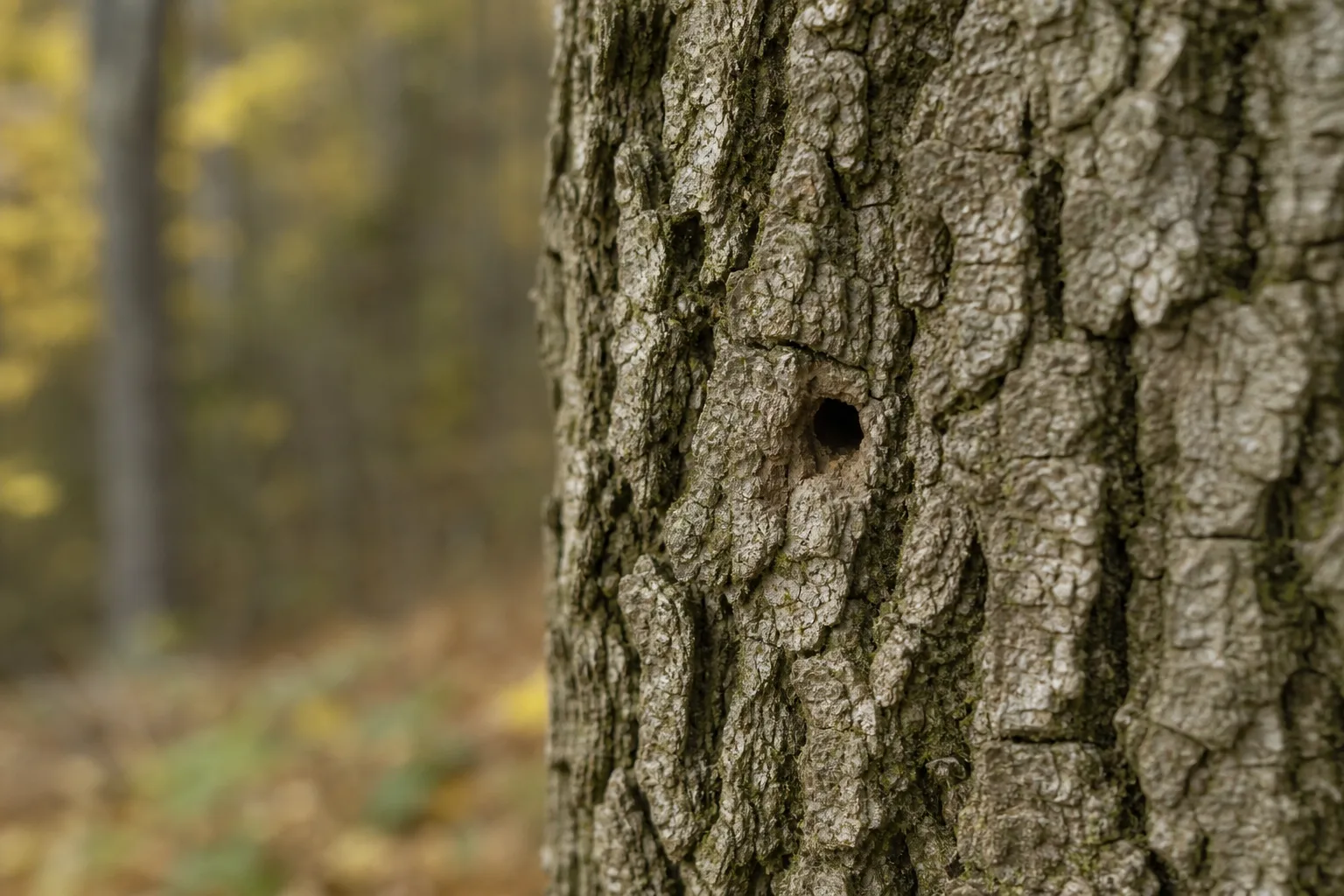
If an ash tree is thinning at the top this fall, do not wait for a perfect diagnosis before acting: inventory the tree, call a certified arborist, and decide between treatment and removal. Emerald ash borer treatment works best before the canopy loses about 30% of its leaves, and trees with roughly 50% thinning are much less likely to respond.
What does emerald ash borer damage look like in fall?
Emerald ash borer damage usually begins high in the ash tree, with yellowing or browning leaves, thinning upper branches, and dieback near the crown. As the infestation advances, inspect for D-shaped exit holes about 1/8 inch wide, S-shaped tunnels under bark, vertical splits, new trunk sprouts, and woodpecker activity. American Family Insurance also advises standing well back because crown thinning is easy to miss from directly underneath.
Fall is a useful inspection season because the crown tells the story. Stand across the yard, not with your nose against the trunk. Look for a top that is noticeably thinner than the lower canopy, bare twigs near the highest branches, or a tree that seems to be leafing out in patches before the rest of the yard changes.
One sign alone does not prove emerald ash borer. A drought-stressed ash can lose leaves, and storm damage can create dead branches. The pattern matters: thinning high in the tree followed by sprouts lower down is more concerning than one broken limb.
Here in Austin, I think about stress in layers. We have alkaline clay, limestone close below it, long stretches near 100 degrees, and winters that can still surprise us. I have killed plants by blaming every ugly leaf on the wrong problem, so I do not diagnose an ash from one photo or one hole.
How should I inspect an ash tree right now?
Inspect an ash tree from the ground in three passes: first the crown, then the trunk, then the base and surrounding area. Record the tree’s location, trunk diameter measured at about 4.5 feet above ground, approximate canopy thinning, and visible symptoms. This inventory gives a certified arborist useful information and helps you compare treatment with removal.
Start at least 50 feet away if the yard allows it. Count the upper branches that carry leaves and compare them with the middle and lower canopy. If roughly one third of the upper canopy looks sparse, stop treating this as casual monitoring. The research recommends beginning treatment before 30% canopy thinning, not after the tree is obviously failing.
Next, walk the trunk slowly. Look for vertical bark splits, excessive branching, and small D-shaped holes about 1/8 inch across. New shoots low on the trunk or along lower branches can be a stress response, especially when the upper crown is declining. Boulder County’s EAB guidance lists these signs along with S-shaped larval tunnels and woodpecker activity.
Write down the date and take photos from the same angle every four weeks through fall. Do not scrape bark off a living tree just to hunt for tunnels. That can add injury without giving you a dependable answer, and a certified arborist can inspect the tree more safely.
Can I confirm emerald ash borer from holes or tunnels alone?
No, holes or tunnels alone cannot confirm emerald ash borer for a homeowner. D-shaped exit holes about 1/8 inch wide, S-shaped larval tunnels, bark splits, sprouts, and woodpecker activity are warning signs, but the whole pattern and the tree’s condition need professional review before you spend money on treatment or schedule removal.
The D-shaped exit hole is the clue people remember, but it is not a magic stamp. Check whether the hole appears on an ash showing crown thinning or upper branch dieback. If the tree is green and vigorous, one questionable opening deserves documentation and monitoring rather than an immediate chemical application.
Woodpeckers are worth noting because they may be working on larvae below the bark. They do not identify the pest by themselves. The same goes for sprouts. A stressed tree may push new growth lower down while the top loses vigor, but other problems can also cause stress.
Ask the arborist to confirm the tree is actually ash, assess the canopy percentage, measure diameter, and inspect its location. That last part matters. An ash over a roof, play area, driveway, or sidewalk carries a different removal risk and cost than one at the back of a large lot.
Should I treat an ash tree or remove it?
Choose treatment when a valuable ash has less than 30% canopy thinning, the trunk and major limbs remain structurally sound, and its location justifies repeated care. Choose removal when thinning is advanced, the tree is declining quickly or unsafe, or ongoing treatment costs exceed removal and replacement costs. Waiting for certainty can leave you with the worst option: a dead tree and a larger bill.
The research supports a clear threshold. Insecticide treatments are significantly more effective below 50% canopy thinning, and another set of guidance recommends starting before 30%. Those numbers are not decorative. They are the difference between protecting a tree with a fighting chance and trying to rescue one that has already spent much of its stored energy.
| Option | Best fit | Honest downside |
|---|---|---|
| Treat with an arborist-applied insecticide | Ash with less than 30% canopy thinning, sound structure, and enough value to justify recurring care | It costs money repeatedly, requires correct timing and application, and becomes less effective as thinning advances |
| Remove and replace | Ash with advanced thinning, serious structural risk, or treatment costs that exceed its value | Removal is a large one-time expense, removes immediate shade, and a replacement tree needs years to mature |
An economic model for ash decisions compares ongoing treatment costs with one-time removal and replacement costs, while considering tree size, location, and the replacement plan. Arboriculture & Urban Forestry describes this approach. I like it because it stops us from pretending that treatment is automatically cheaper just because removal feels dramatic.
Ask yourself a plain question: would you pay for several treatment cycles if the ash were not already in your yard? If the answer is no, and the canopy is thinning past the useful treatment window, removal may be the responsible choice rather than an admission of failure.
What treatment works for emerald ash borer?
Insecticide treatment, often using emamectin benzoate, is the main treatment discussed for protecting an ash tree from emerald ash borer. It works best on trees with less than 50% canopy thinning and should begin before about 30% thinning. A certified arborist should select and apply the treatment because timing, tree size, condition, and application method affect the result.
Emamectin benzoate is not a one-and-done garden spray. The trade-off is ongoing cost and the need for repeat attention, especially if the tree remains valuable and the pest pressure continues. The treatment also cannot turn a severely declining or structurally unsafe tree into a safe one.
The useful size range cited in the supplied guidance is generally 12 to 30 inches in diameter at breast height. Measure at about 4.5 feet above the ground, not at the swollen base. A tree outside that range is not automatically hopeless or automatically treatable, which is another reason to have an arborist assess it rather than buying a product and guessing.
Do not wait until winter to begin the conversation if the crown is thinning now. Fall is the moment to document symptoms, get the tree evaluated, and learn whether treatment can still protect it before the next growing season. Montgomery Township’s ash tree advice specifically points to treating 12 to 30 inch trees before 30% canopy thinning and identifies emamectin benzoate as a common approach.
Who should treat an ash tree, and who should ignore treatment?
Treatment suits homeowners with a healthy, well-placed ash that still has most of its canopy, a trunk diameter generally between 12 and 30 inches, and enough shade or landscape value to justify recurring expense. Ignore treatment and plan removal when the canopy is already heavily thinned, the tree threatens a structure, or treatment would cost more than removal and replacement.
This is for the ash shading your patio, cooling a west-facing window, or standing safely away from targets. It is also for the tree you would genuinely miss, not merely the one you feel guilty about losing. A large, healthy ash can be worth protecting because replacement shade takes years.
This is not for a tree with extensive dead upper branches, major cracks, unstable limbs, or about 50% canopy thinning. University of Wisconsin Extension research reports that treatment is significantly more effective when canopy thinning is below 50%. That does not mean a tree at 49% is a bargain. It means the window is closing.
It also may not suit a rental property owner who cannot commit to repeat inspections and treatment. If you cannot monitor the tree every year and respond to decline, removal and a well-planned replacement can be more honest than postponing the decision until branches become hazardous.
When should an ash tree be removed?
If removal is the decision, schedule it between September 1 and April 31, when emerald ash borer beetles remain under the bark and the risk of spreading the pest is lower. Remove a declining tree sooner if it threatens people, buildings, vehicles, or utility lines. Use a qualified tree professional because dead ash wood can become hazardous quickly.
The dormant-season window is about reducing spread, not making a dangerous tree safe. A tree leaning toward your roof does not become acceptable because the calendar says October. Safety wins. Tell the contractor the tree may have emerald ash borer so wood handling and disposal can be planned correctly.
Do not move firewood from the removed ash to another property. The guidance from Xerces Society emphasizes monitoring ash health, learning the signs, and reporting findings to local authorities. Local rules can affect disposal, so ask your municipal forestry office or arborist what applies in your area.
Replacement is its own design decision. Consider mature size, available water, overhead wires, paving, and the shade you lost. Every replacement has a trade-off: a fast-growing choice may need more pruning, while a slower-growing tree gives you a longer wait for shade. Choose for the site, not for the hole left by the old ash.
If you are still deciding what belongs in that space, browse the plant database for options suited to your conditions. In Austin, I would also account for August clay that bakes hard, February freezes, and water restrictions before I fall in love with a nursery tag.
What should you do this fall if an ash tree is thinning?
This fall, stand back and estimate crown thinning, photograph the upper branches, inspect the trunk for D-shaped holes and bark splits, measure diameter, and list every ash on your property. Then contact a certified arborist before the tree loses more than 30% of its canopy. The decision is treat or remove, not endless waiting.
Make the inventory simple. Note the tree’s location, diameter, canopy condition, nearby targets, and symptoms. If you have three ash trees, list all three, even if only one looks sick. Emerald ash borer decisions are easier when you compare the property as a whole instead of reacting to the ugliest trunk.
What if the tree looks fine from your kitchen window? Stand farther away anyway. Early thinning can hide in the top branches, and the first visible damage is often at the crown. Set a reminder for another inspection in four weeks, but do not use monitoring as an excuse to ignore clear decline.
If you want help thinking through the space after treatment or removal, you can get a concept for your yard before choosing a replacement. I would rather see you plan one good tree for the right spot than panic-buy a pretty one that cannot handle your soil.
What are the most common emerald ash borer questions?
The most useful answers are practical: look at the crown first, confirm the pattern with a certified arborist, treat early if the tree is worth saving, and remove declining or hazardous trees during the lower-risk dormant-season window. The percentage of canopy thinning matters more than any single hole, crack, or woodpecker visit.
How do I know if my ash tree has emerald ash borer?
How do I know if my ash tree has emerald ash borer?
Look for yellowing or browning leaves and thinning at the crown, then check for D-shaped exit holes about 1/8 inch wide, S-shaped tunnels, bark splits, lower sprouts, dead upper branches, and woodpecker activity. These signs do not replace professional confirmation, so photograph the tree, measure its trunk, and ask a certified arborist to inspect it.
Can an ash tree recover from emerald ash borer?
Can an ash tree recover from emerald ash borer?
An ash tree can respond better to treatment when canopy thinning is below 50%, with treatment ideally started before about 30% thinning. An untreated infested tree is unlikely to recover and may die within a few years. A tree with extensive dieback or structural problems may remain unsafe even if some leaves return.
Is emamectin benzoate effective against emerald ash borer?
Is emamectin benzoate effective against emerald ash borer?
Emamectin benzoate is a commonly used insecticide treatment for emerald ash borer, and it is most successful on ash trees with limited canopy thinning. It is not a one-time cure or a substitute for a structural inspection. A certified arborist should decide whether the tree, its size, and its condition justify treatment and repeat expense.
Should I remove an ash tree with 30% canopy thinning?
Should I remove an ash tree with 30% canopy thinning?
Not automatically. About 30% canopy thinning is a warning threshold to begin treatment discussions, not an automatic removal order. Have a certified arborist assess the tree’s structure, location, size, and treatment prospects. Removal becomes more compelling as thinning advances, hazards appear, or ongoing treatment costs exceed removal and replacement costs.
When is the safest time to remove an ash tree with emerald ash borer?
When is the safest time to remove an ash tree with emerald ash borer?
Schedule removal between September 1 and April 31, when the beetles remain under the bark and the risk of spreading them is lower. Safety comes first if the tree threatens people, buildings, vehicles, or utility lines. Tell the tree professional about suspected emerald ash borer so the wood can be handled appropriately.
What should I do with ash firewood after removal?
What should I do with ash firewood after removal?
Do not move ash firewood from the property to another location because it can help spread emerald ash borer. Ask your arborist or local forestry office about disposal and movement rules. Keep the wood handling plan in place before removal begins, especially if the tree is near a driveway, road, or property boundary.
Want a plan for your own yard?
Tell us the space and we will put a planting plan together for it. Start at get my concept, or browse what actually grows where you are over on plants.
Frequently asked questions
How do I know if my ash tree has emerald ash borer?
Look for yellowing or browning leaves and thinning at the crown, then check for D-shaped exit holes about 1/8 inch wide, S-shaped tunnels, bark splits, lower sprouts, dead upper branches, and woodpecker activity. These signs do not replace professional confirmation, so photograph the tree, measure its trunk, and ask a certified arborist to inspect it.
Can an ash tree recover from emerald ash borer?
An ash tree can respond better to treatment when canopy thinning is below 50%, with treatment ideally started before about 30% thinning. An untreated infested tree is unlikely to recover and may die within a few years. A tree with extensive dieback or structural problems may remain unsafe even if some leaves return.
Is emamectin benzoate effective against emerald ash borer?
Emamectin benzoate is a commonly used insecticide treatment for emerald ash borer, and it is most successful on ash trees with limited canopy thinning. It is not a one-time cure or a substitute for a structural inspection. A certified arborist should decide whether the tree, its size, and its condition justify treatment and repeat expense.
Should I remove an ash tree with 30% canopy thinning?
Not automatically. About 30% canopy thinning is a warning threshold to begin treatment discussions, not an automatic removal order. Have a certified arborist assess the tree’s structure, location, size, and treatment prospects. Removal becomes more compelling as thinning advances, hazards appear, or ongoing treatment costs exceed removal and replacement costs.
When is the safest time to remove an ash tree with emerald ash borer?
Schedule removal between September 1 and April 31, when the beetles remain under the bark and the risk of spreading them is lower. Safety comes first if the tree threatens people, buildings, vehicles, or utility lines. Tell the tree professional about suspected emerald ash borer so the wood can be handled appropriately.
What should I do with ash firewood after removal?
Do not move ash firewood from the property to another location because it can help spread emerald ash borer. Ask your arborist or local forestry office about disposal and movement rules. Keep the wood handling plan in place before removal begins, especially if the tree is near a driveway, road, or property boundary.
Free, no obligation
Ready to design your dream landscape? Start here.
Tell us where you are and we will start a free profile for you, with plants that actually survive your climate and a real sense of what the build would cost.