
How to Identify and Treat Grubs in a Lawn
Skunks digging small cone-shaped holes are often giving you the diagnosis. Learn how to confirm lawn grubs, decide whether treatment is justified, and use the right fall timing before the larvae move deeper into the soil.
September 20, 2026
By Diego Navarro
How do you identify grubs in a lawn this fall?
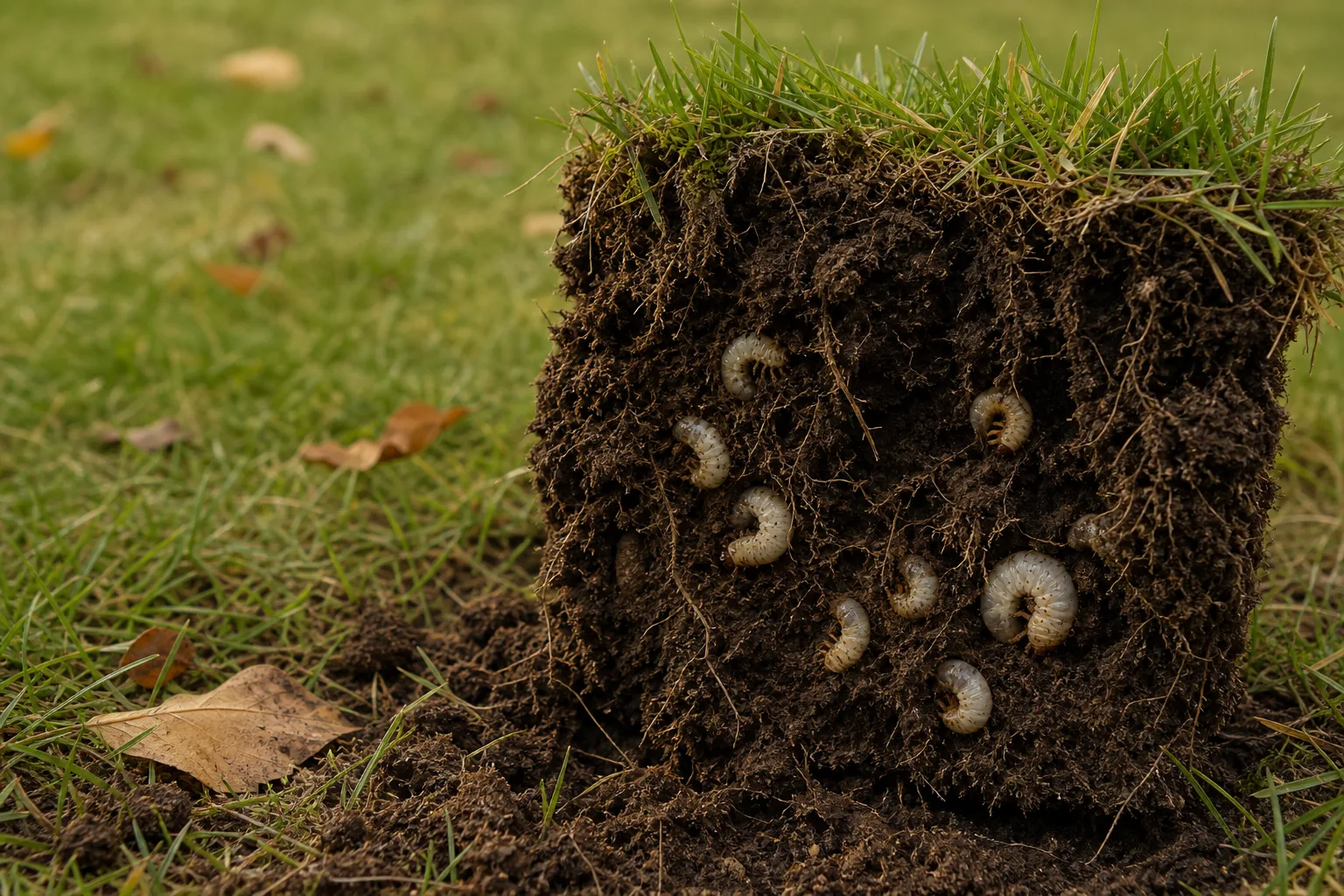
You identify lawn grubs by lifting a one-foot square of sod and looking for white to cream, C-shaped larvae about one inch long, along with spongy turf, irregular brown patches, or roots that pull loose. Fresh shallow, cone-shaped holes made by skunks are the strongest field clue, but the sod slice is your proof.
Cut three sides of a square with a sharp spade, about 2 to 3 inches deep, then fold the flap back. Look in the soil immediately below the roots. White grubs are soft-bodied and pale, usually curled into a C shape, and an infested patch may have several at once. NC State Extension describes the common turf symptoms and grub appearance here.
Do this in three places, not just beside the worst dead patch. A lawn can have one hot spot under a tree and clean soil ten feet away. That is how people end up treating the whole yard for a problem living in one square.
Fall changes the question slightly. You are not trying to guess from brown grass alone. You are checking whether live larvae are still close enough to the surface for a treatment to reach them.
Why are skunk holes the best clue that grubs are present?
Skunks dig small, shallow, cone-shaped holes because they are searching the upper soil for grubs and other insects, so a fresh cluster of those holes is a useful diagnosis before you disturb the lawn. Brown turf by itself proves very little, but wildlife actively feeding in one area tells you something underneath is worth eating.
A skunk hole is usually neat and punched downward, often only a few inches wide. Torn strips of sod and broader disturbance can point toward raccoons or another animal instead. The hole shape distinction is described in this report on skunk and raccoon lawn damage.
You may see the damage first in the morning, especially along lawn edges, beneath trees, or beside landscape beds. Skunks can also stay in a yard while the food supply lasts, so repeated digging over several nights is not random decoration. It is a buffet review. HowStuffWorks also notes that skunks dig shallow holes while searching for grubs.
Here is the rule I use: skunk holes tell you where to inspect, not automatically what chemical to buy. Lift the sod first, because treating an empty lawn costs money and does nothing for the animal that dug it.
How many grubs justify treating a lawn?
Treat a lawn when a random one-foot square contains five or more live grubs, especially if the turf is spongy, thinning, or being dug by skunks. Fewer than five live grubs per square after treatment indicates the program is working, so the count matters more than the sight of a few harmless larvae.
Sample at least three one-foot squares across the affected area. Put one square in the center of the damaged patch, one at its edge, and one where the skunk holes are freshest. Count live larvae, not empty shells, dead larvae, or unrelated soil insects.
If every square has two or three grubs and the grass is rooted firmly, I would monitor rather than spray. That decision is especially sensible in fall, when many larvae are moving deeper and a late treatment may miss them.
If one square has twelve grubs and the other two have none, spot treatment can make more sense than covering the entire lawn. Read the product label for the permitted turf, application rate, protective equipment, and restrictions. The label is not a suggestion taped to the bottle.
What should you do about grubs in fall?
In fall, confirm the grubs first, then use a labeled curative treatment only if live larvae are still near the surface and the product is approved for that timing. The ideal control window is earlier, from mid-July through early September, while larvae are young and roughly 1 to 2 inches long; late treatment becomes less reliable as they grow or move deeper.
Preventive products containing chlorantraniliprole, imidacloprid, or carbaryl are generally timed around mid-July, not casually poured onto a lawn in October. Curative products containing carbaryl or trichlorfon can be used in September while larvae remain near the surface, but follow the label rather than assuming every fall date works everywhere.
This is where the calendar matters more than enthusiasm. If you are standing in the yard in late October and the grubs are several inches down, the sensible move may be to document the hot spots and plan a mid-July treatment next year instead of buying a product that cannot reach its target.
Water according to the label after a treatment if the product requires it, and keep people and pets off the lawn for the stated reentry period. Chemical control has a downside: it can fail late, costs more than monitoring, and adds an exposure concern that a confirmed threshold should justify.
Which grub treatment should you use?
I would use a properly timed labeled insecticide for a confirmed damaging infestation, not milky spore or beneficial nematodes as an automatic cure. Nematodes and milky spore are biological options applied in the same young-grub window, but their results can be slower or less predictable; the best choice depends on timing, soil conditions, label directions, and how many larvae you found.
| Treatment option | Best timing and use | Honest downside |
|---|---|---|
| Chlorantraniliprole preventive | Mid-July before heavy damage, according to the label | It is preventive, so it is poorly timed for a confirmed late-fall infestation |
| Imidacloprid preventive | Mid-July when prevention is justified by prior damage | It does not solve every late-season problem and still requires careful application |
| Carbaryl or trichlorfon curative | September while young larvae remain near the surface | Curative timing is narrow, and the product must be used exactly as labeled |
| Beneficial nematodes | Late summer when soil conditions and label directions fit | Results are less predictable and require careful application conditions |
| Milky spore | Same young-grub window as a biological approach | It may work slowly and is not a dependable answer to every grub species or outbreak |
Nematodes are living organisms, not magic dust. They need the right application conditions, and the research summary identifies examples such as Steinernema feltiae for biological control. Their trade-off is patience and uncertainty compared with a correctly timed curative product.
Milky spore is often sold as a one-time permanent answer. That is oversold. It may colonize soil and affect grubs as they feed, but it does not give you a free pass on species, timing, counting, or lawn care.
I would not apply a preventive insecticide in fall just because a skunk visited. That is the expensive version of guessing.
Does mowing, watering, or aerating get rid of grubs?
Mowing, deep infrequent watering, and aeration do not directly kill lawn grubs, but they help turf tolerate root feeding and recover after damage. Keep grass at its proper mowing height, water deeply rather than a little every day, and aerate compacted soil when the grass is actively growing; these are support measures, not grub treatment.
Do not scalp damaged turf to make it look tidier. Removing too much leaf tissue reduces the lawn's ability to rebuild roots after feeding. The correct mowing height depends on the grass species, so use the height recommended for your turf rather than copying the neighbor's setting.
Deep, infrequent watering also has limits. If the soil is heavy black clay, watering too often can leave the root zone wet and poorly aerated. In Central Texas, August does not negotiate, but a timer does not excuse checking whether water is actually reaching the root zone.
Core aeration can improve compacted soil, but it has a trade-off: it disturbs the surface, can spread weeds, and does nothing for a lawn that is already loose and well drained. Use it for compaction, not as a ritual treatment for grubs.
Who should treat grubs, and who should ignore them?
Treat confirmed grub damage if your lawn has five or more live grubs per one-foot square, repeated skunk digging, or turf that lifts easily and is declining. Ignore or monitor a few isolated larvae when the grass is rooted firmly, the count stays below that threshold, and wildlife is not repeatedly tearing up the surface.
This approach suits a homeowner standing over fresh holes in fall who is willing to cut three sod samples, count larvae, and read a label. It also suits someone planning ahead after last year's damage, because mid-July prevention is more dependable than an emergency application after the lawn turns brown.
It does not suit a person who wants to spray every brown patch without checking the soil. Brown grass can come from drought, compaction, disease, poor rooting, or a broken irrigation zone. Grubs are only one suspect, and skunks are the useful witness.
If you rent, share a lawn, or live beside a drainage area where wildlife moves through, start with inspection and spot repair before treating the whole property. If you are unsure how to handle a pesticide, hire a licensed applicator and ask what threshold and timing justify the application.
How do you repair a lawn after grubs and skunks damage it?
Repair grub-damaged turf only after you address live larvae and stop repeated digging, because new seed or sod will be disturbed again if skunks are still feeding. Rake loose soil, press down lifted edges, add a thin layer of compatible soil if needed, and reseed or patch during the grass's proper growing season rather than during heat or dormancy.
Do not bury a shallow hole with a heavy mound of compost. That creates a soft hump and can smother the remaining grass. Fill lightly, tamp the surface, and match the repair material to the existing lawn.
The timing depends on the turf, but fall is often useful for cool-season grass repair, while warm-season turf in Central Texas may need active growth and soil warmth before it fills in. If the grass is going dormant, wait rather than scattering seed that sits until spring and feeds birds.
After any treatment, check a few random one-foot squares weekly. If fewer than five live grubs are found per square, resume normal lawn care and keep watching for fresh skunk activity. The wildlife will tell you if the kitchen reopened.
For plant choices around the repaired edge, use the plant database to check mature size and site fit before adding another competition for water. A lawn repair is not improved by crowding a bed into it two weeks later.
What should you monitor next spring?
Monitor the same hot spots in spring for fresh cone-shaped holes, loose turf, irregular brown patches, and live larvae near the roots. Keep a simple map of the squares you sampled this fall, then inspect those locations again in April and May; a small record is more useful than trying to remember which corner the skunk preferred.
The main prevention window is still mid-July through early September, when young grubs are 1 to 2 inches long and easier to control. Put a reminder on your calendar for the second week of July, then inspect before choosing a preventive product.
Everyone says to treat at the first sign of lawn trouble. In practice, diagnosis comes first because a treatment aimed at grubs will not fix drought, compacted soil, or an irrigation failure. A five-minute sod sample can save a whole-lawn application.
If you want the lawn and planting beds planned together, you can get a concept for your yard before you spend on seed, sod, or chemicals. Build the repair around the soil you actually have. The ground gets a vote.
What are the answers to common grub questions?
The short answers are simple: confirm grubs beneath the sod, use skunk holes as a clue, count live larvae, and respect the treatment window. Fall is a good time to diagnose and make a plan, but it is not automatically the best time to apply a preventive product, especially after larvae have moved deeper.
Can skunk holes alone confirm lawn grubs?
Can skunk holes alone confirm lawn grubs? No. Small cone-shaped holes strongly suggest that skunks are hunting grubs or other insects, but you should lift a one-foot square of sod and count live larvae before treating. Skunk activity tells you where to inspect, while the soil sample tells you whether grub control is justified.
How deep should I dig to check for lawn grubs?
How deep should I dig to check for lawn grubs? Cut and lift a one-foot square of sod about 2 to 3 inches deep, then inspect the soil directly beneath the roots. The larvae may be near the surface in late summer and September, but they can move deeper in fall, so check more than one location.
How many grubs are too many in a lawn?
How many grubs are too many in a lawn? Five or more live grubs in a random one-foot square is a practical treatment threshold when the turf is damaged or wildlife is digging. Sample three squares, because one crowded patch does not prove the entire lawn needs treatment.
Is fall too late to treat lawn grubs?
Is fall too late to treat lawn grubs? Fall can still be treated in September if live larvae remain near the surface and the product label allows curative use, but the most reliable window is mid-July through early September. By late fall, deeper larvae may be protected from treatment, so plan prevention for mid-July next year.
Do beneficial nematodes always kill lawn grubs?
Do beneficial nematodes always kill lawn grubs? No. Beneficial nematodes can be a biological option during the young-grub window, but results depend on application conditions, the target grub, and the product directions. They may work more slowly and less predictably than a properly timed labeled insecticide, so count larvae before choosing them.
Should I treat the whole lawn after finding one grub?
Should I treat the whole lawn after finding one grub? No. One grub does not justify whole-lawn treatment. Sample three one-foot squares, map the active spots, and treat only confirmed damaging areas when possible. If fewer than five live grubs occur per square and the turf is stable, monitor instead of paying to cover empty soil.
Want a plan for your own yard?
Tell us the space and we will put a planting plan together for it. Start at get my concept, or browse what actually grows where you are over on plants.
Frequently asked questions
Can skunk holes alone confirm lawn grubs?
Can skunk holes alone confirm lawn grubs? No. Small cone-shaped holes strongly suggest that skunks are hunting grubs or other insects, but you should lift a one-foot square of sod and count live larvae before treating. Skunk activity tells you where to inspect, while the soil sample tells you whether grub control is justified.
How deep should I dig to check for lawn grubs?
How deep should I dig to check for lawn grubs? Cut and lift a one-foot square of sod about 2 to 3 inches deep, then inspect the soil directly beneath the roots. The larvae may be near the surface in late summer and September, but they can move deeper in fall, so check more than one location.
How many grubs are too many in a lawn?
How many grubs are too many in a lawn? Five or more live grubs in a random one-foot square is a practical treatment threshold when the turf is damaged or wildlife is digging. Sample three squares, because one crowded patch does not prove the entire lawn needs treatment.
Is fall too late to treat lawn grubs?
Is fall too late to treat lawn grubs? Fall can still be treated in September if live larvae remain near the surface and the product label allows curative use, but the most reliable window is mid-July through early September. By late fall, deeper larvae may be protected from treatment, so plan prevention for mid-July next year.
Do beneficial nematodes always kill lawn grubs?
Do beneficial nematodes always kill lawn grubs? No. Beneficial nematodes can be a biological option during the young-grub window, but results depend on application conditions, the target grub, and the product directions. They may work more slowly and less predictably than a properly timed labeled insecticide, so count larvae before choosing them.
Should I treat the whole lawn after finding one grub?
Should I treat the whole lawn after finding one grub? No. One grub does not justify whole-lawn treatment. Sample three one-foot squares, map the active spots, and treat only confirmed damaging areas when possible. If fewer than five live grubs occur per square and the turf is stable, monitor instead of paying to cover empty soil.
Free, no obligation
Ready to design your dream landscape? Start here.
Tell us where you are and we will start a free profile for you, with plants that actually survive your climate and a real sense of what the build would cost.