
How Do You Identify and Treat Whiteflies?
A white cloud that lifts from disturbed leaves, sticky honeydew, and black sooty mold point strongly to whiteflies. Here is what to do in a fall garden, from knocking adults down today to washing leaves and choosing a treatment that fits the infestation.
October 3, 2026
By Valeria Navarro
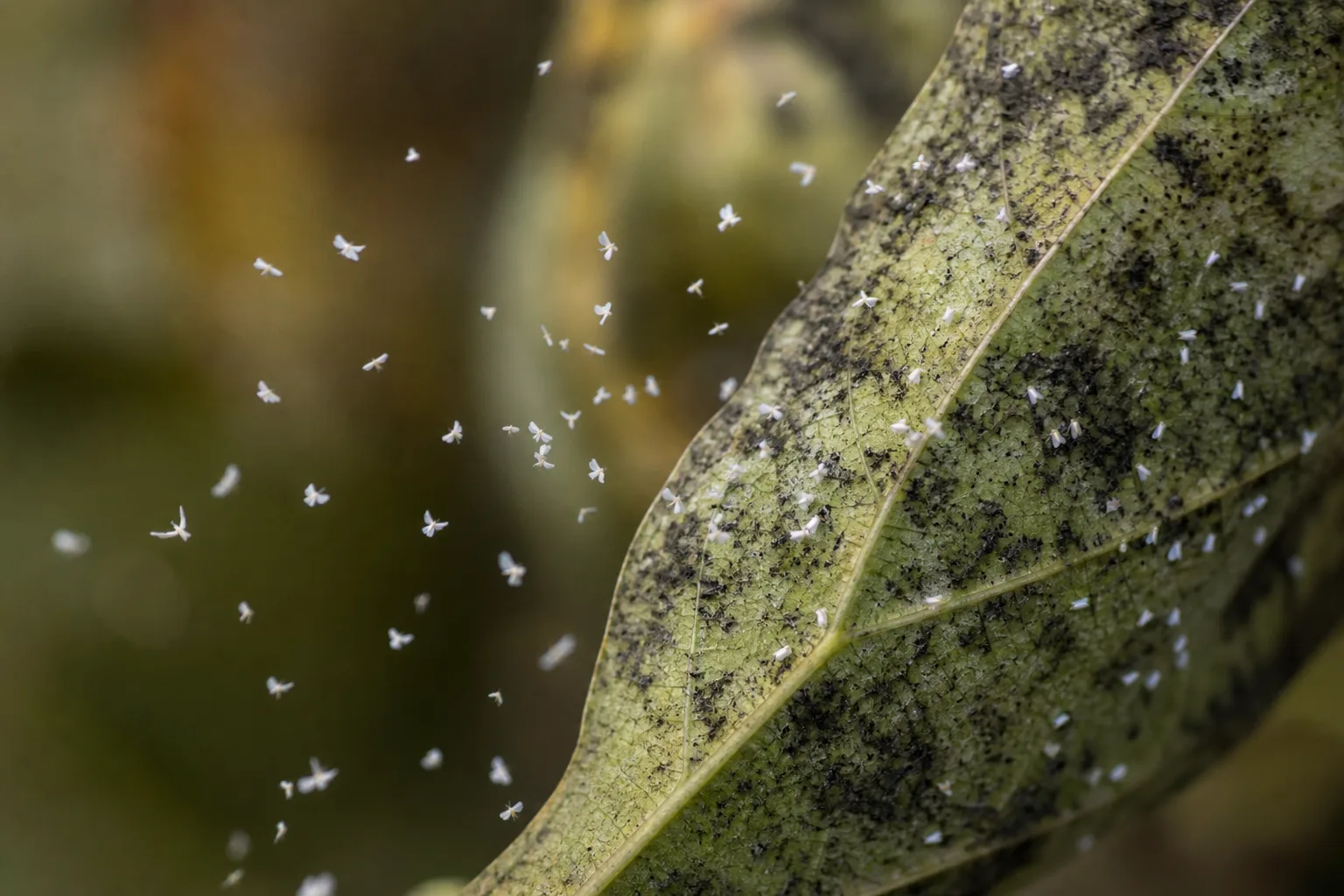
Whiteflies are most likely the culprit if brushing a leaf sends up a tiny white cloud and the foliage below feels sticky or carries a dark, velvety coating. Treat them now by removing adults, trapping the remainder, washing away honeydew and mold, and applying a labeled insecticidal soap, neem oil, or horticultural oil.
How can you tell if the insects are whiteflies?
Whiteflies reveal themselves when a disturbed leaf releases a small cloud of pale flying insects. Look underneath the foliage for adults and eggs, then check the upper surface for sticky honeydew or black, velvety sooty mold. That combination is much more useful than leaf damage alone.
Brush one leaf gently with your fingers. If white insects lift off together and settle again a moment later, you have your first strong clue. Whiteflies usually hide and lay eggs on the undersides, so looking only at the top of the plant is how this little party gets missed.
Honeydew is the second clue. It feels tacky, and sooty mold can grow on it as a dark coating over leaves and stems. Sooty mold grows on honeydew rather than directly infecting plant tissue, but that coating can block sunlight and stunt growth.
Take a white sheet of paper outside. Hold it below a branch and tap the branch lightly. You are looking for the white cloud, not one random pale insect that wandered in from somewhere else.
Why does whitefly damage come with black sooty mold?
Whiteflies feed on plant sap and leave behind a sugary liquid called honeydew. Sooty mold grows on that residue, creating a dark film on leaves and stems. The mold is a signal that sap-feeding insects are active, so treating only the black coating misses the source of the problem.
The mold looks alarming, but it is not the first thing I would attack. Stop the whiteflies and the fresh honeydew declines; then rinse the leaves and loosen the coating with water or a mild soap-and-water solution.
This is where many gardeners spend money in the wrong order. They buy a product for a black leaf, but the real job is finding the insect underneath the leaf and breaking that cycle.
In Austin, I would inspect every nearby plant before deciding the trouble is limited to one pot. Our fall days can still be warm, and a plant sheltered beside a wall can hold onto an infestation while the rest of the garden cools down.
What should you do to whiteflies today?
Start with removal, not a dramatic spray. Gently vacuum or shake adults from the foliage, rinse leaves with a strong spray of water, place sticky traps near the affected plant, and inspect the undersides again before choosing a treatment. These steps reduce the flying adults while you deal with eggs and honeydew.
Use a handheld vacuum carefully around the leaves, or shake the plant over a pale sheet so you can see what comes off. The downside is that this does not finish the infestation, because eggs and hidden insects remain on the plant.
A strong spray of water can knock insects loose and rinse away honeydew. The trade-off is mess and repetition. You may need to repeat the inspection over several days instead of expecting one rinse to solve everything.
Set sticky traps close to the plant. They help catch flying adults, but they do not remove insects already tucked under leaves, and they can also catch insects you would rather keep around. Place them where you can monitor them, not where every beneficial visitor must pass.
If you want help checking the plant, compare its symptoms with the plant database before treating. You do not need a mystery product for every black mark, querida, but you do need to identify the pest before you spend money.
Which whitefly treatment should you choose?
For an active infestation, I would begin with physical removal and then choose insecticidal soap, neem oil, or horticultural oil according to the product label. Insecticidal soap is a direct treatment option, while oils add another approach, but every spray costs time and can fail if the undersides are missed.
| Option | What it does | Honest downside |
|---|---|---|
| Water spray or gentle vacuuming | Knocks adults off and reduces honeydew | Does not finish hidden stages or prevent return by itself |
| Sticky traps | Catches flying adults and helps you monitor activity | Does not reach eggs or insects under leaves |
| Ladybugs | Adds predators that feed on pests | Predators may not stay where food and conditions do not suit them |
| Insecticidal soap | Treats the infestation on contacted foliage | Requires thorough coverage and repeat attention |
| Neem oil or horticultural oil | Provides an oil-based treatment option | Needs careful label use and can miss insects hidden underneath leaves |
Spray coverage is the whole ballgame. Whiteflies hide below the leaf, so coating only the upper surface is a costly half-job. Read the label for dilution and application directions, and keep the treatment limited to what that label allows.
Ladybugs are another option named in the research, and I like the idea of predators when the garden can support them. The honest downside is control. They may move away, and they do not give you a guarantee that the infestation ends today.
Reflective surfaces or sheets can deter whiteflies from landing. That can help around a small container or protected planting, but it is not my first choice for a large bed. Sheets become awkward, weathered, and one more thing to manage when you are already trying to inspect leaf undersides.
How do you wash sooty mold from whitefly leaves?
Wash whitefly leaves with a strong spray of water or a mild soap-and-water solution to rinse away honeydew and loosen sooty mold. Removing the coating improves the leaf’s surface, but it does not replace whitefly control. After the insects decline, prune growth that is heavily molded and improve air circulation.
Work from the top of the plant downward so the sticky residue does not simply land on clean foliage. Use enough water to loosen the film without breaking tender stems, and let the plant dry with space around it.
Do not scrub a leaf until it shines. That is how you turn pest control into fresh plant damage. A gentle rinse is the better trade-off, especially on thin or easily torn foliage.
Prune heavily molded growth after the whiteflies are reduced. The downside is lost foliage and less plant size, but keeping a badly coated section can cost the plant sunlight and leave you with a surface that is difficult to clean.
ForwardPlant explains that sooty mold can block sunlight and stunt growth. That is why I care about the black film even though it is growing on honeydew rather than directly inside the plant tissue.
Who is this whitefly plan for, and who should ignore it?
This plan suits a homeowner who sees a white cloud on disturbance, sticky leaves, or sooty mold and can inspect the plant every few days this fall. Ignore the quick-fix approach if you will not check undersides, repeat removal, or follow a product label, because one dramatic spray rarely reaches the whole infestation.
It is especially useful for potted plants, vegetable starts, ornamental foliage, and small garden sections where you can reach both sides of the leaves. Sticky traps and hand inspection make sense there because you can see the changes from one visit to the next.
A large hedge covered from top to bottom is a different job. You may still use water, pruning, and a labeled treatment, but the labor rises fast when every leaf needs coverage. That is the trade-off nobody puts on the pretty product bottle.
If your plant has only one or two flying insects and no honeydew, eggs, or sooty mold, do not treat the entire garden on suspicion. Check again tomorrow. I have killed enough plants by reacting too quickly to know that “more product” is not a gardening plan.
How should you prevent whiteflies from returning this fall?
Prevent a repeat infestation by keeping foliage clean, checking leaf undersides regularly, removing heavily molded growth, and improving air circulation after treatment. Continue watching for the white cloud and sticky honeydew instead of trusting a clean-looking leaf, because adults can return to the same plant after the first cleanup.
Make inspection part of your fall garden walk. Check the undersides of several leaves, especially on crowded growth, and brush one branch to see whether adults lift away.
Keep affected plants from touching neighboring foliage while you monitor them. Crowding makes inspection harder and keeps leaves rubbing together, so opening the plant gives you a clearer view and better air movement.
Reflective sheets may deter landing, while sticky traps can show whether flying adults are still present. Both have limits. Sheets are awkward in broad beds, and traps do not address eggs or insects hidden below leaves.
Austin gardeners know the season can fool you. A cool morning does not mean the problem vanished, just as one rainy afternoon does not clean every leaf. I learned that again after moving from Miami’s sandy fill, where water disappeared before I finished watering, to Central Texas clay that holds water and then sets like a brick.
What are the most common whitefly treatment questions?
Whitefly control works best as a sequence: confirm the cloud, inspect undersides, reduce adults, wash honeydew and mold, and then use a labeled treatment if the infestation remains. The answers below give you the short version, but each one still depends on reaching the hidden undersides of the leaves.
How do I know whether whiteflies are causing the sooty mold?
Whiteflies are likely causing the sooty mold if brushing the plant releases a cloud of tiny white insects and the leaves feel sticky. Check the undersides for adults and eggs, because sooty mold grows on honeydew from sap-feeding insects. If there is black coating without those clues, inspect more carefully before treating for whiteflies.
Can I remove whiteflies with water alone?
Water can remove many adult whiteflies and rinse honeydew from leaves, but it may not finish an infestation. Use a strong spray carefully, inspect the undersides, and repeat your checks. Water is a useful first step because it reduces visible adults without committing you to a product, but hidden insects can remain.
Should I use insecticidal soap, neem oil, or horticultural oil?
You can use insecticidal soap, neem oil, or horticultural oil as treatment options for whiteflies, following the product label. I would first reduce adults with water or gentle vacuuming, then choose one labeled treatment and aim for complete leaf coverage. The main failure is spraying the top while missing the undersides.
Will sticky traps get rid of whiteflies?
Sticky traps catch flying adult whiteflies and help you monitor activity, but they will not remove eggs or insects hiding under leaves. Put the traps near the affected plant and continue inspecting the foliage. Their downside is simple: they are a monitoring and reduction tool, not a complete treatment by themselves.
How do I remove black sooty mold from leaves?
Remove black sooty mold by rinsing leaves with a strong spray of water or a mild soap-and-water solution, then address the whiteflies producing honeydew. Prune growth that is heavily molded after the insects decline and improve air circulation. The coating can loosen, but fresh honeydew will keep making the problem return until the insects are controlled.
Are ladybugs useful against whiteflies?
Ladybugs can be useful predators against whiteflies, but they are not a guaranteed stand-alone solution. Introduce them only as part of a broader plan that includes inspection, adult removal, and leaf cleaning. The downside is that predators may not stay where conditions and food do not suit them, so you still need to monitor the plant.
Want a plan for your own yard?
Tell us the space and we will put a planting plan together for it. Start at get my concept, or browse what actually grows where you are over on plants.
Frequently asked questions
How do I know whether whiteflies are causing the sooty mold?
Whiteflies are likely causing the sooty mold if brushing the plant releases a cloud of tiny white insects and the leaves feel sticky. Check the undersides for adults and eggs, because sooty mold grows on honeydew from sap-feeding insects. If there is black coating without those clues, inspect more carefully before treating for whiteflies.
Can I remove whiteflies with water alone?
Water can remove many adult whiteflies and rinse honeydew from leaves, but it may not finish an infestation. Use a strong spray carefully, inspect the undersides, and repeat your checks. Water is a useful first step because it reduces visible adults without committing you to a product, but hidden insects can remain.
Should I use insecticidal soap, neem oil, or horticultural oil?
You can use insecticidal soap, neem oil, or horticultural oil as treatment options for whiteflies, following the product label. I would first reduce adults with water or gentle vacuuming, then choose one labeled treatment and aim for complete leaf coverage. The main failure is spraying the top while missing the undersides.
Will sticky traps get rid of whiteflies?
Sticky traps catch flying adult whiteflies and help you monitor activity, but they will not remove eggs or insects hiding under leaves. Put the traps near the affected plant and continue inspecting the foliage. Their downside is simple: they are a monitoring and reduction tool, not a complete treatment by themselves.
How do I remove black sooty mold from leaves?
Remove black sooty mold by rinsing leaves with a strong spray of water or a mild soap-and-water solution, then address the whiteflies producing honeydew. Prune growth that is heavily molded after the insects decline and improve air circulation. The coating can loosen, but fresh honeydew will keep making the problem return until the insects are controlled.
Are ladybugs useful against whiteflies?
Ladybugs can be useful predators against whiteflies, but they are not a guaranteed stand-alone solution. Introduce them only as part of a broader plan that includes inspection, adult removal, and leaf cleaning. The downside is that predators may not stay where conditions and food do not suit them, so you still need to monitor the plant.
Free, no obligation
Ready to design your dream landscape? Start here.
Tell us where you are and we will start a free profile for you, with plants that actually survive your climate and a real sense of what the build would cost.