
How Do You Collect and Store Scion Wood?
Collect scion wood in late winter, not during fall cleanup. Choose fully dormant, pencil-thick one-year shoots, label every bundle, wrap them in a moist medium, and keep them sealed in a refrigerator at 34 to 38 degrees Fahrenheit until spring grafting.
October 1, 2026
By Diego Navarro
Should you collect scion wood in fall?
No. In fall, mark the trees and cultivars you want, then wait until late winter, when the wood and buds are fully dormant, to cut scions; fall-cut wood has not completed the dormant period that helps it hold in storage and graft successfully later. Put the pruning saw down for this job.
The useful window is after the leaves are gone and before the buds open. For many fruit trees, that means late winter, but the exact week varies by tree and climate. Stone fruits generally have an earlier collection window than other fruit trees, according to the Agrarian Sharing Network.
Right now, in fall, walk the tree and mark the cultivar with weatherproof tags. Take a few photographs of the fruit or tree shape if the variety is uncertain. A scion labeled “good red one” is not a label. It is a future argument.
I learned the value of a clear label from my father's twelve foot strip of clay along the driveway in New Jersey, where every tomato had a stake and every stake had a reason. Trees take longer to correct than tomatoes, so write the cultivar name twice, once on the bundle and once on the bag.
When should you cut scion wood in late winter?
Cut scion wood in late winter while the buds are completely closed inside their scales and the tree is still dormant, but before buds begin to swell or open. The research supports collecting during dormancy, with late winter and early spring used for many grafting projects; stone fruits may need to be collected earlier.
Look at the buds, not just the calendar. A dormant bud is tight and covered by scales. If green tissue is showing, the shoot has started growing and is no longer the cleanest choice for storage.
In Central Texas, check the tree in January and February, then respond to the buds and the weather rather than waiting for a particular holiday. A warm spell can move the calendar quickly. The source material from Orchard People also identifies late winter as the collection period for apple, pear, and stone fruit scions.
Do not confuse a cold night with dormancy. A tree can see one freeze and still be close to breaking bud. You want the quiet stretch before the tree starts spending stored energy on new growth.
What branches make the best scion wood?
Choose healthy, straight, one-year-old shoots about pencil thickness, approximately 1/8 to 3/4 inch in diameter, and cut them into 6 to 12 inch pieces. Favor firm terminal growth over suckers and water sprouts, and avoid damaged, diseased, weak, or unusually thick wood. The California Rare Fruit Growers guide also stresses that scions must be completely dormant.
A pencil-thick shoot gives you enough wood to make clean grafting cuts without leaving a flimsy stick that dries out or bends. Very thin wood has little reserve and is awkward to handle. Very thick wood may not match the rootstock or branch you plan to graft.
Choose wood no older than one or two years. A straight shoot with evenly spaced buds is easier to trim and gives you several chances to make a good graft. Suckers and water sprouts can grow hard and fast, but that speed is not a reason to make them your first choice.
Every piece gets a tradeoff. Terminal shoots are usually easier to identify and prepare, but they may be shorter than a vigorous water sprout. A water sprout can provide length, but it may be poorly positioned or too soft at the tip. I would take a sound terminal shoot first and use the other only if the tree gives me no better material.
If you need help confirming a cultivar or finding a compatible fruiting tree, the plant database is a useful place to check before you cut. Identification is cheaper before the sticks are in a bag.
How long and thick should each scion be?
Prepare scions about 6 to 12 inches long and close to pencil thickness, roughly 1/8 to 3/4 inch across, with several healthy buds along the piece. Longer is not automatically better because extra wood takes up storage space and gives more surface area to dry; shorter pieces leave you fewer options for making the graft.
Use clean, sharp pruners or a pruning saw suited to the branch size. Make a slanted cut at the top that points upward, then a straight cut at the base. Those different cuts tell you which end is which after the bundle has been stored.
Do not rely on memory to identify the top. A bundle can sit in a refrigerator for eight weeks, get moved while somebody looks for mustard, and come out with both ends looking exactly alike. The angled top cut prevents that particular foolishness.
Keep the buds intact and do not strip them off. If leaves are still present, the wood was likely collected too early for this storage plan. Fully dormant scions should have buds enclosed by scales, not soft new leaves.
How do you label and bundle scion wood?
Label every cultivar before storage, then bundle roughly a dozen scions of the same variety together with the name written on a durable tag. Include the date collected and, if useful, the tree or branch location. A clear label matters because the scion carries the variety, while the rootstock supplies the lower part of the graft.
Write the cultivar name on the tag with a marker that will not run when damp. Put a second label inside or directly beside the bundle, but do not wrap paper so tightly that it stays pressed against wet cut ends.
Keep different cultivars in separate bundles. Mixing varieties in one bag saves a few inches of refrigerator space and can cost you an entire spring of work. I would rather store three labeled bundles than one mystery bundle with excellent wood.
The MSU Extension guidance describes dormant scion wood as material used for grafting later in winter or spring. That delay is exactly why the label needs to survive handling, condensation, and your own imperfect memory.
How should you wrap scion wood for storage?
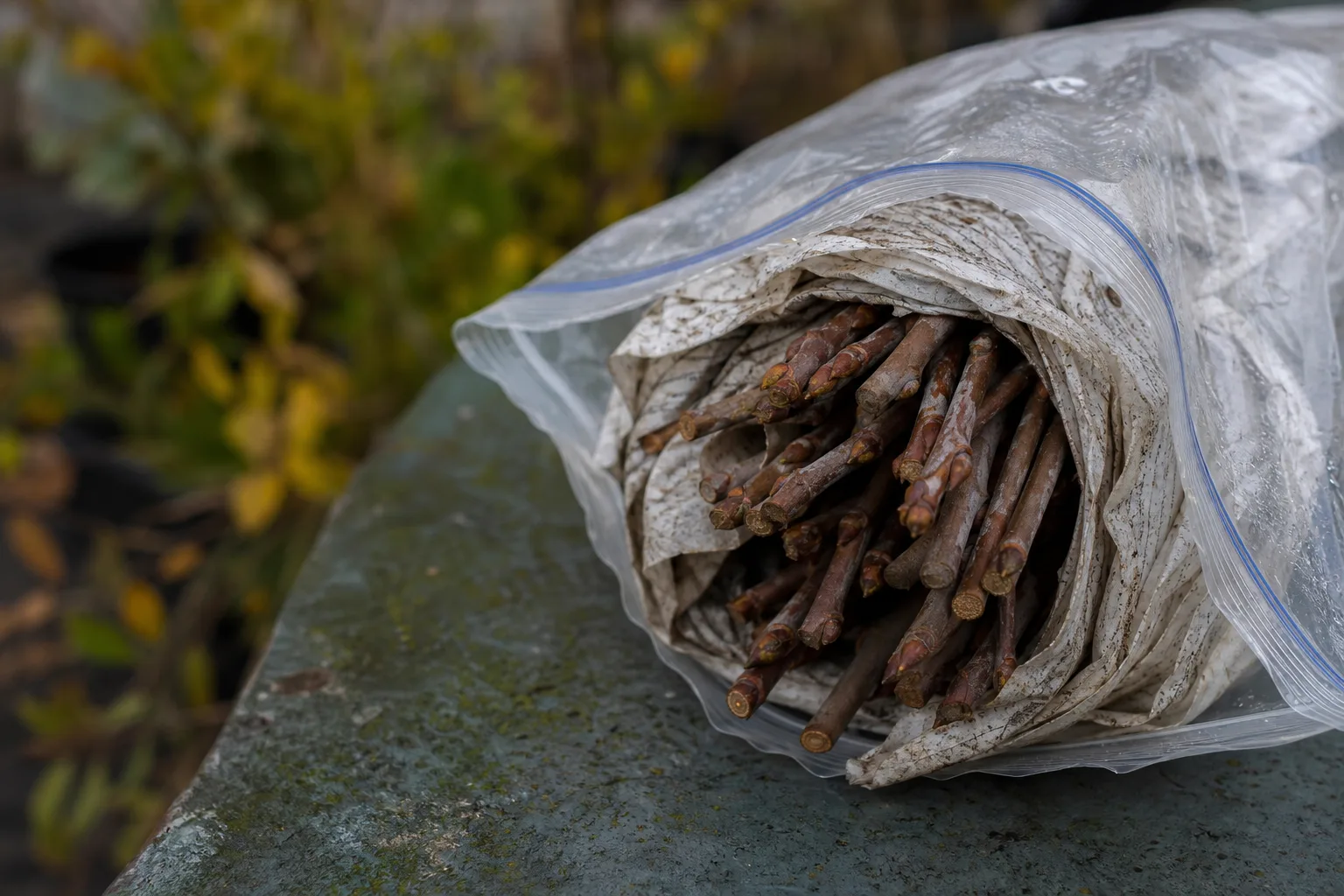
Wrap each labeled bundle in paper towel, old cloth, newspaper, or lightly moistened sphagnum, then seal it in a polyethylene or plastic bag; the material should feel moist but never hold standing water. A sealed bag slows moisture loss, while excess water encourages rot. Damp is the target. Wet is a failure mode.
Moisten the wrapping lightly and squeeze out extra water before placing the scions inside. The Agrarian Sharing Network specifically calls for moist material without standing water in the bag, and that distinction matters more than the brand of wrapping you use.
Newspaper is cheap and easy to find, but it tears when repeatedly opened. Cloth is reusable, but it can stay wetter near the cut ends. Sphagnum holds moisture well, but it is easy to use too much and turn a sealed bag into a small swamp.
You can optionally dip the cut ends in melted candle wax to help lock in moisture. Wax is not required, and it adds another handling step; if the wax is too hot, careless dipping can damage tissue, so I would use it only when I can keep the coating thin and the process controlled.
What temperature should scion wood be stored at?
Store sealed scion bundles in a refrigerator at about 34 to 38 degrees Fahrenheit, keeping them cool and damp but not frozen. The broader guidance allows roughly 30 to 45 degrees, but 34 to 38 is the range I would aim for because the wood needs cold storage without becoming ice-damaged.
Use a refrigerator that stays reliably cold, and check it with a thermometer rather than trusting the dial. A beer refrigerator or spare refrigerator can work, but it has a tradeoff: a separate unit gives you control, while a kitchen refrigerator is convenient and may fluctuate more often.
Keep scions away from fresh fruits and vegetables. The Orchard People storage guidance specifically recommends a cold storage area away from produce. That location also reduces the chance that someone opens the bundle every day to see whether winter is still happening.
Storage can last several weeks to a few months, depending on the material and conditions. Check the bundle after two weeks, then every few weeks for drying, mold, swelling buds, or standing water. Do not freeze the scions. Frozen wood is not cold storage. It is a different problem.
| Storage option | Best use | Honest downside |
|---|---|---|
| Kitchen refrigerator | Small bundles you can monitor easily | Temperature changes and produce storage can make conditions less consistent |
| Separate beer or spare refrigerator | Several labeled bundles needing steady cold storage | It costs money, space, and electricity |
| Cool storage area | Very short holding periods when conditions stay cold and damp | Temperature control is less reliable than a refrigerator |
Who is collecting and storing scion wood for?
This method suits a gardener who already knows the cultivar, can keep a refrigerator between 34 and 38 degrees Fahrenheit, and plans to graft within several weeks to a few months. It is not a good fit for someone who cannot identify the tree, has no dependable cold storage, or wants to cut green growing shoots in fall and hope the bag fixes the timing.
It also suits homeowners preserving a family tree, exchanging a known variety, or preparing material for spring grafting. If your goal is simply to grow a new tree from seed, scion storage is the wrong project because a scion is selected vegetative wood used to preserve a named variety.
You should ignore this method for now if the buds are already opening, the wood is soft, or your only storage spot freezes. In that case, collect closer to grafting time if the tree is still dormant, or wait for the next proper dormant season.
If you have several trees and do not know which one is worth preserving, get a concept for your yard can help you think through placement and the future size of the planting before you start taking wood. A graft is small. The tree it becomes is not.
What are the most common scion storage mistakes?
The common failures are cutting too early, choosing the wrong shoot, allowing the wrapping to dry out, soaking the bundle, losing the cultivar label, storing it above or below the target temperature, and waiting until buds open. Each mistake damages a different part of the process, but all of them cost you time before spring grafting.
Everyone says “keep it damp.” In practice, people often read that as “add more water,” then open the bag to find standing water and softened cut ends. The correct check is simple: the wrapping should be moist to the touch, with no puddle in the bag.
Another rule of thumb says any vigorous branch is good scion wood. In practice, a straight, healthy, pencil-thick terminal shoot is easier to cut, label, store, and graft than a wild water sprout. Fast growth does not erase poor position or uncertain maturity.
Do not store the bundle beside a freezer vent, against a freezing back wall, or in a drawer where it will be forgotten until April. Set a calendar reminder for two weeks after collection and another for the planned grafting date. Your refrigerator will not remind you. It has other duties.
Should I collect scion wood in fall?
No, wait until late winter when the buds are fully dormant and still enclosed in bud scales. Fall is the time to identify the cultivar, mark the tree, and plan your grafting materials. Cutting too early can give you wood that has not reached the proper dormant condition, while waiting too long lets the buds begin to open.
How thick should scion wood be?
Scion wood should be about pencil thickness, approximately 1/8 to 3/4 inch in diameter. Choose healthy, straight, one-year-old shoots rather than damaged wood, suckers, or water sprouts when possible. That size gives you enough material for a clean graft while keeping the piece manageable for labeling, wrapping, and refrigerated storage.
Can scion wood be frozen for storage?
No, scion wood should not be frozen. Store it sealed and cold at about 34 to 38 degrees Fahrenheit, with a broader acceptable range of roughly 30 to 45 degrees. Freezing is not a safer version of refrigeration, so keep the bundle away from freezer vents and any refrigerator wall that regularly develops ice.
How long can scion wood stay in the refrigerator?
Scion wood can stay refrigerated for several weeks to a few months when it remains fully dormant, sealed, and wrapped in a moist but not saturated material. Check the bundle after two weeks and then every few weeks. If the wood dries, molds, swells, or sits in water, its storage conditions need correction immediately.
Should scion wood be wrapped in wet paper towels?
Scion wood should be wrapped in paper towels, newspaper, cloth, or lightly moistened sphagnum that is damp but not wet enough to leave standing water. Wet paper towels can keep the cut ends saturated inside a sealed plastic bag and increase the chance of decay. Squeeze out excess water before wrapping the labeled bundle.
How do I know if scion wood is still dormant?
Scion wood is still dormant when its buds are tight and completely enclosed by bud scales, with no green tissue or opened leaves showing. Inspect the buds before cutting and again before grafting. If the buds have started to open, you waited too long for the cleanest storage window, even if the calendar still says winter.
This fall, make the labels and choose the tree, then leave the branches alone until late winter gives you tight buds and firm, pencil-thick shoots. Store the bundles cold, damp, and clearly marked, because spring grafting rewards preparation and punishes mystery.
Want a plan for your own yard?
Tell us the space and we will put a planting plan together for it. Start at get my concept, or browse what actually grows where you are over on plants.
Frequently asked questions
Should I collect scion wood in fall?
No, wait until late winter when the buds are fully dormant and still enclosed in bud scales. Fall is the time to identify the cultivar, mark the tree, and plan your grafting materials. Cutting too early can give you wood that has not reached the proper dormant condition, while waiting too long lets the buds begin to open.
How thick should scion wood be?
Scion wood should be about pencil thickness, approximately 1/8 to 3/4 inch in diameter. Choose healthy, straight, one-year-old shoots rather than damaged wood, suckers, or water sprouts when possible. That size gives you enough material for a clean graft while keeping the piece manageable for labeling, wrapping, and refrigerated storage.
Can scion wood be frozen for storage?
No, scion wood should not be frozen. Store it sealed and cold at about 34 to 38 degrees Fahrenheit, with a broader acceptable range of roughly 30 to 45 degrees. Freezing is not a safer version of refrigeration, so keep the bundle away from freezer vents and any refrigerator wall that regularly develops ice.
How long can scion wood stay in the refrigerator?
Scion wood can stay refrigerated for several weeks to a few months when it remains fully dormant, sealed, and wrapped in a moist but not saturated material. Check the bundle after two weeks and then every few weeks. If the wood dries, molds, swells, or sits in water, its storage conditions need correction immediately.
Should scion wood be wrapped in wet paper towels?
Scion wood should be wrapped in paper towels, newspaper, cloth, or lightly moistened sphagnum that is damp but not wet enough to leave standing water. Wet paper towels can keep the cut ends saturated inside a sealed plastic bag and increase the chance of decay. Squeeze out excess water before wrapping the labeled bundle.
How do I know if scion wood is still dormant?
Scion wood is still dormant when its buds are tight and completely enclosed by bud scales, with no green tissue or opened leaves showing. Inspect the buds before cutting and again before grafting. If the buds have started to open, you waited too long for the cleanest storage window, even if the calendar still says winter.
Free, no obligation
Ready to design your dream landscape? Start here.
Tell us where you are and we will start a free profile for you, with plants that actually survive your climate and a real sense of what the build would cost.