
Can You Fix Included Bark Before a Fruit Tree Limb Fails?
A narrow crotch in a young fruit tree is a structural problem, but it is still correctable before included bark forms. Here is how to inspect the union, spread the angle, remove the right branch, and prune safely this fall.
September 30, 2026
By Diego Navarro
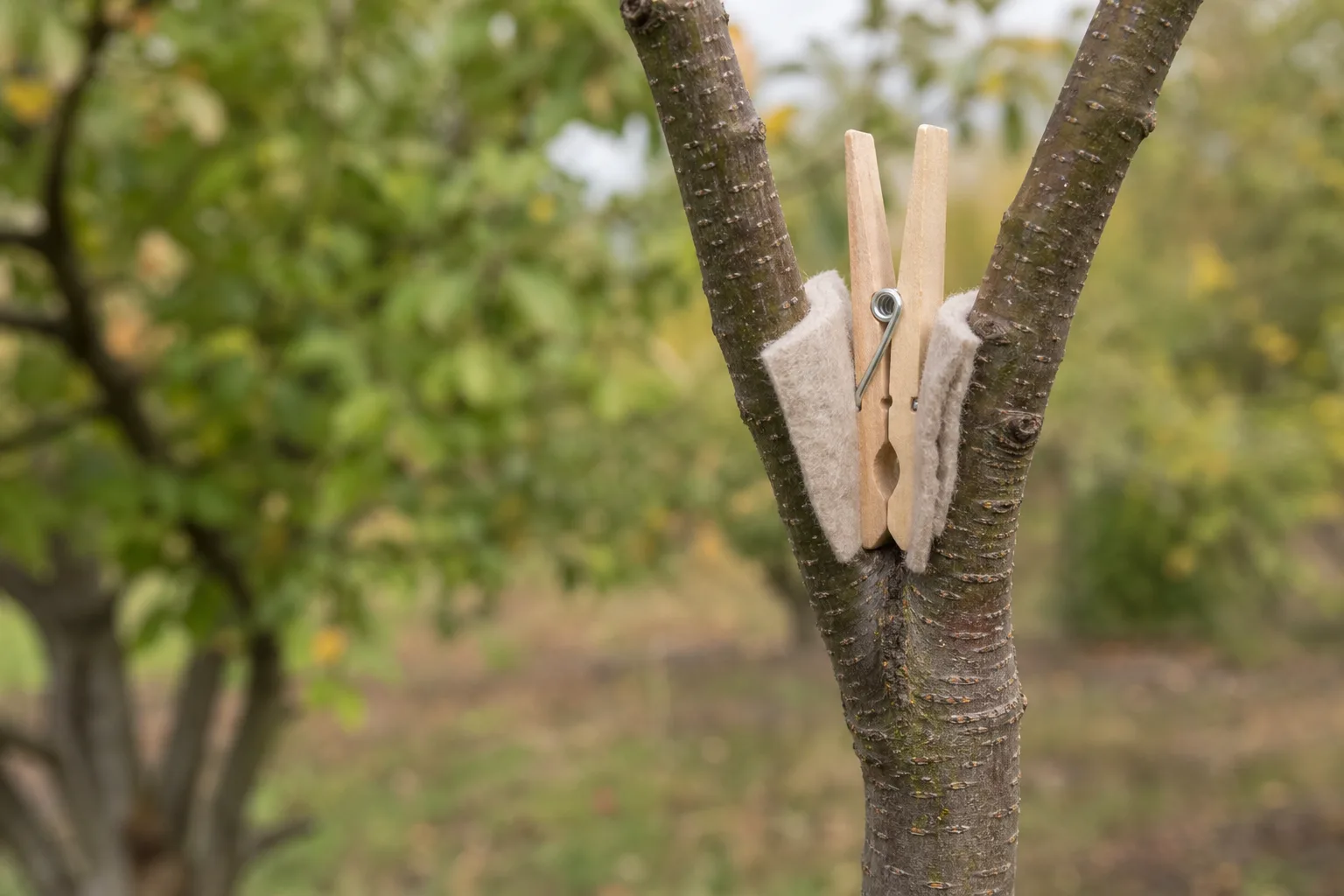
A narrow crotch in a young fruit tree is a structural defect, but you can often correct it before included bark forms by widening the union with a toothpick or clothespin and removing the weaker competing limb. If bark is already trapped deeply between large stems, do not pry it apart. Reduce the load or call an arborist.
Can I fix included bark before a fruit tree limb fails?
You can correct a narrow young crotch before included bark develops, but you cannot make mature included bark disappear by forcing the stems apart. Young branches can be trained while they are flexible; large codominant limbs need careful reduction or removal because the bark trapped between them can contribute to failure. NC State Extension describes narrow crotch angles as weaker and capable of leading to included bark.
First, stand back and find the place where two stems leave the trunk or one another. If the branches rise almost straight up and press together, you have a problem worth fixing now, not after the first ice storm or a heavy crop.
I learned this lesson in a twelve foot strip of New Jersey clay beside my father's tomatoes. We trained young stems early because moving a pencil-sized branch was simple, while moving a thumb-sized one meant bruised bark and a bad evening. The tree does not care that you meant well.
A narrow angle is not automatically an emergency. A young branch that bends without cracking can usually be trained over several weeks, while a split, hanging limb, or union with a visible seam needs a different response.
What does included bark look like on a young fruit tree?
Included bark appears when bark becomes trapped in a tight branch union instead of the branches forming a broad, strong connection. Look for two stems joined in a sharp V, a dark line running down between them, raised bark ridges on both sides, rubbing, cracks, or one stem leaning away under fruit weight. Those signs justify correcting the structure before the limb gets large.
Inspect the tree from the ground, then crouch close enough to see the union without tugging it. Check for dead, diseased, damaged, or crossing branches, because those defects add clutter and can hide the main structural problem. NC State Extension recommends pruning and training to create a strong framework for fruit production. Its pruning guidance explains the role of branch structure and narrow crotches.
Measure the angle with your eye first, then use a ruler or a phone photo for comparison. A nearly vertical V is the one I would address first. You do not need a perfect number, but a broad U-shaped union has more room for wood to form between the stems.
Do not pull hard on a branch to test it. If the bark lifts, the union opens, or you hear a crack, stop and remove weight only if you can do it safely from the ground.
How wide should a young fruit tree crotch be?
Aim for a broad, open crotch rather than a tight V, with the two branches separated enough that they are not rubbing and can carry fruit without pressing together. For flexible young growth, a practical starting point is roughly 45 to 60 degrees from the trunk, adjusted so the branch remains attached without bending sharply or tearing bark.
The exact angle is less useful than the condition of the branch. A branch forced outward until it creases is not trained, it is injured. Leave enough spring that the stem can move in wind while the support holds the general position.
Use temporary spacing for four to eight weeks, then inspect the bark. If the branch stays open after the support comes off, you are making progress. If it springs back within a day, replace the support for another few weeks rather than tightening it harder.
Everyone says to spread a branch as far as possible. In practice, gentle spacing wins because sudden pressure can split the union you were trying to save. Trees are patient. They also remember every bad cut.
How do I use a toothpick or clothespin to open the crotch?
Use a clean toothpick or clothespin only on a young, flexible branch that is roughly pencil-sized or smaller and has no crack at the union. Place the spacer between the stems, adjust it until the branch sits in a wider position, and check the bark after one day, one week, and four weeks.
A toothpick works for a very small shoot because it creates a little separation without a strap around the bark. Its downside is that it can fall out, press into swelling tissue, or be too weak once the branch thickens.
A clothespin can hold a slightly stronger shoot, but its downside is pressure. Pad the contact point with a small piece of soft cloth, keep the grip loose enough that bark is not pinched, and remove it after four to eight weeks.
Do not use wire, bare cord, or a tight zip tie as a permanent brace. Those materials can constrict the expanding branch, and the restraint can become another defect. If you need a rigid brace to hold the limb, it is probably too large for this simple training method.
| Correction option | Best use | Honest downside |
|---|---|---|
| Toothpick spacer | Very young, pencil-sized shoots with a tight V | Falls out easily and can press into swelling tissue |
| Clothespin spacer | Flexible shoots that need steadier separation | Can pinch bark if left tight or forgotten |
| Selective pruning | A competing or crossing branch that is already too stiff | Removes leaf area and fruiting wood, and a bad cut creates a new defect |
| Remove and retrain | A cracked, dangerous, or deeply included limb | Leaves a larger wound and may change the tree's shape for several seasons |
Which branch should I remove from a narrow crotch?
Remove the branch that is crossing, rubbing, cracked, badly attached, dead, diseased, damaged, or growing straight through the center of the canopy, provided the cut can be made safely. If both stems are healthy and young, keep them temporarily and spread them; if one is much larger or already splitting the union, reduce or remove the weaker-positioned stem rather than forcing it apart.
Start with the smallest clear correction. Removing every upright branch at once can leave a sparse tree with too little leaf area and can trigger vigorous shoots in the wrong places. Young fruit trees need a framework, not a haircut.
A crossing branch has a plain cost: the limbs rub, wounds open, and the original defect remains hidden until the branch is larger. Guidance for young tree pruning also emphasizes removing branches that cross one another while the tree is young. Arkansas gardening guidance makes the same point for building a strong branching structure.
If the branch is hanging, split, or close to a walkway, do not wait for the ideal training window. A dangerous limb is a removal problem first. Keep both feet on the ground and hire help for anything requiring a ladder, chainsaw, or work near wires.
Where should I cut a branch with included bark?
Make a removal cut just outside the branch collar and branch bark ridge, without cutting flush against the trunk and without leaving a long stub. The collar is the swollen area where the branch joins the trunk; preserving it lets the tree close the wound more effectively than a flat trunk cut. NC State's pruning guidance illustrates the correct collar-cut position and the damage caused by bark inclusion.
Use sharp bypass pruners for small branches, loppers only when the branch fits cleanly within their capacity, and a saw for anything larger. The tradeoff with hand pruners is that forcing them through a thick branch crushes tissue, while a saw takes longer but makes a cleaner controlled cut.
Cut outside the collar in one deliberate motion when possible. Do not paint the wound, carve the cut smooth, or cut into the trunk to chase every dark line. Those extra actions enlarge the wound without repairing the structural defect.
For a branch that is too large to remove safely, reduce its end weight only as a temporary measure and get an arborist's assessment. The Pacific Northwest International Society of Arboriculture identifies structural defects and excess end weight as causes of tree failure that correct pruning can address.
Should I prune a narrow crotch in fall?
Fall is a good time to inspect a young fruit tree and make a limited structural correction, especially after leaves thin enough to reveal the union, but timing depends on the tree and local disease pressure. Train flexible shoots now, remove dead or dangerous wood, and avoid large unnecessary cuts when wet weather or freezing conditions are close.
In Central Texas, I inspect fruit trees in October and November, then make small cuts on a dry day when the wood is easy to see. I avoid turning a young tree into a bare collection of stubs just because the calendar says pruning season.
Do not prune an oak during the months when oak wilt spread is a concern, but do not confuse that rule with every fruit tree. Sanitize tools between cuts if you are moving from diseased wood to healthy wood, and postpone work if the bark is wet or the tree is stressed.
After training, mark the date on your calendar for four weeks and again for late winter. A clothespin forgotten until spring can become a tight band around a growing shoot. That is not a training tool anymore.
Who should correct a narrow fruit-tree crotch now, and who should wait?
This correction suits a homeowner with a young fruit tree, flexible branches, a visible narrow V, and safe ground-level access. Wait or hire an arborist if the union is large and cracked, the limb is over a roof or path, the tree needs a ladder, or bark is already deeply included around a major codominant stem.
A two-year-old peach, apple, pear, or similar fruit tree with pencil-sized competing shoots is a good candidate for a toothpick, clothespin, or careful selective cut. The tradeoff is that you must inspect it every week for pressure and rubbing.
A mature tree with two heavy trunks is not a weekend spacer project. The downside of guessing is a large wound, a damaged trunk, or a failed limb that costs more than the original pruning would have.
If you are unsure which stem is the permanent leader, take clear photos from three sides and use the plant database to check the tree's mature habit and pruning notes. If the whole framework needs planning rather than one correction, you can get a concept for your yard before you start cutting.
What should I do to a narrow fruit-tree crotch while standing in the garden this fall?
Photograph the union, remove only dead, diseased, damaged, or clearly crossing wood, and place a loose toothpick or padded clothespin between flexible stems if the bark is intact. Recheck the spacing after one week and four weeks, then remove the support after four to eight weeks if the branch holds its position.
Here is my fall sequence:
- Look from three sides and identify the trunk, the main leader, and the competing branches.
- Check for a crack, bark seam, rubbing, or movement at the union.
- Remove dangerous or damaged wood first, using a collar cut and clean tools.
- Spread a flexible young branch gently, stopping before the bark creases.
- Write the inspection dates on a tag or in your phone: one week, four weeks, and eight weeks.
- Recheck after the first heavy fruit set, because fruit weight can pull a repaired branch back into a narrow angle.
Do not add fertilizer to solve a structural problem. Extra growth can make the branch larger before the attachment is strong enough, while spacing and selective pruning address the actual defect.
The goal is not a tree that looks symmetrical from the kitchen window. The goal is a framework that stays attached when fruit, wind, and one inconvenient storm all arrive together.
What are the most common questions about fixing included bark?
The short answers below cover the decisions most homeowners face in fall: whether a young crotch can be changed, how long to leave a spacer, when to remove a branch, and when the job has become too large for hand tools. Each answer starts with the action that matters most.
Can a young fruit tree recover from a narrow crotch?
Can a young fruit tree recover from a narrow crotch? Yes, if the branches are flexible, the bark is intact, and you widen the angle before the union becomes deeply included. Use gentle training for four to eight weeks and remove a crossing or damaged branch when needed. A mature cracked union is a different problem and may require an arborist.
How long should I leave a clothespin on a fruit tree branch?
How long should I leave a clothespin on a fruit tree branch? Leave it for about four to eight weeks, checking after one day, one week, and four weeks for pinched bark, rubbing, or a branch that has sprung back. Remove it sooner if the stem swells against the clothespin. Its tradeoff is simple: it holds well, but it can injure bark if forgotten.
Can I pry apart included bark on a large branch?
Can I pry apart included bark on a large branch? No, do not pry apart a large union because the pressure can split living wood and turn a structural defect into an immediate failure. Reduce the load only if you can do so safely from the ground, then have an arborist assess a large, cracked, or overhead limb.
Should I remove both branches in a narrow V?
Should I remove both branches in a narrow V? No, usually keep one sound branch and train or selectively remove the other, rather than removing both and leaving a large bare section. Keep both temporarily if they are young, flexible, and uninjured. Removing both can reduce leaf area, change the tree's balance, and create a larger wound than necessary.
Where do I cut a branch with included bark?
Where do I cut a branch with included bark? Cut just outside the branch collar and branch bark ridge, leaving the collar attached to the trunk and avoiding a flush cut or long stub. Use sharp tools suited to the branch size. If the branch is large, overhead, cracked, or near a wire, stop and hire an arborist.
Is fall too late to correct a young fruit-tree crotch?
Is fall too late to correct a young fruit-tree crotch? No, fall is often a useful inspection window because leaf drop exposes the structure, and a flexible young branch can be trained with a loose spacer. Make small corrections on a dry day, avoid unnecessary large cuts, and check the support again after one week and four weeks.
Want a plan for your own yard?
Tell us the space and we will put a planting plan together for it. Start at get my concept, or browse what actually grows where you are over on plants.
Frequently asked questions
Can a young fruit tree recover from a narrow crotch?
Can a young fruit tree recover from a narrow crotch? Yes, if the branches are flexible, the bark is intact, and you widen the angle before the union becomes deeply included. Use gentle training for four to eight weeks and remove a crossing or damaged branch when needed. A mature cracked union is a different problem and may require an arborist.
How long should I leave a clothespin on a fruit tree branch?
How long should I leave a clothespin on a fruit tree branch? Leave it for about four to eight weeks, checking after one day, one week, and four weeks for pinched bark, rubbing, or a branch that has sprung back. Remove it sooner if the stem swells against the clothespin. Its tradeoff is simple: it holds well, but it can injure bark if forgotten.
Can I pry apart included bark on a large branch?
Can I pry apart included bark on a large branch? No, do not pry apart a large union because the pressure can split living wood and turn a structural defect into an immediate failure. Reduce the load only if you can do so safely from the ground, then have an arborist assess a large, cracked, or overhead limb.
Should I remove both branches in a narrow V?
Should I remove both branches in a narrow V? No, usually keep one sound branch and train or selectively remove the other, rather than removing both and leaving a large bare section. Keep both temporarily if they are young, flexible, and uninjured. Removing both can reduce leaf area, change the tree's balance, and create a larger wound than necessary.
Where do I cut a branch with included bark?
Where do I cut a branch with included bark? Cut just outside the branch collar and branch bark ridge, leaving the collar attached to the trunk and avoiding a flush cut or long stub. Use sharp tools suited to the branch size. If the branch is large, overhead, cracked, or near a wire, stop and hire an arborist.
Is fall too late to correct a young fruit-tree crotch?
Is fall too late to correct a young fruit-tree crotch? No, fall is often a useful inspection window because leaf drop exposes the structure, and a flexible young branch can be trained with a loose spacer. Make small corrections on a dry day, avoid unnecessary large cuts, and check the support again after one week and four weeks.
Free, no obligation
Ready to design your dream landscape? Start here.
Tell us where you are and we will start a free profile for you, with plants that actually survive your climate and a real sense of what the build would cost.