
Are Ducks Good for Slug Control? What They Eat and What They Wreck
Ducks can be a better garden companion than chickens, but they are not a tidy slug-control machine. Here is what I would expect from ducks in a fall garden, what they may damage, and why ponds and water tubs need more protection than your vegetables.
October 4, 2026
By Valeria Navarro
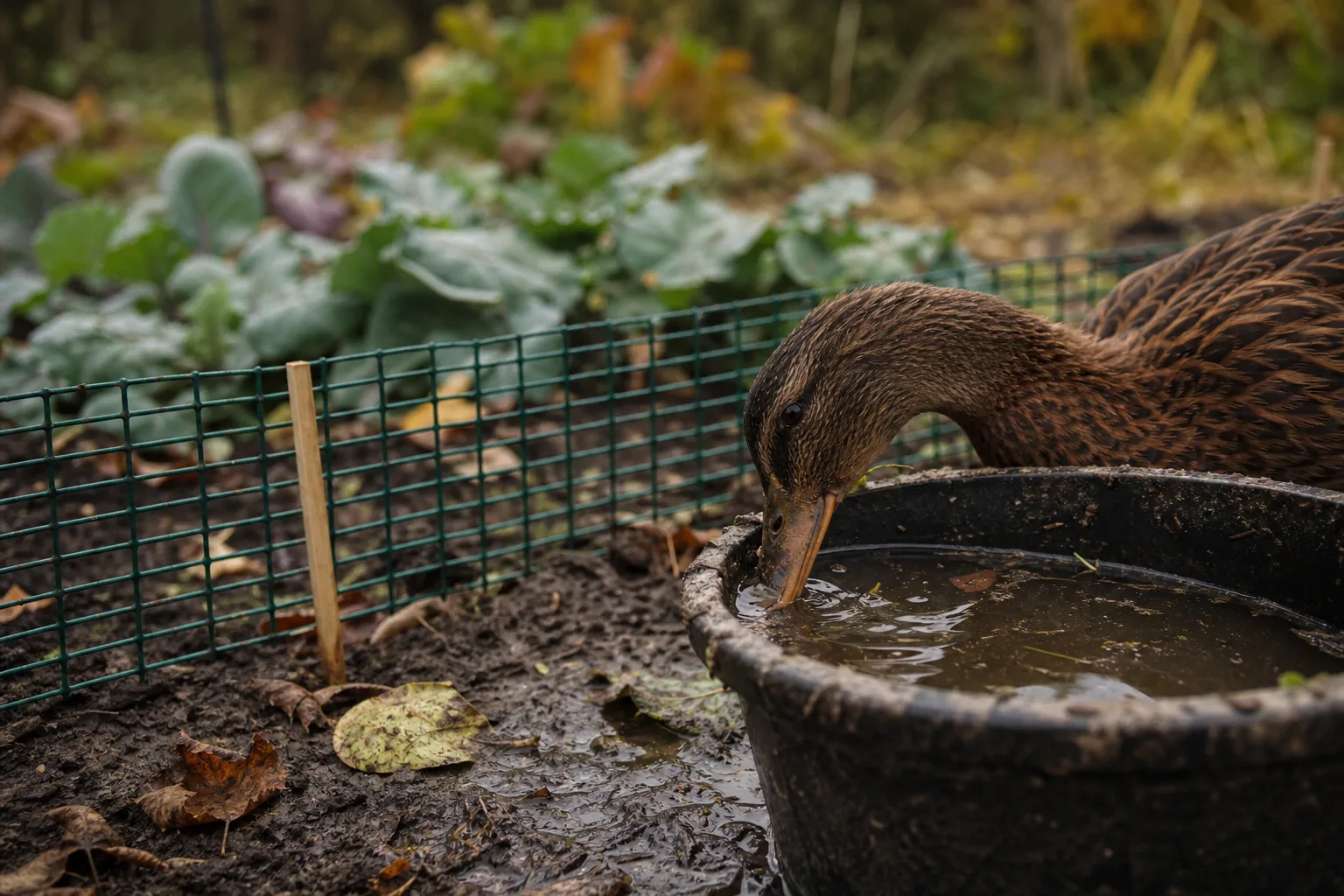
Ducks can be a better garden companion than chickens, but they are not a tidy slug-control machine. I would use them as supervised pest foragers near protected beds, never as the whole slug plan, because their broad diet can cost you seedlings, mulch, soil structure, and a clean pond.
Do ducks actually eat slugs?
Ducks may eat slugs while foraging, but the supplied research does not establish slugs as a preferred food or prove that ducks provide dependable slug control. The honest answer for your fall garden is maybe, not magic: ducks eat broadly, so they may sample slugs alongside feed, greens, insects, and anything else they can reach.
The feed source describes an organic whole grain layer mash as suitable for ducks and all waterfowl, and it characterizes ducks and chickens as animals that eat broadly according to the product listing. That supports a wide-diet argument. It does not support promising you a slug-free bed.
This distinction matters in November. Slugs hide under boards, dense debris, and damp cover, while a duck may wander past the hiding place and go straight for the tender thing you planted yesterday. I have killed enough basil to know that “it eats pests” is not a complete garden plan.
My position is simple: let ducks contribute to slug pressure, but measure success by fewer damaged leaves over several weeks, not by the number of ducks you add. If you need certainty, use hand checks at dusk and remove hiding places too. Those methods take time, but they do not have bills.
Do ducks actually eat slugs?
Ducks may eat slugs, but the supplied research does not prove that slugs are a preferred food or that ducks reliably control them. Their broad diet makes slug foraging plausible, yet you should expect ducks to investigate edible plants, feed, soil, and damp hiding places too, so use them as one part of a supervised fall garden plan.
Are ducks better than chickens in a garden?
I would choose ducks over chickens for a garden where the main goal is gentle ground foraging, but only if the beds are protected and water is managed separately. The supplied sources support a broad diet for both birds, not a measured damage comparison, so “better” here is my practical design judgment, not a proven trial result.
Chickens scratch. That is the part people forget while admiring the eggs. A chicken group can turn a loose mulch surface into bare ground quickly, and the same behavior that exposes insects can disturb shallow roots and young plants.
Ducks have a bill rather than the chicken’s scratching habit, so I prefer them beside established paths and between mature planting areas. That does not make ducks gentle. A broad diet still means they may sample leaves, pull at small plants, and press wet ground into a mess.
The trade is worth it in a specific garden: ducks can patrol without making scratching the main event, but they need more water planning and more cleanup. In Austin’s alkaline clay, wet traffic can become a slick patch, then a hard crust when the weather dries. That is not pest control. That is a new project for Diego and me to disagree about.
Are ducks better than chickens for garden pest control?
Ducks are my choice over chickens for supervised garden foraging because chickens scratch and ducks are easier to place beside established beds without making scratching the main disturbance. The comparison is a design judgment, not a source-backed trial result. Ducks still have a broad diet, can damage young plants, and create more water-management work.
What do ducks eat besides slugs?
Ducks should be treated as broad-diet animals, not specialist slug hunters. The supplied feed listing says its whole grain layer mash suits ducks and all waterfowl, and its wording presents ducks and chickens as eating broadly in the product description, so assume anything reachable may become part of their investigation.
That includes their proper feed, tender garden growth, fallen scraps, damp organic material, and whatever small creatures they encounter. The research does not give a preferred-food list, so I will not pretend that ducks choose slugs over seedlings. They may. They may also make your most expensive fall planting their first course.
Feed belongs in a controlled station, not scattered through the beds. Layer mash has a clear benefit, which is that it gives ducks a designated food source, but it also has a cost: spilled grain attracts attention, becomes waste, and can make your pest-control area less tidy.
Your fall rule should be boring and firm. Feed the ducks away from crops, supervise their garden time, and remove them before dusk if you cannot see what they are doing. Boring keeps the greens alive. I say this as someone who once trusted a charming little flock around herbs and regretted my optimism before dinner.
Which garden areas should ducks avoid?
Ducks should avoid new seedlings, loose mulch, freshly planted bulbs, soft soil, and any bed where you cannot replace damaged plants. I would allow access only beside established paths or mature plantings after a short supervised test, because the research supports broad eating but gives no safe-plant list or reliable damage threshold.
Protect the things that are small, expensive, or slow to recover. A fall garden can look sturdy while roots are still settling, and a duck does not understand that your tiny transplant is the one you counted on for Thanksgiving greens.
Raised beds are useful because they create a physical boundary, but they are not a duck-proof system by themselves. Their downside is cost and access. You still need a gate, low mesh, or another barrier that prevents the birds from walking straight through the planting area.
A temporary enclosure is cheaper and more flexible. Its downside is daily moving and checking, plus the fact that it turns “let the ducks help” into a chore. I would rather move a small enclosure for two weeks than replant a bed in December.
If you are redesigning rather than improvising, use the plant database to choose plants by mature size and site conditions, then keep ducks away from the new planting zone until the plants are established. A database cannot make a duck polite, but it can help you stop buying fragile plants for a high-traffic area.
How much water do ducks need in a garden?
Ducks need a dedicated water setup deep enough for normal bill and head washing, but the supplied research does not provide a volume, cleaning schedule, or equipment standard. My garden recommendation is to separate their water from ornamental features and inspect it daily, because a broad-diet bird with a bill, feathers, webbing, and wings is a poor match for a delicate water display.
A shallow decorative bowl is easy to tip and soil quickly. A deeper tub is more stable, but it is heavier, uglier, and harder to empty. A stock tank holds more water, yet it takes more space and turns cleaning into a real maintenance job.
The source material lists bill, feathers, webbing, and wings as defining duck features in the duck-feature listing. That is not a husbandry manual, but it is enough to make the design lesson plain: ducks are built around water, and water will follow them into places you hoped would stay clean.
Keep the bird water on a surface that can drain without sending muddy runoff into beds. In Austin, I would not place it over thin soil above limestone or beside a path you use after every rain. Put it where a spill is acceptable, because the first week of autumn rain will show you exactly where your drainage plan was pretending.
Can ducks share a garden pond?
Ducks can share a pond only if you accept more disturbance, debris, and cleaning than an ornamental pond usually allows. The research provided does not specify pond damage, but ducks’ broad diet and physical features support a cautious design. I would give ducks a separate working tub and keep a planted or lined water feature outside their enclosure.
What do ducks wreck in a water feature?
Ducks can wreck the cleanliness and planting of a water feature more readily than the structure itself, and the research provided does not prove specific liner, pump, or pond damage. I would still keep them away from ornamental water because their broad diet and water-oriented bodies create an obvious risk of debris, muddy edges, disturbed plants, and extra maintenance.
A planted pond is the worst place to test your optimism. Young marginal plants are reachable. Loose soil at the edge becomes a traffic zone. Water that looked clear on Friday may look like a worksite after a weekend of enthusiastic bird activity.
A lined pond has a different weakness. Its liner may survive, but a muddy approach can hide the edge and create a slipping hazard for birds and people. A pump or filter also adds a maintenance burden, and the provided research gives no basis for promising that ducks will leave either alone.
This is why I say ducks are harder on water features than chickens as a design judgment, not as a measured scientific comparison. Chickens can still damage a pond edge by scratching, but ducks are the birds I would plan around if water is part of the landscape.
Should you get ducks for slug control this fall?
Get ducks for slug control only if you already want ducks, have a secure enclosure, can provide separate water, and can protect young crops. Ignore the idea if your garden depends on a pristine pond, you cannot supervise access, or you need guaranteed slug reduction, because the supplied research does not prove ducks deliver that result.
This suits a small homestead with established beds, a spare corner for a water station, and time for daily observation. A homestead class specifically discusses incorporating chickens, ducks, and pigs into small-scale systems and the value of using them together in its course description. That supports integration as a homestead approach, not a promise that ducks solve one pest.
It does not suit a balcony garden, a brand-new raised-bed installation, or a decorative pond with delicate edge planting. It also does not suit a household that will resent cleaning water every day. The bird is not the problem there. The mismatch is.
If you want a tailored layout before buying anything, use get a concept for your yard. Show the beds, gates, water feature, and the place where a tub could drain. The right question is not “Can ducks eat slugs?” It is “Can my yard absorb ducks without losing the things I built it to enjoy?”
Who should ignore ducks for slug control?
Ignore ducks for slug control if you have a delicate pond, newly planted beds, no secure enclosure, or no time for daily water and access checks. Ducks also make a poor choice if you need guaranteed slug reduction, because the supplied research supports a broad diet but does not prove that ducks prefer slugs or control them reliably.
How should you test ducks in a garden without wrecking it?
Test ducks in one empty or established section for one week before giving them wider access. Use a temporary barrier, keep feed and water outside the crop bed, inspect the soil and leaves each day, and stop the trial if damage appears faster than the slug problem improves.
Start with fifteen minutes of supervised access on the first day. Increase by fifteen minutes every two days only if the ground remains stable and the plants remain intact. Those numbers are my risk-control rule, not a research finding, and they give you a clean way to change course before the garden pays for your experiment.
Record four things: damaged leaves, visible slugs, muddy ground, and water cleanup. Do it for seven days. If the ducks reduce nothing you care about but create three new chores, the answer is already there.
Compare that trial with hand-picking slugs at dusk and removing damp hiding debris. Hand-picking costs your time and feels very unglamorous. Ducks cost feed, fencing, water, and supervision, so choose the method you can actually repeat for four weeks.
| Option | Best use | Honest downside |
|---|---|---|
| Ducks | Supervised foraging beside established garden areas | Broad diet, muddy water, and possible damage to young plants |
| Chickens | Homestead systems where scratching and soil disturbance are acceptable | Scratching can disturb mulch, soil, and shallow-rooted plants |
| Hand checks | Small beds where you want direct control | Requires repeated evening labor and does not suit a large garden |
How long should a duck garden trial last?
Run a duck garden trial for seven days, beginning with fifteen minutes of supervised access and increasing time only when plants and soil remain stable. A week is long enough to reveal whether the birds create useful pest pressure or simply add cleanup. These timings are my risk-control recommendation, not a research-backed husbandry standard.
Fall is the right season to test because you are standing in the garden now, before spring planting makes every mistake more expensive. Walk the route first. Block the pond. Protect the little plants. Then let the ducks show you what kind of neighbors they are.
What is the safest duck setup for a garden?
The safest duck setup is a secure enclosure beside, not inside, the growing beds, with a separate working water container placed where spills can drain safely. Add supervised access only to established areas. This arrangement protects seedlings and ornamental water while still letting you evaluate whether duck foraging helps your garden.
I would choose a simple, washable water station over a pretty feature. Its downside is visual clutter, but clutter is cheaper than rebuilding a pond edge or replacing a bed. Keep the setup close enough to inspect daily and far enough from crops that one tipped container does not flood your roots.
You are not trying to make ducks behave like garden tools. They are living, broad-diet animals. Give them a useful lane, give the garden a boundary, and let the relationship stay honest.
Are ducks worth it for slug control?
Ducks are worth it for slug control only when you already want ducks and can provide protected beds, separate water, and daily supervision. They may eat slugs, but the supplied research does not prove reliable control. Choose them for the whole homestead relationship, not for a single pest promise.
That is the line I would use in my own Austin yard. Better than chickens for my garden layout, harder on water features, and never a substitute for noticing what is happening under the leaves.
Want a plan for your own yard?
Tell us the space and we will put a planting plan together for it. Start at get my concept, or browse what actually grows where you are over on plants.
Frequently asked questions
Do ducks actually eat slugs?
Ducks may eat slugs, but the supplied research does not prove that slugs are a preferred food or that ducks reliably control them. Their broad diet makes slug foraging plausible, yet you should expect ducks to investigate edible plants, feed, soil, and damp hiding places too, so use them as one part of a supervised fall garden plan.
Are ducks better than chickens for garden pest control?
Ducks are my choice over chickens for supervised garden foraging because chickens scratch and ducks are easier to place beside established beds without making scratching the main disturbance. The comparison is a design judgment, not a source-backed trial result. Ducks still have a broad diet, can damage young plants, and create more water-management work.
Can ducks share a garden pond?
Ducks can share a pond only if you accept more disturbance, debris, and cleaning than an ornamental pond usually allows. The research provided does not specify pond damage, but ducks’ broad diet and physical features support a cautious design. I would give ducks a separate working tub and keep a planted or lined water feature outside their enclosure.
Who should ignore ducks for slug control?
Ignore ducks for slug control if you have a delicate pond, newly planted beds, no secure enclosure, or no time for daily water and access checks. Ducks also make a poor choice if you need guaranteed slug reduction, because the supplied research supports a broad diet but does not prove that ducks prefer slugs or control them reliably.
How long should a duck garden trial last?
Run a duck garden trial for seven days, beginning with fifteen minutes of supervised access and increasing time only when plants and soil remain stable. A week is long enough to reveal whether the birds create useful pest pressure or simply add cleanup. These timings are my risk-control recommendation, not a research-backed husbandry standard.
What is the safest duck setup for a garden?
The safest duck setup is a secure enclosure beside, not inside, the growing beds, with a separate working water container placed where spills can drain safely. Add supervised access only to established areas. This arrangement protects seedlings and ornamental water while still letting you evaluate whether duck foraging helps your garden.
Are ducks worth it for slug control?
Ducks are worth it for slug control only when you already want ducks and can provide protected beds, separate water, and daily supervision. They may eat slugs, but the supplied research does not prove reliable control. Choose them for the whole homestead relationship, not for a single pest promise.
Free, no obligation
Ready to design your dream landscape? Start here.
Tell us where you are and we will start a free profile for you, with plants that actually survive your climate and a real sense of what the build would cost.