
Do Ollas Work for Garden Irrigation?
Ollas are a practical, low-tech way to keep small garden beds evenly watered, especially through hot Central Texas weather. Here is how to bury them, space them, refill them, and know when this ancient method is worth using instead of drip irrigation.
October 2, 2026
By Diego Navarro
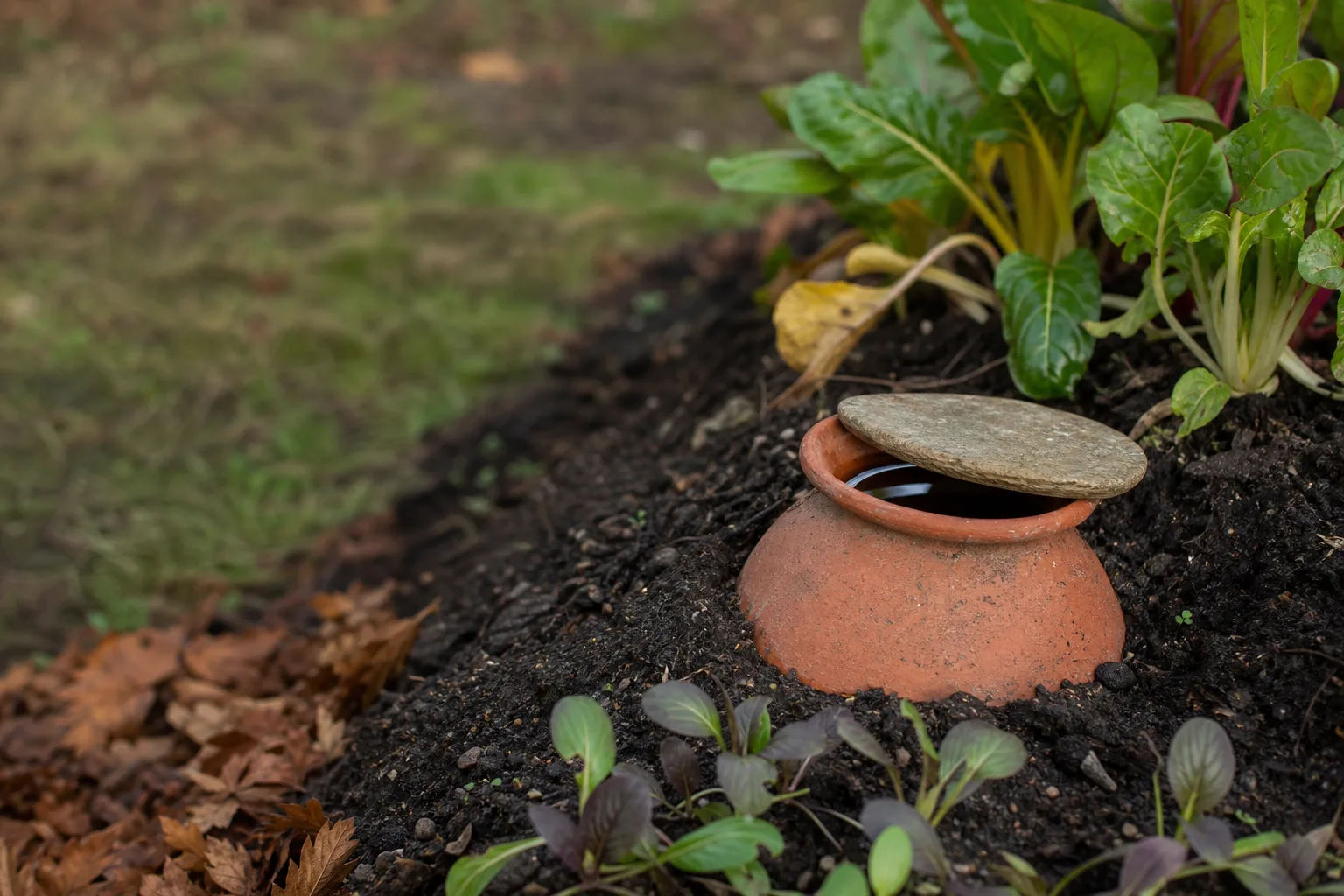
Ollas are worth using in a small garden bed, especially for fall vegetables, herbs, and container plantings where you can reach every pot and refill it easily. The unglazed clay releases water into nearby soil as the soil dries, but an olla is not a magic underground sprinkler, and it loses to drip irrigation once the bed gets large.
How do ollas water plants?
An olla is an unglazed clay vessel buried with only its neck above the soil, then filled with water so moisture can move gradually through the porous walls into the surrounding root zone. That is the same porous-clay principle used by smaller terracotta watering spikes made for pots, as this description of terracotta watering spikes explains.
The clay does not spray water outward. Soil beside the pot takes up moisture as it dries, while wetter soil slows the movement. That makes an olla steadier than dumping a watering can on the surface, although the trade-off is a limited wetting circle.
For a small bed, use a vessel between 1 and 2 gallons. A 1 gallon olla usually suits about 8 to 12 square feet of closely planted soil, while a 2 gallon vessel can serve roughly 16 square feet if the soil is open and roots can reach it.
Unglazed clay is the method's strength and its weakness. It can release water through its walls, but it can also crack from impact, freeze damage, or rough handling, so inspect it before burying it each season.
Are ollas useful in a fall garden right now?
Yes, fall is a good time to install ollas because young greens and herbs need consistent moisture while their roots establish, and cooler weather makes refilling less frequent than in August. In Central Texas, install one before planting or beside existing plants, fill it completely, and watch the soil for seven days before deciding whether the spacing works.
If you are standing in the garden in October, clear away mulch from the planting spot and dig the hole 1 inch wider than the pot. Set the olla so its shoulder is below the soil and its neck rises 1 to 2 inches above it, then firm soil around the outside without packing clay against the vessel.
Lettuce benefits from the even moisture but bolts when warm weather returns, so its trade-off is a short harvest window. Cilantro handles the cooler fall season well but can flower quickly after a warm spell, which means an olla supports establishment but cannot change the calendar.
For Austin beds, refill every 3 to 7 days in October and November, depending on sun, wind, soil, and plant size. If the pot is still full after a week, your spacing may be too tight or the bed may be staying wetter than the plants need.
How far apart should you bury ollas?
Place 1 gallon ollas 18 to 24 inches apart in a small bed, with plants generally 6 to 12 inches from the vessel wall. Use one 2 gallon olla for about a 4 by 4 foot bed only when the soil is reasonably loose and planted densely enough for roots to reach the moist zone.
Everyone says an olla waters a wide circle. In practice, hard dry clay and compacted soil can leave dry pockets between vessels, while loose amended soil lets moisture travel farther. The soil decides. It always gets a vote.
I would place two 1 gallon ollas in a 4 by 4 foot bed, not one large pot in the center, if the bed contains mixed greens, herbs, and young peppers. Peppers enjoy steady moisture but can sulk in cold fall soil, so their trade-off is that they may stop producing before the olla becomes the limiting factor.
Keep at least 6 inches between the olla and a plant stem. A plant touching the neck can crowd the opening, hide the water level, and make it harder to lift the lid without bruising leaves.
How do you install and fill an olla?
Dig a hole deep enough to bury the rounded body while leaving the opening above the soil, place the olla upright, and backfill around it in thin layers so there are no large air gaps. Add a lid or flat stone, fill with clean water, and check the water level after 48 hours before adding mulch.
Do not force a pot into a hole that is too small. I have used a rock bar for two hours to make a hole through Central Texas limestone, and that is a bad afternoon for a vessel you can crack with one careless shove.
In black clay, make the hole 2 inches wider than the olla and avoid installing it while the soil is sticky enough to smear. Expanding and shrinking clay moves buried objects over wet winters, so a little room around the pot is cheaper than repairing a cracked vessel in spring.
Use a small lid, saucer, or flat stone that overhangs the opening by about 1 inch. The cover reduces evaporation and keeps mulch, insects, and soil from falling inside, but the trade-off is another piece to lift every time you refill the pot.
Are ollas better than drip irrigation?
Ollas are better than drip irrigation for a small bed where you want simple, quiet watering close to the roots and do not mind checking the water every few days. Drip irrigation is better for beds larger than about 32 square feet, long rows, or a garden that must stay watered while you are away for more than one week.
| Irrigation option | Best use | Honest downside |
|---|---|---|
| Buried olla | Small beds, containers, closely planted fall crops | Limited wetting area and regular hand refilling |
| Drip irrigation | Larger beds, rows, automatic schedules | Tubing clogs, shifts, and needs a filter, timer, and seasonal adjustment |
| Hand watering | A few containers or newly planted spots | Easy to overwater the surface and easy to skip a day |
| Terracotta watering spike | Individual pots and small container plants | Too small for a full garden bed and still needs a filled bottle or reservoir |
A drip system on a timer is my choice for a serious summer vegetable bed in Austin because August does not negotiate. Its trade-off is setup: use a filter, pressure regulator, and emitters suited to the line, then inspect the system every two weeks.
Hand watering is fine for three pots by the back door, but it becomes unreliable across a 20 foot bed. The honest cost is not just water. It is the harvest you miss after one busy week.
A waterpot spike is useful in a container because it applies the same porous-clay idea in a smaller format, but it does not have enough capacity for a bed. A small tool should not be asked to do a large tool's job.
What plants suit buried clay pot irrigation?
Ollas suit plants with steady moisture needs and compact root zones, including fall lettuce, cilantro, parsley, small peppers, and young tomato plants, as long as each plant has space around the vessel. They are a poor match for dry-soil plants, seedlings with tiny roots, and large crops that quickly outgrow the moist area.
Parsley appreciates consistent moisture but grows slowly, so its trade-off is that you may wait several weeks for a useful harvest. A tomato plant can take advantage of an olla while young, but its trade-off is size, since a mature plant can demand more water than one buried pot can provide.
Rosemary is a poor olla companion because it dislikes soil that stays wet for long periods, even though it tolerates drought once established. Its trade-off is that it asks for less help but punishes a wet planting pocket.
For a mixed 4 by 4 foot fall bed, I would plant lettuce 8 inches apart, cilantro 8 inches apart, and parsley 10 inches apart around two 1 gallon ollas. I would keep rosemary in its own raised, gritty spot rather than pretending every plant wants the same irrigation.
Use the plant database to check mature spacing and water needs before you bury the pots. The olla is only as good as the planting plan around it.
Who are ollas for, and who should ignore them?
Ollas suit a homeowner with a 4 by 4 foot or smaller bed, a container gardener who can refill by hand, or someone establishing fall plants near a patio. Ignore them for a large production garden, a bed more than 32 square feet, a site with frequent freezing, or any location where you cannot inspect the water level at least once a week.
They also suit gardeners working around shallow rock because you can use two small vessels instead of digging one deep reservoir, although the trade-off is more openings to refill. If your soil hits limestone at 8 inches, do not turn the project into a personal argument with the ground.
A family garden with children may need lids that cannot be easily knocked aside. A buried olla is simple, but a broken clay edge is still sharp, and the trade-off for low-tech equipment is that it does not repair itself.
If your bed is far from the house, use drip instead. You can get a concept for your yard if you need to decide where a small irrigated bed should go before digging into caliche or black clay.
How often should you refill an olla in Central Texas?
Refill an olla every 3 to 7 days in a Central Texas fall, then adjust by checking the water level and the soil 3 inches from the pot. Refill sooner when the vessel empties in less than 48 hours, and wait longer when water remains after seven days and the nearby soil is still damp.
Start with a full vessel on installation day, check it after 48 hours, then again on day seven. Record the level with a pencil mark on the neck if you want a useful comparison instead of trusting your memory, which has enough work already.
In October, a shaded bed may go nearly a week between fills. A sunny bed beside a hot wall may need water every two or three days, especially if wind dries the mulch and the plants are still small.
Apply mulch 2 to 3 inches deep around the olla, keeping it 1 inch away from the neck. Mulch slows surface drying, but its trade-off is that it can hide leaks, cracks, and a buried opening if you pile it carelessly.
What should you check before leaving ollas in the ground?
Before leaving ollas in the ground, check for cracks, clean the opening, confirm that water is moving into the surrounding soil, and make sure the lid is secure. Empty or remove the vessels before a hard freeze if your area is forecast to freeze, because water inside porous clay can worsen existing damage.
Lift each pot carefully at the end of the season. If roots have wrapped around it, loosen the soil with a hand fork instead of pulling the vessel by its neck.
Rinse the inside and let the pot dry completely before storing it above ground. A stained pot is not automatically a failed pot, but a visible crack is a reason to replace it rather than bury a future leak.
One supplied search result is a Kansas City rooftop bar listing rather than horticultural research, so it offers no irrigation guidance; you can see that unrelated page here. The useful evidence for this method is the porous-clay principle, not every page that happened to arrive in a search packet.
Do ollas work in raised beds?
Yes, ollas work in raised beds when the bed is small enough for the moist zones to overlap, usually about 16 to 32 square feet per 1 or 2 gallon vessel. Bury the pot with its neck above the soil, keep plants 6 to 12 inches away, and check the water level after 48 hours.
How deep should an olla be buried?
Bury the rounded body of the olla below the soil while leaving 1 to 2 inches of the neck exposed. The exact hole depth depends on the vessel, but the pot should sit upright without its opening covered by soil or mulch.
How many plants can one olla water?
One 1 gallon olla can usually support two or three closely planted small crops within 6 to 12 inches of the vessel, while a 2 gallon olla can serve a small cluster across roughly 16 square feet. Large tomatoes and peppers may outgrow that supply as their roots and leaves expand.
Can ollas replace drip irrigation?
Ollas can replace drip irrigation in a small, accessible bed, but they are not a good replacement for larger beds or unattended gardens. Use ollas when you can refill every 3 to 7 days, and choose filtered drip irrigation with a timer when the bed exceeds about 32 square feet.
Do ollas waste water?
Ollas can reduce surface evaporation compared with open watering because the reservoir is buried, but they still lose water through the clay and can overwater a poorly drained pocket. Check the vessel and nearby soil weekly instead of assuming every drop is reaching a useful root.
Should you use ollas in fall?
You should use ollas in fall for small beds of lettuce, cilantro, parsley, and young vegetables that need even moisture while roots establish. Install them in October or November, refill every 3 to 7 days, and remove cracked vessels before a hard freeze.
Ollas are old technology with a narrow job, and that is exactly why I like them. Put one in a small fall bed, watch what the soil tells you for a week, and do not make a 4 by 4 foot project behave like a farm.
Want a plan for your own yard?
Tell us the space and we will put a planting plan together for it. Start at get my concept, or browse what actually grows where you are over on plants.
Frequently asked questions
Do ollas work in raised beds?
Yes, ollas work in raised beds when the bed is small enough for the moist zones to overlap, usually about 16 to 32 square feet per 1 or 2 gallon vessel. Bury the pot with its neck above the soil, keep plants 6 to 12 inches away, and check the water level after 48 hours.
How deep should an olla be buried?
Bury the rounded body of the olla below the soil while leaving 1 to 2 inches of the neck exposed. The exact hole depth depends on the vessel, but the pot should sit upright without its opening covered by soil or mulch.
How many plants can one olla water?
One 1 gallon olla can usually support two or three closely planted small crops within 6 to 12 inches of the vessel, while a 2 gallon olla can serve a small cluster across roughly 16 square feet. Large tomatoes and peppers may outgrow that supply as their roots and leaves expand.
Can ollas replace drip irrigation?
Ollas can replace drip irrigation in a small, accessible bed, but they are not a good replacement for larger beds or unattended gardens. Use ollas when you can refill every 3 to 7 days, and choose filtered drip irrigation with a timer when the bed exceeds about 32 square feet.
Do ollas waste water?
Ollas can reduce surface evaporation compared with open watering because the reservoir is buried, but they still lose water through the clay and can overwater a poorly drained pocket. Check the vessel and nearby soil weekly instead of assuming every drop is reaching a useful root.
Should you use ollas in fall?
You should use ollas in fall for small beds of lettuce, cilantro, parsley, and young vegetables that need even moisture while roots establish. Install them in October or November, refill every 3 to 7 days, and remove cracked vessels before a hard freeze.
Free, no obligation
Ready to design your dream landscape? Start here.
Tell us where you are and we will start a free profile for you, with plants that actually survive your climate and a real sense of what the build would cost.