
Damping Off, Leggy Seedlings and the Three Fixes That Actually Work
Most seedling trouble starts with one setup problem: too much moisture, too little light, or stagnant air. Here is how to use light, airflow, and controlled bottom heat to grow sturdy seedlings this fall.
September 30, 2026
By Diego Navarro
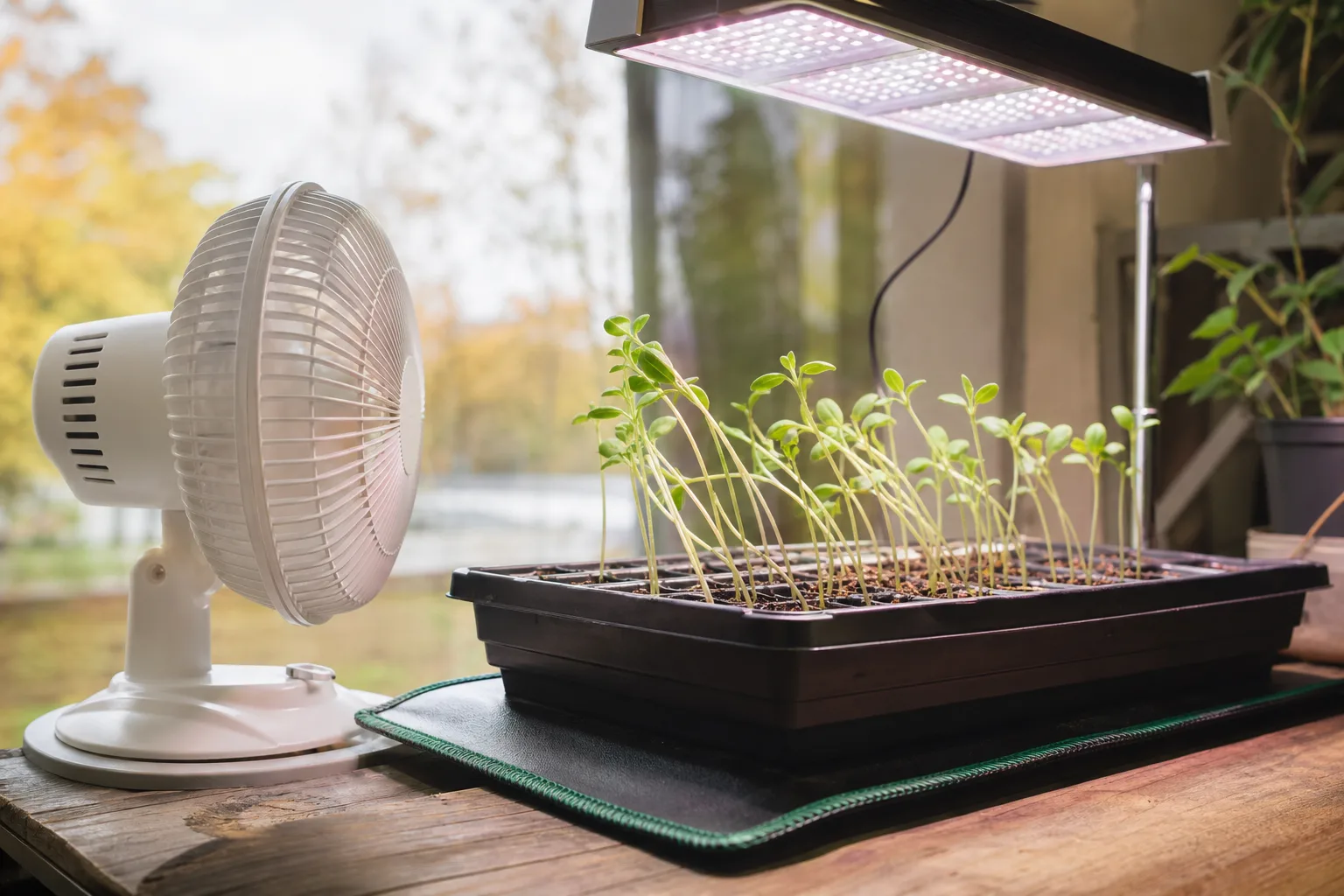
What are the three fixes for damping off and leggy seedlings?
The three fixes are intense light, steady gentle airflow, and controlled bottom heat, with moisture managed so the tray never stays soggy. Use sterile peat-based mix, bottom-water only when the tray feels noticeably lighter, keep LED lights 2 to 3 inches above seedlings, and remove the heat mat after sprouts appear.
That is the argument. Do not start with fungicide. Start with the conditions that let a weak stem collapse.
A source on LED-grown seedlings reports that controlling moisture first and airflow second prevented damping off more reliably than relying on fungicides, after an entire flat was lost to wet mix on heat mats (Best of Home & Garden). That matches what I see on a workbench: warm, wet, still air is a tiny greenhouse for trouble.
For fall sowing in Austin, this matters even if the room feels cool. A sunny window can be bright to your eyes and still leave a seedling reaching sideways for usable light. The plant does not care that the window is attractive.
Why does damping off happen in a seed-starting tray?
Damping off happens when tender seedlings grow in persistently wet, poorly ventilated conditions and their stems collapse at the soil line. The practical defense is sterile peat-based seed-starting mix, bottom-watering only after the tray lightens, constant low airflow, and no standing water under the cells.
Use fresh sterile peat-based seed-starting mix rather than garden soil, compost, or old potting soil. Sterile mix reduces the load of troublemakers, but its trade-off is that it dries unevenly and contains little nutrition, so you must watch the tray instead of watering by calendar.
Bottom-watering means setting the tray in a shallow amount of water long enough for the mix to wick moisture upward, then removing it completely. The advantage is less disturbance to seeds and stems. The downside is easy to miss: a tray forgotten in water stays saturated below the surface.
Never leave trays sitting in a saucer of water. The surface can look dry while the bottom remains swampy, which is exactly the sort of detail that turns a good fall sowing into compost with name tags.
How often should I bottom-water seedlings?
Bottom-water seedlings only when the tray feels noticeably lighter and the mix surface has had time to dry between waterings. Lift the tray every day, add water from below only when it has lost obvious weight, and remove it once the cells have wicked moisture upward; do not water by a fixed daily schedule.
A full tray and a recently watered tray should feel different in your hands. If you cannot tell, lift one cell or compare it with a dry tray filled with the same mix. This is more useful than poking the surface with a finger, because the bottom can stay wet while the top looks dusty.
Set the tray in water for about 10 to 20 minutes, then drain it thoroughly. The exact time depends on cell size and how dry the mix became, so the weight test still decides the next watering.
Watering from below has a trade-off. It can keep delicate stems from being knocked over, but repeated bottom-watering can leave the lower mix wetter than the top, so airflow and drainage holes still matter.
If you are arranging fall crops, the plant database can help you check whether a particular seedling belongs in a cool-season schedule rather than on a warm heat mat. The tray does not know your calendar. It knows temperature and moisture.
Does a small fan really prevent damping off?
A small oscillating fan on low, running 24 hours a day, provides the gentle constant airflow that helps seedlings stay dry at the stem line and grow stronger. Keep the fan moving air across the room rather than blasting one tray, because harsh wind dries cells unevenly and bends young stems.
Place the fan 2 to 4 feet from the trays, depending on its size, and aim it so leaves barely tremble. That movement is enough. You are not trying to recreate a prairie in the spare bedroom.
Run the fan day and night after sowing, including during the dark period. Its trade-off is evaporation, so the tray may need water sooner, but that is a manageable problem you can see by lifting the tray.
Remove humidity domes once the first seedlings emerge. A dome helps retain moisture during germination, but after emergence its trade-off becomes obvious: it traps humid air around tender stems and makes overwatering harder to notice.
You can keep a dome on an empty section that has not germinated yet only if the emerged seedlings are protected from the trapped humidity. In a small home tray, that is usually more fiddly than useful. Take it off.
How close should LED grow lights be to seedlings?
Keep LED grow lights 2 to 3 inches above the tops of seedlings to provide intense, direct light and reduce stretching. Raise the fixture as plants grow so it stays close without touching leaves; a dim window or light placed several inches too high produces thin stems even when the room looks bright.
Leggy seedlings are usually reaching for more usable light, not asking for more water. A guide to correcting leggy growth also identifies insufficient light as a central cause and recommends stronger, closer lighting (Garden Betty).
Keep the light on a consistent daily schedule, and make sure the whole tray receives similar coverage. A narrow fixture over a wide tray gives you sturdy seedlings in the middle and pale climbers along the edges.
The trade-off of close LED lighting is heat at the leaf surface if the fixture is poorly ventilated or unusually powerful. Check the foliage after an hour. If leaves feel hot or bleach, raise the light slightly, but do not move it a foot away because one corner got nervous.
A sunny windowsill can work for a few seedlings, but its downside is weak, directional light and cold glass at night. In fall, a window may give warmth in the afternoon and a chilly root zone after sunset. Use a light you can position instead.
Should seedlings stay on a heat mat after they emerge?
Keep bottom heat at 70 to 75°F for germination, then remove the heat mat after sprouts emerge and let the root zone fall to about 60 to 65°F. Warmth speeds germination, but continuing it after emergence can encourage stretching and keeps wet mix warm, a poor combination for sturdy seedlings.
Use a thermostat-controlled heat mat if you use one. Its trade-off is cost and another cord on the floor, but an unregulated mat can make the mix warmer than the room and dry cells at different rates.
Check the temperature at tray level, not on the shelf beside the tray. A cheap probe or thermometer placed near the cells tells you more than the number printed on the mat dial.
Everyone says warmth helps seedlings. In practice, warmth helps most before emergence; afterward, light intensity and air movement matter more, while warm saturated mix can leave stems vulnerable. Remove the mat promptly rather than waiting for the seedlings to look stretched.
For a fall sowing, this is especially useful if your house is already around 68 to 72°F. Adding bottom heat after emergence may spend electricity to create a problem your room was already solving.
Which seedling setup should you choose?
For most home growers, I would choose sterile peat-based mix, bottom-watering by tray weight, a low oscillating fan, and a close LED light, using a heat mat only through germination. A sunny window or constant heat can work in narrow cases, but they lose because light and moisture vary more than you can see.
| Setup | Best use | Honest downside |
|---|---|---|
| LED light, fan, controlled heat mat | Reliable indoor starts and fall seedlings | Costs more and needs cords, timers, and daily checks |
| Sunny windowsill without heat mat | A few trays in a bright, stable room | Directional light often produces stretched stems |
| Heat mat kept on after emergence | Fast germination for warmth-loving seeds | Warm wet mix can increase stretching and collapse risk |
I would not buy fungicide before I bought a fan and fixed the watering routine. The research provided for this piece specifically favors moisture control and airflow over fungicides for damping-off prevention (Best of Home & Garden).
The equipment trade-offs are real. An LED light uses electricity, a fan makes a quiet hum, and a heat mat takes bench space. Replacing a whole flat of seedlings costs more time than any of those things.
If you want help deciding how many trays fit your space, you can get a concept for your yard before you start buying lights and shelves. Valeria draws the clean version. I am the one who has to carry it upstairs.
Who is this seedling setup for, and who should ignore it?
This setup suits anyone starting seeds indoors in fall, especially gardeners with dim windows, cool rooms, humid shelves, or a history of collapsed stems. Ignore the full equipment plan if you are growing only two seedlings in a bright, ventilated room and can check their moisture daily, because a whole propagation station would be unnecessary.
Use the full three-fix approach if you are starting several trays, growing in a basement or laundry room, or keeping seedlings under a humidity dome. It also suits anyone who has lost a flat in three days and does not want to repeat the lesson.
A bright window may be enough for a small number of starts, but its trade-off is inconsistency. If the sun moves across the glass and the seedlings lean, turn the tray daily or use an LED instead.
You can skip a heat mat when the room stays near the target temperature, but do not skip light or airflow because the tray is small. Small trays can collapse just as efficiently as large ones. They are very democratic that way.
Can leggy seedlings be saved after they stretch?
Leggy seedlings can sometimes be saved if the stems are still green and upright by moving the LED light to 2 to 3 inches above the foliage, adding gentle airflow, and correcting excess warmth. Severely collapsed seedlings usually will not recover, so act as soon as you see pale stems, leaning, or rapid height gain.
First, correct the cause instead of burying the evidence. Move the light closer, remove the heat mat after emergence, take off the dome, and start checking tray weight rather than adding water because the seedlings look unhappy.
Some seedlings tolerate deeper planting at transplant, but that depends on the crop and stem structure, so do not bury every species automatically. The trade-off is stem rot or poor recovery if a tender stem is covered too deeply.
Space the seedlings so leaves do not form a solid wet canopy. Crowding saves bench space, but it limits airflow and makes one watering mistake spread across the whole tray.
The best time to fix stretch is the first day you notice it. A leggy seedling can gain strength over the next couple of weeks under better light and airflow, but a stem already pinched at the soil line is not waiting for a motivational speech.
What should you do today for fall seedlings?
Today, lift each tray, remove standing water, take off any dome above emerged seedlings, set the LED 2 to 3 inches above the leaves, and put a small fan on low so foliage barely moves. If the seedlings have emerged, remove the heat mat and aim for 60 to 65°F at the root zone.
Write the date on the tray and record whether it felt light, medium, or heavy. Do that for seven days. You will learn your room's drying rhythm faster than by following a generic watering chart.
Check the setup every morning in fall because indoor conditions change as nights cool and heating starts. A tray beside a window can dry differently from one on an interior shelf even if both are in the same room.
The order matters: light first, airflow second, heat controlled after emergence, and water only as the tray needs it. Fixing all four at once is not complicated. It is simply less forgiving of neglect.
How often should I bottom-water seedlings?
Bottom-water seedlings only when the tray feels noticeably lighter and the mix surface has had time to dry between waterings. Set the tray in shallow water for about 10 to 20 minutes, remove it, and let it drain fully; never leave cells standing in water because the lower mix can remain saturated while the surface looks dry.
How close should LED grow lights be to seedlings?
Keep LED grow lights 2 to 3 inches above the seedling tops and raise them as the plants grow. Close, direct light reduces stretching, while a light placed too high or a dim window encourages pale, leaning stems; the trade-off is that an unusually powerful fixture may warm foliage, so check leaves after positioning it.
Should I remove the humidity dome after seedlings emerge?
Yes, remove the humidity dome after seedlings emerge because trapped humid air and wet mix increase the conditions associated with stem collapse. A dome is useful during germination, but its trade-off after emergence is poor ventilation and slower surface drying; if only one section has germinated, protecting the emerged seedlings matters more than keeping the remaining cells covered.
Should seedlings stay on a heat mat after they emerge?
No, remove the heat mat after seedlings emerge unless the room is too cold for the crop, and aim for 60 to 65°F after emergence. Keep bottom heat at 70 to 75°F during germination, but continued warmth can encourage stretching and keep wet mix warm, which is a bad pairing for tender stems.
Can a small fan prevent damping off?
A small oscillating fan on low can help prevent damping off by keeping gentle air moving across the seedlings and reducing stagnant humidity around the stem line. Run it 24 hours a day, aim it across the room rather than directly at one tray, and accept that the trade-off is faster drying that requires closer tray-weight checks.
Can leggy seedlings be saved?
Leggy seedlings can sometimes be saved if they are still green and upright by moving the LED light to 2 to 3 inches above the leaves, removing excess heat, and improving airflow. Severely collapsed seedlings usually will not recover, so correct the setup as soon as you see pale stems, leaning growth, or unusual height gain.
Want a plan for your own yard?
Tell us the space and we will put a planting plan together for it. Start at get my concept, or browse what actually grows where you are over on plants.
Frequently asked questions
How often should I bottom-water seedlings?
Bottom-water seedlings only when the tray feels noticeably lighter and the mix surface has had time to dry between waterings. Set the tray in shallow water for about 10 to 20 minutes, remove it, and let it drain fully; never leave cells standing in water because the lower mix can remain saturated while the surface looks dry.
How close should LED grow lights be to seedlings?
Keep LED grow lights 2 to 3 inches above the seedling tops and raise them as the plants grow. Close, direct light reduces stretching, while a light placed too high or a dim window encourages pale, leaning stems; the trade-off is that an unusually powerful fixture may warm foliage, so check leaves after positioning it.
Should I remove the humidity dome after seedlings emerge?
Yes, remove the humidity dome after seedlings emerge because trapped humid air and wet mix increase the conditions associated with stem collapse. A dome is useful during germination, but its trade-off after emergence is poor ventilation and slower surface drying; if only one section has germinated, protecting the emerged seedlings matters more than keeping the remaining cells covered.
Should seedlings stay on a heat mat after they emerge?
No, remove the heat mat after seedlings emerge unless the room is too cold for the crop, and aim for 60 to 65°F after emergence. Keep bottom heat at 70 to 75°F during germination, but continued warmth can encourage stretching and keep wet mix warm, which is a bad pairing for tender stems.
Can a small fan prevent damping off?
A small oscillating fan on low can help prevent damping off by keeping gentle air moving across the seedlings and reducing stagnant humidity around the stem line. Run it 24 hours a day, aim it across the room rather than directly at one tray, and accept that the trade-off is faster drying that requires closer tray-weight checks.
Can leggy seedlings be saved?
Leggy seedlings can sometimes be saved if they are still green and upright by moving the LED light to 2 to 3 inches above the leaves, removing excess heat, and improving airflow. Severely collapsed seedlings usually will not recover, so correct the setup as soon as you see pale stems, leaning growth, or unusual height gain.
Free, no obligation
Ready to design your dream landscape? Start here.
Tell us where you are and we will start a free profile for you, with plants that actually survive your climate and a real sense of what the build would cost.