
What Crop Rotation Actually Breaks Disease Cycles?
Rotate by plant family, not by individual crop, and give each family at least three years before returning to the same bed. Here is a practical fall garden plan for tracking families, handling small spaces, and extending the gap for diseases that linger.
September 22, 2026
By Diego Navarro
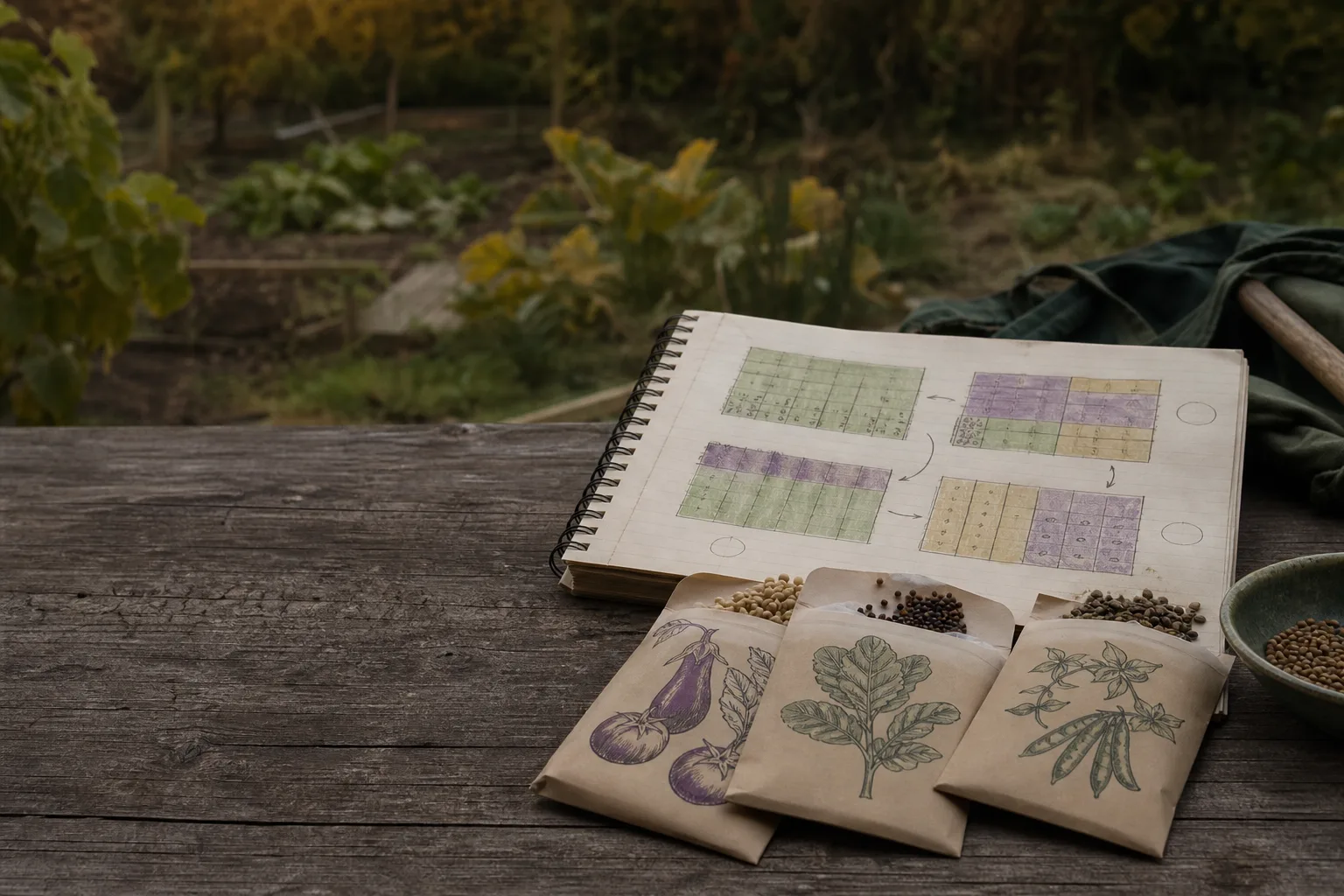
Rotate by plant family, not by crop, and give every family a minimum three-year break before returning to the same bed. A tomato followed by a pepper is not rotation because both belong to Solanaceae and can share pests and diseases. That is the whole argument. The rest is bookkeeping, soil, and not fooling yourself.
What should you rotate to break a disease cycle?
Rotate plant families, not individual vegetables, and keep a family out of the same bed for at least three years. Tomato, pepper, and eggplant count as one Solanaceae group, while cabbage, broccoli, and cauliflower count as Brassicaceae. Closely related crops often share pests and diseases, so changing the crop name alone does not create a meaningful break. NC State Extension makes the same point plainly.
A tomato bed followed by peppers is the garden version of changing shirts and calling it laundry. The pathogen does not care what the seed packet says.
Use these family groups for an ordinary vegetable garden:
| Plant family | Common crops | Honest downside of grouping this way |
|---|---|---|
| Solanaceae | Tomato, pepper, eggplant | A three-year gap can be difficult because these are warm-season staples |
| Brassicaceae | Cabbage, broccoli, cauliflower | Brassicas occupy fall and spring beds, so they can crowd out other rotations |
| Asteraceae | Lettuce, spinach, chicory | Cool-season timing makes the family easy to repeat without noticing |
| Leguminosae | Beans, peas | Peas and beans have different seasons but still use the same rotation slot |
| Cucurbitaceae | Cucumber, squash, pumpkin | Vining crops need room and can take over a small bed |
| Apiaceae | Carrot, celery | Carrots can stay in the soil for months and complicate the next planting |
| Poaceae and other grasses | Corn, oats | Corn needs space, while oats can be awkward in a small home bed |
This family list is not a demand that every garden grow every group. It is a way to stop making false rotations.
How many years should you wait before planting the same family again?
Wait at least three years before returning the same plant family to the same bed, which means two full intervening growing seasons without that family and a third season before its return. For diseases that linger longer, including tomato late blight in the supplied guidance, extend the interval to five or seven years. Three years is the floor, not a magic reset button.
Here is the simple sequence I would use for a bed planted with Solanaceae this year:
- Year one, Solanaceae.
- Year two, Brassicaceae or Leguminosae.
- Year three, Cucurbitaceae, Asteraceae, or Apiaceae.
- Year four, Solanaceae again, only if the bed had no serious lingering disease.
Everyone says a four-bed garden makes rotation easy. In practice, a small garden usually has one bed, two seasons, and a memory that goes soft by February. Write it down.
For serious disease, do not return tomatoes after only three years because the calendar feels tidy. A five-year gap is safer than pretending the same bed became clean on January 1.
What should you do in the garden this fall?
In fall, map each bed or container area, remove diseased plant debris, and record the family that grew there before you plant the next crop. Do not rely on a photograph of a lush summer garden because it will not tell you whether that green mass was tomato, pepper, or eggplant. Label the bed with the family and year.
Take a sheet of paper and draw rectangles for the beds. Give them names such as A, B, and C, then write “Solanaceae, 2026” or “Brassicaceae, fall 2026” inside each rectangle.
Pull plants that are finished and remove visibly diseased leaves and stems from the bed rather than leaving them as a winter blanket. The tradeoff is labor, but leaving infected litter in place can preserve the very problem you are trying to interrupt. Do not put questionable diseased material into homemade compost unless you know your pile reaches and maintains adequate heat.
If you are in Central Texas, fall gives you a useful second chance because the garden may hold cool-season crops while the summer family is still fresh in your memory. Black clay can stay wet after a storm, so do not turn the bed into paste just because the calendar says October.
Can cover crops replace a three-year crop rotation?
Cover crops can support a rotation, but they do not replace the minimum three-year break from a problem plant family. Clover and rye can improve soil health and suppress weeds, yet a cover crop should be recorded as its own decision, not treated as proof that a tomato disease has disappeared. Rotation changes the host; a cover crop mainly occupies the ground between crops.
Clover is useful where you want living cover, but it can be harder to remove before spring planting and may compete for moisture. Rye gives strong ground cover, but its dense growth can make bed preparation slower. Both are better than bare soil in some situations, and neither is a miracle cure.
The supplied crop-rotation research identifies cover crops such as clover or rye as supplements to rotation, not substitutes for it. Broader rotation guidance also connects crop diversity and cover crops with soil and pest management benefits, while admitting that simple rotations are hard to leave in real farming systems. Agriculture 4 U offers that broader context.
My rule is plain: if tomatoes had a disease problem in Bed A, plant a cover crop there if it fits, but still write “Solanaceae excluded through 2031” on the map. The rye does not get to erase the note.
Who is crop rotation for, and who should ignore it?
Family-based rotation suits gardeners with two or more beds, repeated disease in one location, or enough containers to move a crop away from contaminated soil. It is less useful as a strict three-year plan for a single four-foot bed that grows only one tomato each summer, where a container, fresh soil, or a fallow year may work better. Space decides the method.
Use rotation if your tomato bed has had the same disease twice, if brassicas repeatedly struggle in one corner, or if you plant vegetables in more than one season. It also suits anyone willing to keep a one-page garden record.
Ignore the fantasy that rotation alone will solve every leaf spot, wilt, insect, or watering mistake. Rotation reduces the buildup of some soilborne pests and pathogens, but it cannot repair a bed that stays saturated, a plant spacing problem, or infected transplants brought in from elsewhere.
If space is tight, plant database can help you check family relationships before you assign next year’s bed. That matters more than whether two vegetables look unrelated at the grocery store.
What if you only have one small garden bed?
With one small bed, skip the problem family for one or two years, use a raised bed with fresh soil, or grow that family in movable containers. NC State Extension specifically recommends fallowing limited spaces, replacing soil in raised beds, and using containers where a disease problem is known. The tradeoff is cost, hauling, and the fact that fresh soil can still be mishandled.
A one-year fallow period means the bed does not grow the affected family, but it is not permission to leave weeds and volunteer tomatoes in place. Volunteers count as hosts. Pull them.
A raised bed gives you more control over soil, but new soil costs money and the structure can dry faster than native ground. In Austin, a raised bed filled with loose soil may need more frequent irrigation in July and August than the black clay beside it.
Containers let you move tomatoes away from the old bed, but a large tomato needs a container with enough volume and reliable water. Small pots dry quickly, especially during a fifth week over 100 degrees. A container is not portable if you have to carry it twice a day.
Does rotating tomato, pepper, and eggplant count as rotation?
No, rotating tomato, pepper, and eggplant does not count as a family break because all three are Solanaceae. Move the entire family away from the bed for at least three years, and extend the interval to five or seven years where a persistent disease such as tomato late blight is involved. The tradeoff is fewer warm-season favorites in that location.
This is where gardeners lose the thread. Tomato one year, pepper the next, and eggplant after that feels varied because the harvests differ, but the disease cycle sees familiar hosts returning every season.
I learned the value of family labels before I learned the word for them. My father grew tomatoes in a twelve-foot strip of New Jersey clay along the driveway, and I watched him change where things went even when the space was stingy. Down here, caliche stops a shovel eight inches down and black clay moves what you build, so a map saves more trouble than confidence does.
If you want a warm-season crop in the old tomato bed, choose a different family and accept its own tradeoff. Cucumbers need space, beans can finish quickly but leave a different harvest window, and carrots may occupy the soil longer than you planned.
How do you build a three-year rotation plan?
Build the plan from this year backward: list every family in every bed, assign a different family for the next two seasons, and schedule the original family no earlier than the fourth year. A three-year break means the family is absent during years two and three, then returns in year four. Record dates, not just crop names.
For three beds, a workable pattern might look like this:
- Bed A, 2026 Solanaceae, 2027 Brassicaceae, 2028 Leguminosae, 2029 Solanaceae.
- Bed B, 2026 Brassicaceae, 2027 Cucurbitaceae, 2028 Asteraceae, 2029 Brassicaceae.
- Bed C, 2026 Leguminosae, 2027 Apiaceae, 2028 Cucurbitaceae, 2029 Leguminosae.
Those are planning slots, not commands from the garden police. If a disease appears, extend the gap and change the family choice.
Do not plant a crop based only on what is empty today. Look at the previous three years first, then check whether the new family has a serious tradeoff for your site, such as vining cucurbits overrunning a narrow bed or corn demanding more room than you have.
A simple notebook works. If you prefer a digital plan, get a concept for your yard before you build another bed, because the best rotation on paper is still a bad plan if every bed sits in the same shade or drains into the next one.
What mistakes make crop rotation fail?
Crop rotation fails when gardeners rotate species instead of families, forget volunteer plants, count a cover crop as a complete cure, or return to a diseased bed after only one season. It also fails when records disappear, containers reuse contaminated soil, or the replacement family brings the same problem back through closely related plants. The calendar helps, but accuracy does the work.
The most common mistake is calling tomato to pepper a rotation. The second is planting a volunteer tomato under the fence and then wondering why the bed was not actually host-free.
Another failure is moving diseased soil with a shovel, boot, or wet transplant. Clean tools after working in a problem bed, avoid moving wet soil across beds, and do not assume a new raised bed is protected if old soil is mixed into it.
You should also expect rotation to be incomplete. It reduces pressure; it does not guarantee a spotless season. The source guidance says crop rotation is valuable for reducing insect and disease issues, but it also warns that many home gardens lack enough room to implement it fully. That is why fallow periods, fresh soil, and containers belong in the plan.
Is a three-year rotation enough for every disease?
No, three years is not enough for every disease. Use three years as the minimum family break for a typical home garden, but extend the interval to five or seven years for diseases that linger longer, such as tomato late blight in the supplied guidance. If the disease history is severe, change the site or container as well as the calendar.
That answer is less satisfying than a universal number, but gardens are not filing cabinets. Disease pressure depends on what was grown, what remains in the soil or litter, and whether volunteer hosts return.
For a bed with repeated serious tomato disease, I would skip Solanaceae for five years if I had the room. If I did not, I would use a container with fresh soil and keep the old bed out of tomatoes, peppers, and eggplant rather than pretending a short break solved it.
Ask yourself a blunt question: do you know the family planted there in each of the last three years? If the answer is no, count the bed as uncertain and start the record this fall. A clean record begins today.
How do you rotate crops without losing your favorite vegetables?
Keep favorite vegetables by moving their entire family to another bed, using a container, or accepting a longer return interval for the old site. You do not need to stop growing tomatoes or beans; you need to stop growing the same family in the same soil every year. The tradeoff is more planning and sometimes less convenience.
Put a tomato in Bed B rather than Bed A, then record Bed B as Solanaceae. Next year, Bed B needs a different family too. Moving the crop without moving the record is how the same mistake gets a fresh address.
For containers, replace or responsibly discard diseased potting soil rather than scattering it through the vegetable beds. Fresh mix costs money, and large containers are heavy, but that cost can be smaller than rebuilding a whole bed after repeated disease problems.
Rotate what fits your household. A garden that produces fewer varieties but keeps its soil healthier is doing its job better than a crowded garden that repeats the same family until September takes it personally.
Frequently asked questions about crop rotation
What is the minimum crop-rotation gap for vegetable diseases?
The minimum crop-rotation gap is three years before returning the same plant family to the same bed. That provides two intervening growing seasons without the family, although diseases that linger longer may require five or seven years. Rotate tomato, pepper, and eggplant together as Solanaceae rather than treating them as separate crops.
Can I rotate tomatoes with peppers?
You cannot create a meaningful family rotation by moving tomatoes to peppers because both belong to Solanaceae and can share pests and diseases. Keep the entire Solanaceae family out of that bed for at least three years. Use a different family, a fallow period, fresh raised-bed soil, or a movable container instead.
What should I plant after diseased tomatoes?
After diseased tomatoes, plant a different family such as beans, peas, cucumbers, squash, lettuce, carrots, or corn, while keeping tomato, pepper, and eggplant out of the bed. Each alternative has a tradeoff, including space, season length, or moisture needs. For persistent disease, do not return Solanaceae for five or seven years.
Do cover crops count as crop rotation?
Cover crops do not count as a complete substitute for crop rotation because they do not provide the same host break as moving a vegetable family away from the bed. Clover and rye can support soil health and suppress weeds, but they have tradeoffs: clover can be harder to remove, and rye can slow spring bed preparation.
What can I do if I only have one garden bed?
If you only have one garden bed, skip the affected family for one or two years, use fresh soil in a raised bed, or grow that family in containers. Remove volunteer plants and diseased debris, and keep a written record. A container costs more and needs dependable water, but it can move the crop away from contaminated ground.
Should I rotate by vegetable family or by individual crop?
You should rotate by vegetable family, not by individual crop, because related vegetables often share pests and diseases. Solanaceae includes tomatoes, peppers, and eggplant, while Brassicaceae includes cabbage, broccoli, and cauliflower. A family-based plan gives each group at least three years away from the same bed.
Want a plan for your own yard?
Tell us the space and we will put a planting plan together for it. Start at get my concept, or browse what actually grows where you are over on plants.
Frequently asked questions
What is the minimum crop-rotation gap for vegetable diseases?
The minimum crop-rotation gap is three years before returning the same plant family to the same bed. That provides two intervening growing seasons without the family, although diseases that linger longer may require five or seven years. Rotate tomato, pepper, and eggplant together as Solanaceae rather than treating them as separate crops.
Can I rotate tomatoes with peppers?
You cannot create a meaningful family rotation by moving tomatoes to peppers because both belong to Solanaceae and can share pests and diseases. Keep the entire Solanaceae family out of that bed for at least three years. Use a different family, a fallow period, fresh raised-bed soil, or a movable container instead.
What should I plant after diseased tomatoes?
After diseased tomatoes, plant a different family such as beans, peas, cucumbers, squash, lettuce, carrots, or corn, while keeping tomato, pepper, and eggplant out of the bed. Each alternative has a tradeoff, including space, season length, or moisture needs. For persistent disease, do not return Solanaceae for five or seven years.
Do cover crops count as crop rotation?
Cover crops do not count as a complete substitute for crop rotation because they do not provide the same host break as moving a vegetable family away from the bed. Clover and rye can support soil health and suppress weeds, but they have tradeoffs: clover can be harder to remove, and rye can slow spring bed preparation.
What can I do if I only have one garden bed?
If you only have one garden bed, skip the affected family for one or two years, use fresh soil in a raised bed, or grow that family in containers. Remove volunteer plants and diseased debris, and keep a written record. A container costs more and needs dependable water, but it can move the crop away from contaminated ground.
Should I rotate by vegetable family or by individual crop?
You should rotate by vegetable family, not by individual crop, because related vegetables often share pests and diseases. Solanaceae includes tomatoes, peppers, and eggplant, while Brassicaceae includes cabbage, broccoli, and cauliflower. A family-based plan gives each group at least three years away from the same bed.
Free, no obligation
Ready to design your dream landscape? Start here.
Tell us where you are and we will start a free profile for you, with plants that actually survive your climate and a real sense of what the build would cost.