
How Do You Acidify Soil for Blueberries Without Wrecking the Surrounding Bed?
Use a soil test, elemental sulfur, and a contained root zone to lower pH for blueberries without spreading aluminum or acid through the rest of the garden.
September 19, 2026
By Diego Navarro
What should you use to acidify soil for blueberries this fall?
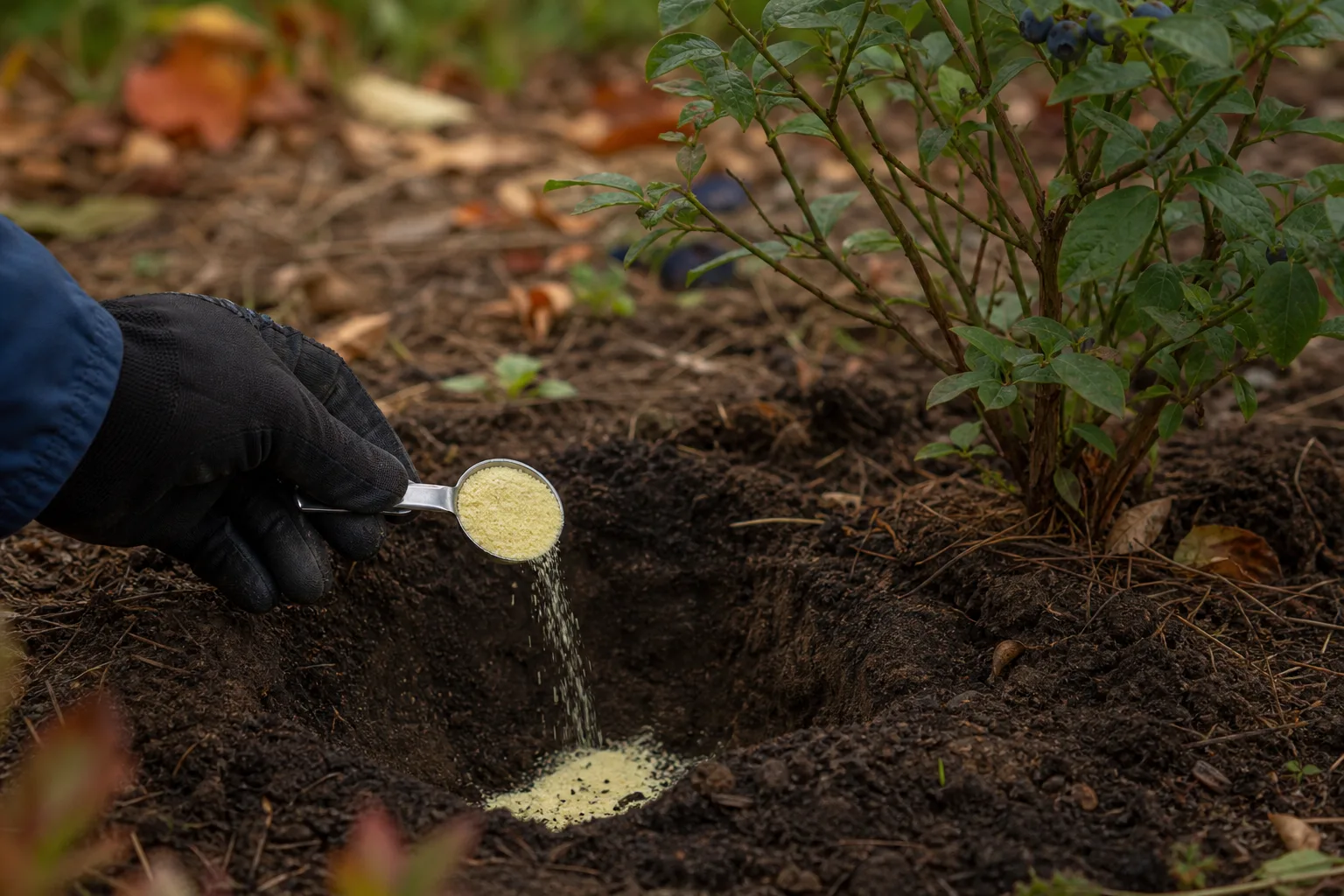
Use elemental sulfur, not aluminum sulfate, and apply it only to the blueberry root zone after a soil test. Aim for a pH between 4.5 and 5.0, mix sulfur into the top 6 to 8 inches, and expect the change to take several months rather than several days.
That slower timing is the point. Soil bacteria called thiobacilli oxidize elemental sulfur into sulfuric acid, and they need moisture and time to do it. Keep the soil moist, but not saturated.
I would rather see a blueberry sit through one season at pH 5.4 than watch somebody splash aluminum sulfate across an entire mixed bed because the bag promised a fast fix. Fast is not automatically kind to roots.
In Central Texas, I would start this work in October or November, while the ground is workable and fall rain can help maintain moisture. The plant will not wake up tomorrow with a new root system. That is gardening, not a vending machine.
What pH do blueberries need, and why does the number matter?
Blueberries need a strongly acidic soil pH of 4.5 to 5.0, so test the soil before adding anything and adjust only the area intended for their roots. A soil test tells you both the current pH and, through soil texture, how much sulfur may be needed to move it one pH unit.
The same scoop of sulfur does not behave the same in sand, silt loam, and heavy clay. For a one-unit drop across 100 square feet, the research rates are about 0.7 pound for sandy soil, 1.1 pounds for silt loam, and 1.8 pounds for heavy clay.
Those are not casual handful numbers. Heavy clay holds onto its existing chemistry, so it takes more amendment and more patience. That is familiar territory here, where black clay swells, shrinks, and moves anything you set on it.
Test again before adding a second dose. A pH meter stuck into dry mulch is not a soil test, and guessing twice can put the blueberry zone below the target before the first sulfur has finished reacting.
If you want help identifying plants that can tolerate the same conditions, use the plant database, but do not assume every companion plant wants blueberry soil. Many plants in a mixed bed will not.
How much elemental sulfur should you apply?
For a one-unit pH reduction over 100 square feet, apply approximately 0.7 pound of elemental sulfur in sandy soil, 1.1 pounds in silt-loam soil, or 1.8 pounds in heavy clay. For a single mature blueberry, the research also gives a practical planting-hole rate of about one-quarter cup mixed thoroughly with the soil.
Elemental sulfur is the option I would use because its main downside is slowness, not a sudden chemical shock. Measure it. More sulfur does not mean a better blueberry crop, and an oversized dose can push the root zone past pH 4.5.
For an established bush, work around the root zone rather than piling sulfur against the crown. The extension guidance describes holes near the drip line, at least 1 foot deep and 4 to 8 inches wide, with four holes as a minimum and eight to twelve preferred for a larger tree-sized plant. Blueberries are shallower than that example, so I would use the same distribution principle without tearing through the main crown area.
A small addition of iron, 2 to 3 tablespoons per plant, may help blueberry iron uptake. Iron is not a substitute for correcting pH, and the tradeoff is simple: adding it without fixing the soil can spend money without solving the cause.
Everyone says to sprinkle amendments on top and wait for rain. In practice, that leaves much of the material sitting in mulch, because sulfur needs contact with moist soil to be converted.
How do you keep sulfur from spreading into the surrounding bed?
Keep the sulfur inside a defined blueberry root zone instead of broadcasting it across the whole bed. Mark a circle around each bush, mix sulfur into the soil inside that circle only, water lightly, and leave neighboring soil untreated unless its own test shows a need for acidification.
For a mature bush, I would mark a root zone roughly 2 to 3 feet from the crown, then divide the measured sulfur among several small digging areas rather than making one deep trench. The goal is even distribution through the top 6 to 8 inches, not a concentrated pocket.
Do not mix sulfur into the soil around plants that prefer alkaline conditions. The research warns that aluminum sulfate can damage neighboring alkaliphilic plants, but the broader lesson applies here too: a mixed bed should not be treated as one chemical bucket.
Mulch can help keep the surface from drying, but it also hides where you applied the product. Put down a label or sketch with the date, rate, and treated circle. Future-you deserves evidence.
If the bed is crowded, a separate raised blueberry area is cleaner than trying to negotiate pH boundaries with six different root systems. A contained bed costs more effort at the start, but it lowers the chance of correcting one plant by disturbing five others.
Why is aluminum sulfate a poor choice for blueberry beds?
Aluminum sulfate lowers soil pH in days to weeks, but it can create aluminum toxicity around blueberry roots and harm neighboring plants that prefer alkaline soil. That speed is its selling point and its problem, so elemental sulfur is the safer home-garden choice for a mixed bed, even though sulfur takes several months.
The extension guidance does not recommend aluminum sulfate because aluminum toxicity can significantly reduce root growth and plant performance. That is not a small downside you solve with a prettier label.
If you must use it, keep the rate under 5 pounds per 100 square feet, dissolve 2 tablespoons in 1 gallon of water, and drench only the blueberry root zone. Monitor nearby plants closely. I would still avoid it unless a contained situation leaves no practical alternative.
One source on aluminum sulfate estimates roughly 1.2 pounds per 10 square feet for a half-point drop, while also emphasizing that soil type changes the requirement and that the material works faster than sulfur (ScienceInsights explains the timing and rate problem). That disagreement in scale is exactly why I do not recommend calculating from a generic internet rate without a soil test.
The cost of getting this wrong is not just a lower pH. It is a damaged root zone, stressed neighboring plants, and another round of digging to remove or dilute a treatment that moved too far.
Can fertilizer or organic material lower blueberry soil pH?
Ammonium sulfate can lower soil pH by about 0.2 to 0.3 unit and may be useful for a small correction, while peat moss and pine needles provide much slower acidifying effects around the plants. None is a good substitute for testing, and each has a tradeoff: limited pH movement, added material, or slow results.
Use ammonium sulfate only when the test shows a modest adjustment is needed. Its advantage is speed for a small change, but it is not the tool for moving pH from 7.2 to 4.8. That would be asking fertilizer to do excavation work.
Peat moss can add organic material, but it takes volume to influence a larger bed and does not provide a quick, measured pH correction. Pine needles are easy to place and slow to act, so they are better treated as surface mulch than as a precise soil amendment.
The research from Oregon State University identifies elemental sulfur as the preferred option and notes nitrogen fertilizer for a 0.2 or 0.3 unit decrease (OSU Extension compares sulfur, nitrogen fertilizer, and aluminum sulfate). That is the approach I would follow in a fall garden.
Do you have a pH of 5.2 and a healthy bush? Use a restrained correction. Do you have alkaline clay and a dying bush? Test the soil and redesign the root zone before throwing three products at the problem.
Who is this sulfur approach for, and who should ignore it?
This approach suits a homeowner with one to several blueberries, a fall soil test, and enough room to treat a defined root zone over several months. Ignore it for now if you cannot test, if the bed contains plants that need alkaline soil in the same root zone, or if you need an immediate pH change for a plant already in severe decline.
It is especially useful for a new blueberry area where you can mix sulfur into the top 6 to 8 inches before planting. It also works for established bushes when you can distribute small amounts around the drip line without cutting through major roots.
It is a poor fit for a packed foundation bed with no separation between shrubs. In that case, a dedicated container or separate raised bed may be more honest than pretending a 3-foot circle controls every root.
Here is the practical comparison I use on site:
| Option | Best use | Timing | Honest downside |
|---|---|---|---|
| Elemental sulfur | Main correction toward pH 4.5 to 5.0 | Several months | Slow, and the rate depends on soil texture |
| Ammonium sulfate | Small 0.2 to 0.3 unit adjustment | Faster than sulfur for a modest change | Cannot replace a large pH correction |
| Peat moss or pine needles | Slow surface support around the root zone | Slow and gradual | Poor precision for a measured pH change |
| Aluminum sulfate | Narrow, carefully contained emergency correction | Days to weeks | Aluminum toxicity and damage beyond the target zone |
The table is not a menu of equal choices. Elemental sulfur is the one I would buy for a normal home blueberry bed.
How should you apply and monitor sulfur during fall?
In fall, test the soil, measure the sulfur, mix it into the top 6 to 8 inches of the blueberry root zone, and water lightly so the soil stays moist without becoming saturated. Recheck the pH after several months, then make only a second measured adjustment if the result still misses 4.5 to 5.0.
Work when the soil is damp enough to dig but not sticky. In Austin clay, if the shovel leaves a shiny smear and the soil clings in a solid ribbon, wait. You will compact the bed and then blame the blueberry.
I learned that lesson from my father's twelve-foot strip of clay along the driveway in New Jersey, where every shovel pass had to earn its keep. Central Texas adds limestone and a rock bar, so I am even less interested in digging twice for a correction I could have measured the first time.
Apply the sulfur evenly, water lightly, and keep the area from swinging between bone dry and saturated. The bacteria need moisture, but a wet root zone is not a favor to the plant.
Write down the starting pH, soil texture, sulfur rate, application date, and next test date. Schedule the retest for late winter or spring, not next Tuesday. Sulfur is slow because biology is doing the work.
If the whole layout needs a rethink before you dig, you can get a concept for your yard and place the blueberries in a contained zone instead of acidifying every bed in sight.
What are the most common mistakes with blueberry soil acidification?
The common mistakes are skipping the soil test, applying a whole-bed dose to a single plant, expecting sulfur to work in days, and choosing aluminum sulfate because the label promises speed. Blueberries need a narrow pH range, so careless correction costs more than the bag of amendment.
How long does elemental sulfur take to acidify soil for blueberries?
Elemental sulfur usually takes several months to acidify blueberry soil because native thiobacilli must convert it into acid under moist soil conditions. In a fall application, plan to check the pH in late winter or spring rather than expecting a result within days. Its tradeoff is patience, but that slower movement is safer around neighboring plants.
What pH should soil be for blueberries?
Blueberry soil should test between pH 4.5 and 5.0. Test before applying sulfur because the needed amount depends on the starting pH and soil texture, with heavy clay generally requiring more sulfur than sandy soil for the same one-unit decrease. A lower number is not automatically better, because overshooting can also stress the root zone.
Can I use aluminum sulfate around blueberries?
You can use aluminum sulfate only as a tightly contained, carefully measured correction, but I do not recommend it for ordinary blueberry beds. It lowers pH in days to weeks and may cause aluminum toxicity to roots or damage nearby plants. If used, keep it under 5 pounds per 100 square feet and drench only the blueberry root zone.
How much elemental sulfur does one blueberry bush need?
A practical research rate for one mature blueberry bush is about one-quarter cup of elemental sulfur mixed into the soil in the planting area, but the correct amount still depends on the soil test and texture. Spread the amendment through the root zone instead of placing one concentrated pile against the crown. More is not a shortcut.
Can pine needles acidify soil enough for blueberries?
Pine needles can provide a slow, gradual acidifying effect around blueberries, but they are not a precise replacement for elemental sulfur when the soil needs a measured pH change. Their downside is timing and limited control. Use them as surface mulch while relying on a soil test and measured sulfur for the main correction.
Should I acidify the whole garden bed for blueberries?
No, acidify only the blueberry root zone unless a soil test shows the entire bed needs the same treatment. A whole-bed application can disturb plants that prefer less acidic soil and makes it harder to track the actual rate received by each blueberry. A separated bed or container is cleaner when neighboring plants need different soil conditions.
Want a plan for your own yard?
Tell us the space and we will put a planting plan together for it. Start at get my concept, or browse what actually grows where you are over on plants.
Frequently asked questions
How long does elemental sulfur take to acidify soil for blueberries?
Elemental sulfur usually takes several months to acidify blueberry soil because native thiobacilli must convert it into acid under moist soil conditions. In a fall application, plan to check the pH in late winter or spring rather than expecting a result within days. Its tradeoff is patience, but that slower movement is safer around neighboring plants.
What pH should soil be for blueberries?
Blueberry soil should test between pH 4.5 and 5.0. Test before applying sulfur because the needed amount depends on the starting pH and soil texture, with heavy clay generally requiring more sulfur than sandy soil for the same one-unit decrease. A lower number is not automatically better, because overshooting can also stress the root zone.
Can I use aluminum sulfate around blueberries?
You can use aluminum sulfate only as a tightly contained, carefully measured correction, but I do not recommend it for ordinary blueberry beds. It lowers pH in days to weeks and may cause aluminum toxicity to roots or damage nearby plants. If used, keep it under 5 pounds per 100 square feet and drench only the blueberry root zone.
How much elemental sulfur does one blueberry bush need?
A practical research rate for one mature blueberry bush is about one-quarter cup of elemental sulfur mixed into the soil in the planting area, but the correct amount still depends on the soil test and texture. Spread the amendment through the root zone instead of placing one concentrated pile against the crown. More is not a shortcut.
Can pine needles acidify soil enough for blueberries?
Pine needles can provide a slow, gradual acidifying effect around blueberries, but they are not a precise replacement for elemental sulfur when the soil needs a measured pH change. Their downside is timing and limited control. Use them as surface mulch while relying on a soil test and measured sulfur for the main correction.
Should I acidify the whole garden bed for blueberries?
No, acidify only the blueberry root zone unless a soil test shows the entire bed needs the same treatment. A whole-bed application can disturb plants that prefer less acidic soil and makes it harder to track the actual rate received by each blueberry. A separated bed or container is cleaner when neighboring plants need different soil conditions.
Free, no obligation
Ready to design your dream landscape? Start here.
Tell us where you are and we will start a free profile for you, with plants that actually survive your climate and a real sense of what the build would cost.